


Behringer article
Behringer Explained: Features, Types and Tips
Behringer's catalogue spans synths, mixers and interfaces at a fraction of premium prices. Here's what it actually offers and where the trade-offs lie.
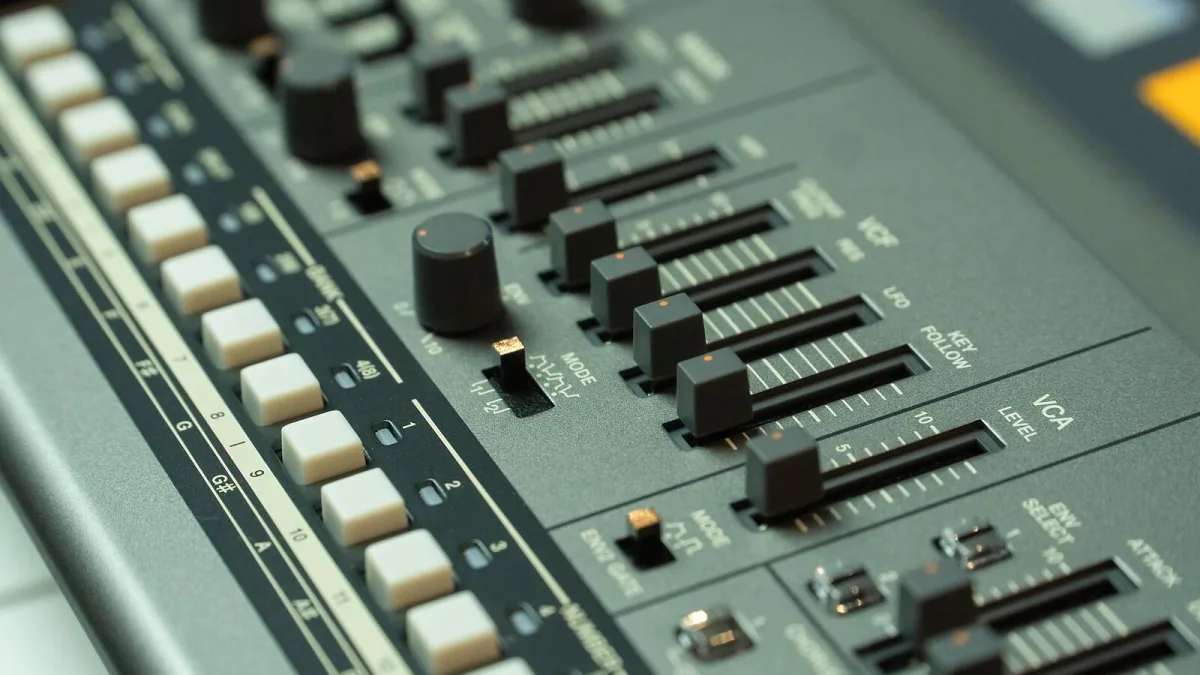
If you've been shopping for a synth, a mixer or a home studio interface, you've almost certainly bumped into the name Behringer — usually attached to a price tag that seems too good to be true. It often isn't. This German-founded brand has built its whole reputation on making music gear affordable, and understanding what it actually offers (and where the trade-offs lie) will save you a lot of confused browsing. Let's take it steadily.
Where Behringer came from
The company was founded by Uli Behringer and grew by selling budget-friendly studio and live-sound equipment to musicians who couldn't stretch to premium brands. Over time that mission expanded into synthesizers, mixers, audio interfaces, microphones, effects pedals, monitor speakers and DJ gear — an unusually wide catalogue for one manufacturer. What ties it together is the same idea: take a category of gear that's normally expensive, and make a genuinely usable version of it for a fraction of the price.
The main product families
Behringer's range is broad enough that it helps to think of it in categories rather than one big list:
- Analog and semi-modular synthesizers — instruments like the Model D, Poly D, Neutron and Crave, many inspired by classic designs from Moog, Roland, Sequential and Korg.
- Polyphonic synths — the DeepMind and UB-Xa families, aimed at pads, chords and layered parts rather than single melodic lines.
- Digital mixers — led by the X32 platform and the higher-end WING, both widely used in live sound, churches and rehearsal spaces.
- Audio interfaces and microphones — entry-level home-recording gear, including compact USB interfaces.
- Eurorack modules — smaller building blocks for modular synth systems.
The "clone" conversation, explained fairly
You'll often see Behringer instruments described as "clones" of famous vintage synths — the Model D echoing the Minimoog, the MS-1 echoing Roland's SH-101, the UB-Xa drawing on Oberheim's OB-Xa. That word gets used loosely, so it's worth separating a few genuinely different questions: does the circuit resemble an earlier instrument technically, does the name or branding raise trademark concerns, is there an enforceable patent involved, and is copying ethically fine even when it's legal? These are different issues, and a low price doesn't automatically mean a product is technically identical to what inspired it — component tolerances, calibration, build quality and firmware can all differ. What it does mean is that circuits and workflows once locked behind vintage price tags are now within reach of ordinary musicians.
Choosing between Behringer synth types
If you're weighing up which instrument suits you, it helps to think about what you'll actually play:
| Type | Best for | Behringer examples |
|---|---|---|
| Monophonic | Basslines, leads, sequenced parts | Model D, Pro-1, MS-1, K-2 |
| Paraphonic | Simple chords sharing one signal path | Poly D |
| Polyphonic | Pads, chords, layered arrangements | DeepMind, UB-Xa |
| Semi-modular | Hands-on patching without full modular commitment | Neutron, Crave |
If you're just getting your bearings with any of this, our beginner's guide walks through a gentler first step.
Practical tips once you own one
- Set gain at the source rather than trying to fix a clipped recording afterwards.
- Update firmware carefully — confirm your exact hardware revision and back up presets first.
- Understand voice allocation on polyphonic instruments; unison and split modes can eat into your available voices faster than you'd expect.
- Start from the normalled signal path on semi-modular gear before patching, changing one connection at a time.
- Save mixer scenes on an X32 before making routing changes, so you always have a known-good starting point.
Recent additions worth knowing about
Behringer's catalogue keeps expanding: 2026 brought the JN-80 (an eight-voice, Juno-inspired polysynth), the JT-2 (a Jupiter-style analog synth open for preorder), the BMX sampling drum machine inspired by the Oberheim DMX, and the budget D Mini, a compact Minimoog-style synth. Worth noting: announcement and preorder news moves fast in this space, and a product appearing on a "coming soon" list isn't the same as one sitting on a shelf, so always check current availability before you commit to buying.
The bottom line
Behringer earns its popularity fairly: broad range, real feature density, and access to sounds and workflows that used to be locked behind vintage price tags. The trade-off is that build quality and long-term support can vary by product, so it pays to research the specific model rather than assuming the brand name guarantees anything either way. Ready to actually buy one? Our complete buyer's guide covers exactly what to check, and if you want value-for-money picks by category, our best-value roundup is the natural next stop.




Comments