


Marching Band article
Marching Band Subgenres, Explained
Traditional, show-style, corps-style, HBCU, scramble bands and more — here's how marching band's many distinct styles actually differ.
Say the same word to a drum corps veteran, an Ivy League student and a village parade organiser, and you'll get three completely different pictures in their heads. That's because this activity has splintered into genuinely distinct styles, each with its own rules, culture and idea of what "good" looks like. Here's how to tell them apart.
Traditional and Parade-Style Bands
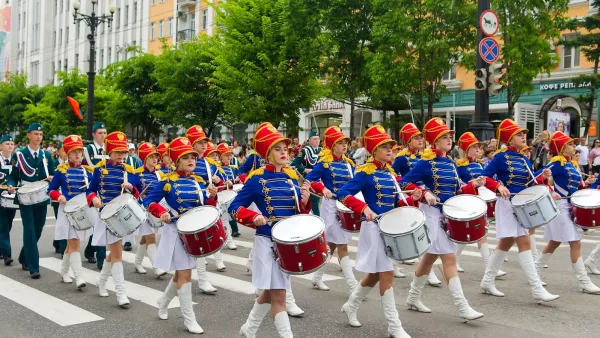
This is the oldest and most straightforward form: a band moving forward along a route, playing accessible, crowd-pleasing repertoire — marches, popular tunes, the occasional novelty number — for a civic parade, ceremony or ceremonial occasion. There's little in the way of complex formations here; the priority is projection, a steady step and keeping spirits up along the route.
Show-Style College Bands
This is the version most people picture from American football: a large ensemble staging a themed production on the field, with drill (planned movement and formations) built around a piece of music or a concept, changing shape continuously across an eight-to-ten-minute halftime show. It blends serious musicianship with visual design, and it's the style that produced famous moments like Ohio State's "Script Ohio" formation.
Corps-Style and Drum & Bugle Corps
A more specialised, competitive branch built entirely around brass, percussion and colour guard — no woodwinds at all. Drum and bugle corps, organised competitively under Drum Corps International, tour for an entire summer season and are judged on musical and visual excellence at an intensely high standard. Many college show-style programmes borrow techniques and visual concepts directly from this world.
HBCU Show-Style Bands
Historically Black colleges and universities developed a distinct approach that prioritises entertainment, dance and crowd interaction alongside musicianship, often performing at a faster tempo with more overtly choreographed movement than a typical corps-style show. It's a style with huge cultural reach, having shaped how much of the wider public imagines this kind of performance even outside college football.
Scramble Bands: The Activity's Rebels
Mostly found at a handful of Ivy League universities, scramble bands deliberately reject precision drill altogether. Instead of forming neat shapes, performers run ("scramble") into loose, often comedic formations, frequently paired with irreverent commentary and satirical routines. It's a style built on humour and spontaneity rather than the discipline that defines every other style on this list — genuinely the odd one out.
Military and Ceremonial Bands
Closer to the activity's original roots, military and ceremonial bands prioritise precision, uniformity and tradition, performing at official ceremonies, state occasions and military events. Their repertoire leans heavily on marches — including much of John Philip Sousa's output — and their visual style tends to be restrained compared with the theatrical productions of show-style bands.
Indoor Percussion and Winter Guard: The Indoor Cousins
Not quite the same activity, but closely related: indoor percussion and winter guard take the drill-and-performance approach indoors, into gyms and arenas, stripping away the outdoor winds section to focus purely on battery percussion, front ensemble or colour guard choreography. The emphasis on staging and theatrical presentation is even sharper than in a typical outdoor field show.
Which Style Should You Watch or Join?
If you want spectacle and precision, look to corps-style and Drum Corps International. If you want energy and showmanship, HBCU bands are unmatched. If you want tradition, a military band or a classic parade band delivers it. And if you just want to laugh, find your nearest Ivy League scramble band. For the full story of how these styles diverged in the first place, our history of marching band traces it properly, and our guide to the best-known names tells you exactly who to watch in each style.
The Bottom Line
There's no single "correct" version of marching band — there's a whole family of related styles, each shaped by a different set of priorities: precision, spectacle, tradition or pure comic chaos. Knowing which is which makes it far easier to find the version you'll actually enjoy watching.




Comments