


Classical Music article
Classical Music Subgenres, Explained
From Baroque to minimalism: a map of the main classical styles, sorted by era, by performing forces, and by twentieth-century departures.
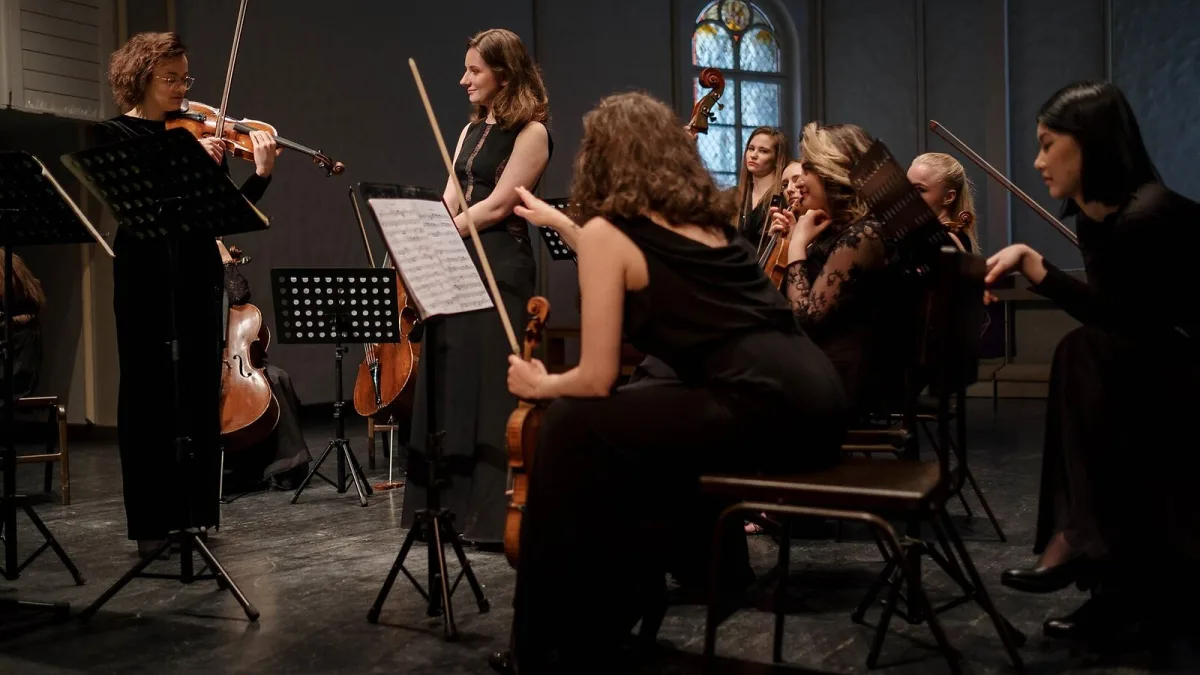
Not every classical music subgenre fits neatly onto a timeline. Some, like the Baroque or Romantic styles, are defined by the era they belong to. Others, like chamber music or minimalism, are defined by scale, forces or technique instead, and can turn up in almost any period. This guide sorts the main classical music subgenres by what actually defines them, rather than forcing everything into a single chronological line.
Styles Defined by Era
| Subgenre | Rough dates | Defining trait | Key figure |
|---|---|---|---|
| Baroque | c. 1600–1750 | Ornament, driving rhythm, continuous bass line | J. S. Bach |
| Classical | c. 1750–1820 | Balance, symmetry, clear phrase structure | Haydn, Mozart |
| Romantic | c. 1820–1900 | Personal expression, expanded harmony, larger orchestras | Chopin, Wagner |
| Impressionism | c. 1890–1920 | Colour and atmosphere over strict structure | Debussy |
These four alone cover most of what a beginner will encounter first, and our full history of classical music traces how one style gave way to the next in far more detail than a table can manage.
Styles Defined by Performing Forces
Rather than a time period, these classical music subgenres are defined by who's actually playing.
- Chamber music: written for a small group — a string quartet or piano trio, say — and intended to be heard at close quarters rather than in a huge hall.
- Choral music: written for voices, with or without instrumental accompaniment, ranging from small vocal ensembles to massed choirs.
- Orchestral and symphonic music: written for a full orchestra, spanning everything from a tightly structured Classical-period symphony to a sprawling Romantic tone poem.
- Opera: sung musical drama that combines voices, orchestra and staging into a single theatrical work.
Sacred and Early Traditions
Two closely related styles sit right at the root of the whole tradition.
- Gregorian chant: unaccompanied sacred melody, sung in Latin, that dominated Western church music for centuries before harmony as we'd recognise it existed.
- Early music: a broader modern label for medieval, Renaissance and Baroque repertoire, closely tied to the “historically informed performance” movement, which favours period instruments and playing techniques over modern ones.
Twentieth-Century Departures
The last hundred years or so produced several distinct styles that deliberately broke with what came before, rather than simply following on from it.
- Neoclassicism: a 20th-century return to older, more restrained forms and textures, associated with a later phase of Stravinsky's career, as a reaction against Romantic excess.
- Serialism and atonality: pioneered by Arnold Schoenberg, this approach abandoned traditional key-based harmony in favour of structured, systematic organisation of pitch.
- Minimalism: built from short repeating patterns that shift gradually over long stretches of time, a marked contrast to the dense, constantly developing textures of earlier eras.
- Avant-garde and experimental music: a loose umbrella for approaches involving graphic notation, chance procedures, electronics or unconventional instrumental techniques.
Contemporary and Cross-Genre Blends
Today's composers rarely commit to a single one of these classical music subgenres for an entire career. It's common to find minimalist techniques inside a film score, early-music instruments used in a brand-new commission, or folk and non-Western influences woven into an otherwise orchestral work. That fluidity is arguably the defining feature of contemporary classical composition: fewer fixed camps, and far more composers borrowing freely across every category above.
Which Subgenre Should You Try First?
If you're not sure where to enter this map, your own taste in other music is a reasonable guide.
| If you already enjoy… | Try this subgenre first |
|---|---|
| Film scores and soundtracks | Romantic orchestral music — big, emotionally direct writing for a full orchestra |
| Ambient or repetitive electronic music | Minimalism, with its slowly shifting, hypnotic patterns |
| Choral or gospel singing | Choral music, or Gregorian chant for something starker and older |
| Intimate, unplugged acoustic sets | Chamber music, written for just a handful of instruments |
| Musical theatre | Opera, its older and more musically demanding relative |
None of these pairings are rules, just reasonable doors in. Once one style clicks, the others tend to become far easier to appreciate, since most classical music subgenres share the same underlying building blocks — melody, harmony, rhythm and form — even when the surface sound is completely different.
Putting the Map to Use
None of these categories are watertight, and plenty of individual works sit across two or three of them at once — a Baroque oratorio is also, technically, choral music, for instance. Use this as a starting vocabulary rather than a strict filing system. For the people behind these styles, see our guide to essential classical composers, and if you'd rather start with specific pieces than categories, our pick of essential classical pieces is a more hands-on way in.




Comments