
Read next

Capo article
Capo for Beginners: A Complete Guide
A capo lets you change key, match a singer and turn hard chords into easy open shapes — with shapes you already know. Here's how a guitar capo works and how to use one properly.
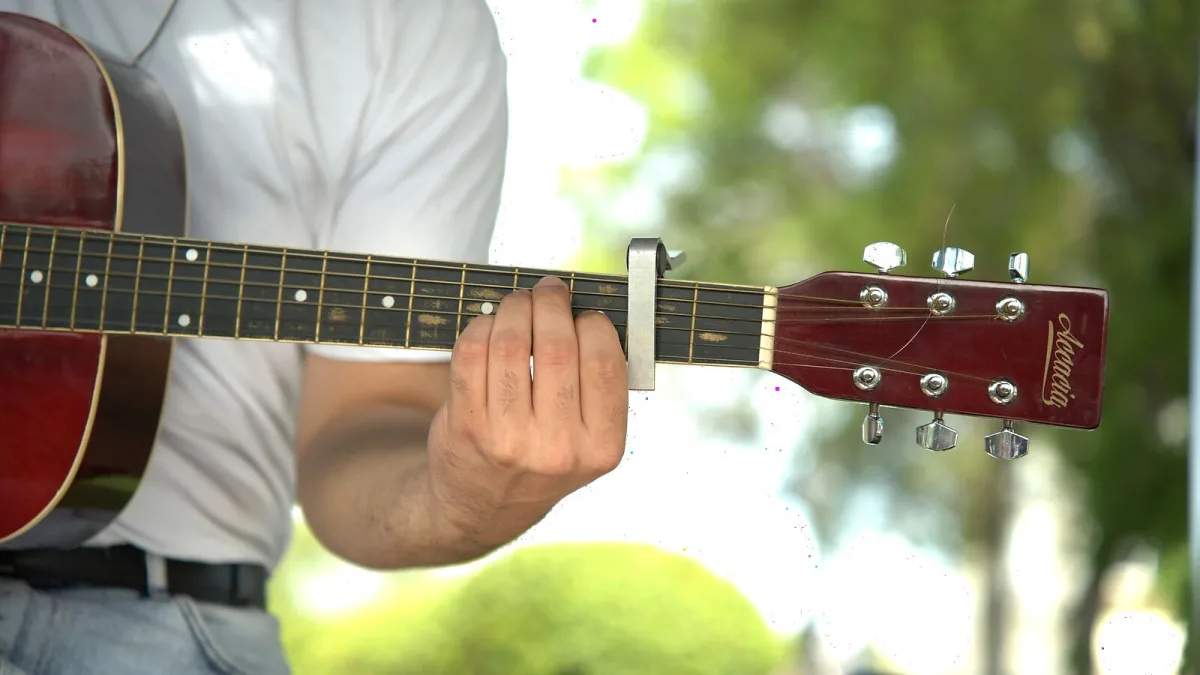
A capo is one of the cheapest, most useful accessories a guitarist can own — and one of the most misunderstood by beginners. Clip it onto the neck and you can change a song's key, match a singer's range or turn tricky barre chords into easy open shapes, all without learning anything new. This guide explains exactly what a capo does, how to use it correctly, and how to choose your first one.
What is a capo?
The word capo comes from the Italian capotasto, meaning “head of the fingerboard.” It is a clamp that presses down all (or some) of the strings at a chosen fret, shortening the vibrating length of the strings and raising the guitar's pitch. Crucially, it lets you keep using familiar open-chord shapes while the guitar sounds in a higher key.
For beginners, a capo is mainly used to:
- Change a song's key without learning new chords.
- Turn hard chords into easier open-position shapes.
- Match a song to a singer's vocal range.
- Add brighter, more resonant tone.
- Create drone and alternate-tuning effects (with a partial capo).
How a capo changes pitch
Each fret raises the pitch by one semitone, so the capo's position tells you exactly how much higher the guitar will sound:
| Capo position | Pitch increase |
|---|---|
| 1st fret | 1 semitone |
| 2nd fret | 2 semitones |
| 3rd fret | 3 semitones |
| 5th fret | 5 semitones |
| 12th fret | 12 semitones (one octave) |
The golden rule: the sounding pitch equals the fingered position plus the capo position. Play a C shape with a capo at the 2nd fret and the audience hears a D. Your fingers do the same thing; only the pitch moves up.
How to use a capo, step by step
- Tune the guitar in standard tuning first.
- Choose your fret.
- Place the capo just behind the fret wire, toward the body of the guitar — never on top of the metal fret, and not in the middle of the fret space.
- Make sure it covers every string evenly.
- Clamp firmly enough to stop buzzing, but no harder than necessary.
- Pick each string to check for clean, unmuted notes.
- Re-check your tuning — many capos pull strings slightly sharp.
A spring (trigger) capo is the easiest starting point because you can move it with one hand.
Chord shape vs sounding chord
This is the concept that trips up most beginners. If a chord chart says “G, capo 2,” it means play a G shape — but the guitar is actually sounding in A. That distinction matters whenever you play with other musicians, read charts, use a tuner or talk to a singer about keys. The capo never changes the shape you finger; it only changes the pitch that shape produces.
Choosing your first capo
| Type | Strengths | Trade-offs | Best for |
|---|---|---|---|
| Spring / trigger | Fast, cheap, one-handed | Fixed pressure can pull strings sharp | Beginners and live use |
| Screw / adjustable | Precise pressure, better tuning stability | Slower to move | Recording and careful acoustic playing |
| Lever / self-locking | Quick and adjustable | More expensive | Regular gigging players |
| Partial | Covers selected strings for drone effects | Needs more chord knowledge | Alternate-tuning textures |
Well-known makes include Kyser (Quick-Change trigger capos), Shubb and G7th (adjustable, controlled-tension designs), Dunlop and Fender (accessible entry-level options), and the Spider Capo for partial-capo tricks. Whatever you buy, check it suits your instrument: a steel-string acoustic capo often won't fit a classical guitar's wider, flatter neck.
Transposing a song with a capo
Say a song is written in E but you want to use easy C shapes. E is four semitones above C, so put the capo on the 4th fret, play C shapes, and the guitar sounds in E. The general method:
- Decide the concert key you want.
- Pick a chord-shape family you find comfortable.
- Count the semitones between that shape's natural key and your target key.
- Put the capo on that fret.
- Check every chord in the song is still playable.
A capo is great for moving a song up in pitch; to move it down you'll need different shapes, a retune, or another instrument.
Capo myths, tuning and barre chords
A capo is not the same as retuning: retuning changes the relationship between open strings, while a capo raises them all by the same interval. It also won't magically remove every barre chord — if a progression is still awkward after transposing, you may need partial barres, alternative voicings or a different capo position. And always tune before clamping on, then check again afterwards, especially on guitars with low action where fixed-pressure capos are most likely to pull notes sharp.
Songs that famously use a capo
Capos are everywhere in popular acoustic music. Common beginner arrangements include Oasis's “Wonderwall” (capo 2), Tracy Chapman's “Fast Car” (capo 2), Tom Petty's “Free Fallin'” (capo 3), Coldplay's “The Scientist” (capo 3), Vance Joy's “Riptide” (capo 4) and The Beatles' “Let It Be” (capo 5). Treat these as teaching versions — different guitarists may use different tunings or voicings — but they're a perfect way to hear what a capo can do.
Common beginner mistakes to avoid
- Placing the capo in the middle of the fret space, or right on top of the fret wire.
- Clamping far harder than needed (this pulls the strings sharp).
- Forgetting to retune after attaching it.
- Confusing the chord shape with the chord that's actually sounding.
- Buying a capo that doesn't fit your guitar's neck.
- Treating a capo as a replacement for learning barre chords and basic theory.
The bottom line
A capo is a tiny investment that instantly expands what a beginner can play: new keys, easier chords and a brighter sound, all with shapes you already know. Buy one that fits your guitar, place it just behind the fret, keep the pressure light, retune, and remember the difference between the shape you play and the chord you hear. Master those basics and the capo becomes one of the most creative tools on your fretboard.



Comments