
Read next

Music Accessories How-to
How to Tune a Guitar With a Tuner
Standard tuning, what the needle is actually telling you, and the order to work in so the sixth string is still right by the time you reach the first.
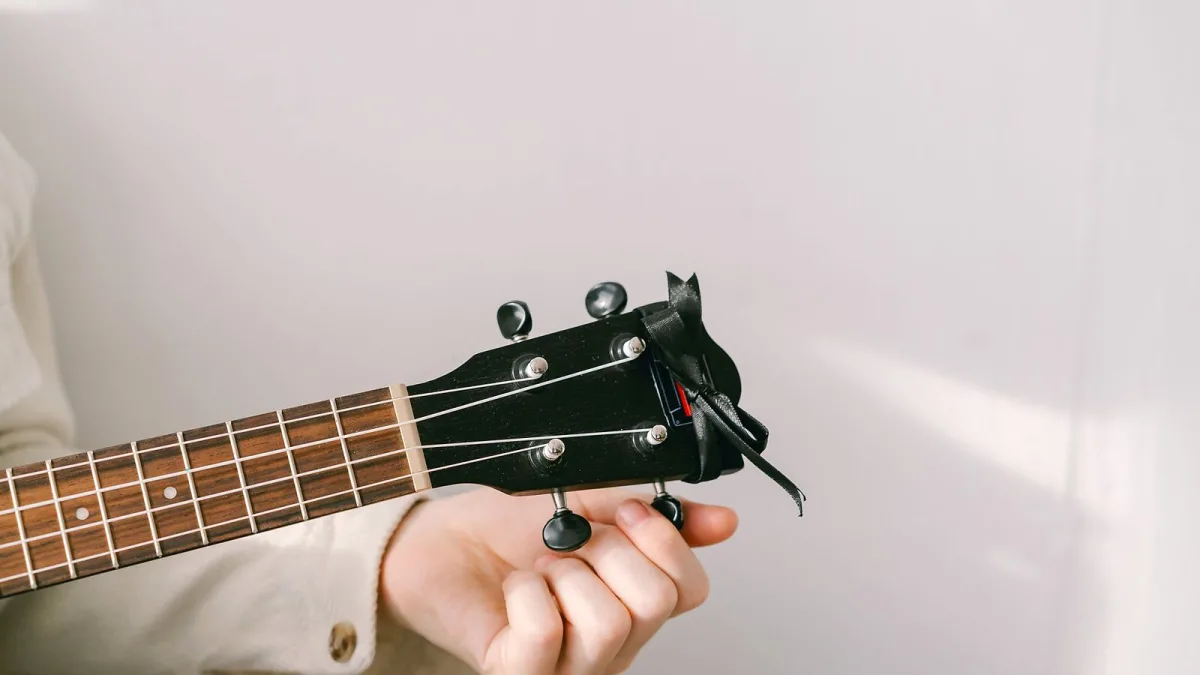
A guitar that is even slightly out of tune makes every chord sound wrong, and no amount of practice will fix that. It is also the single most common reason a beginner decides they are not making progress when in fact they are. The good news is that tuning is a two-minute job once you understand what your tuner is telling you.
What standard tuning actually means
From the thickest string to the thinnest, a guitar in standard tuning is E, A, D, G, B, E. Written with octave numbers those notes are E2, A2, D3, G3, B3 and E4. The thick low E is called the sixth string, the thin high E is the first, and it is worth learning that numbering early because every chord chart and tab you ever read assumes it.
Almost every tuner you will meet is set to concert pitch, where the A above middle C sits at 440 Hz. Unless you are playing alongside an instrument that is deliberately tuned elsewhere, leave that setting exactly where it is.
Choosing a tuner
Clip-on tuners
A clip-on tuner grips the headstock and reads the vibration of the instrument itself rather than the sound in the room. That makes it the most forgiving option in a noisy space, which is why you will see them clamped to half the guitars in any rehearsal room. For an acoustic player it is usually the only tuner worth owning.
Pedal tuners
An electric player who already has a pedalboard is better served by a pedal tuner. It sits first in the signal chain, mutes the output while you tune so nothing reaches the amp, and reads the pickup signal directly. Silent tuning between songs is the whole point.
Phone apps
Tuning apps listen through the phone's microphone, so they work perfectly well in a quiet room and struggle badly in a loud one. They are a fine place to start, especially if you are not yet sure you will stick with the instrument.
Tuning, string by string
- Start on the low E, the thickest string, and work across to the high E. Pluck one string at a time, near the soundhole or over the pickups, with a steady medium-strength note.
- Read the display. To the left of centre, or flat, means the string is below pitch and the tuning peg needs tightening. To the right, or sharp, means it is above pitch.
- Turn the peg slowly. A quarter turn moves the pitch further than beginners expect, and small corrections are much easier to hear than large ones.
- Always arrive at the note from below. If a string is sharp, wind it down past the note and bring it back up. Coming up to pitch takes up the slack in the tuning machine and holds far better than settling down onto it.
- Go round again. Tightening one string changes the tension on the neck slightly, which nudges the others. A second pass, and occasionally a third, is normal rather than a sign you have done something wrong.
Why it drifts out again
New strings
Fresh strings stretch. For the first day or two of playing they will go flat repeatedly, and the fix is to help them along: gently pull each string away from the fretboard an inch or so, retune, and repeat a few times until it stops dropping.
Temperature and humidity
Wood moves. A guitar carried in from a cold car, or left next to a radiator, will need retuning once it has settled. This is worth remembering before a gig: unpack early, let the instrument reach room temperature, then tune.
Hardware
If one particular string will not hold while the others are fine, the usual culprits are a badly wound string, a nut slot that is pinching, or a worn tuning machine. Rewinding the string neatly, with three or four tidy turns down the post, solves it more often than not.
Use the tuner to train your ear
A tuner is a measuring tool, not a substitute for listening. Try guessing whether a string is sharp or flat before you look at the display, then check. Within a few weeks you will find yourself reaching for the peg before the tuner has finished deciding, and that is a genuinely useful skill on stage.
The short version
Clip a tuner to the headstock, work from the sixth string to the first, always come up to the note rather than down, and go round twice. Do that before every practice session and your chords will start sounding like the recordings you are learning from.



Comments