


Vinyl Player article
Vinyl Player Explained: Features, Types and Tips
What's really going on inside a vinyl player, the main types you'll come across, and the terms worth understanding before you start comparing decks.
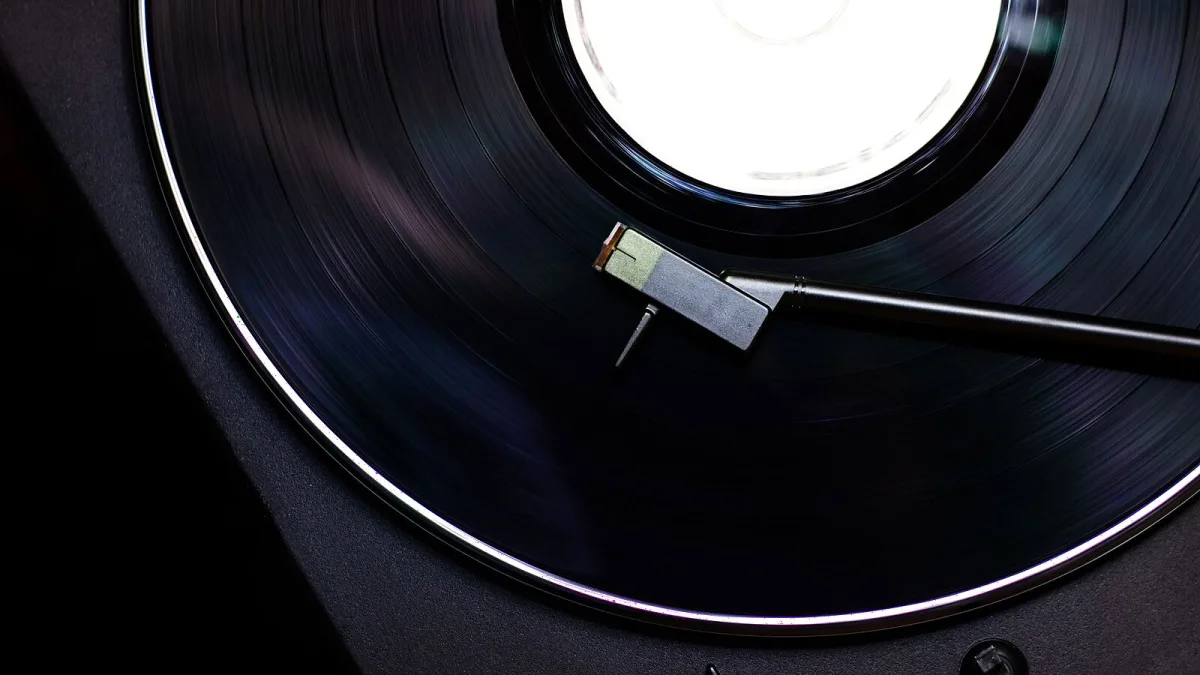
Ask three people what a vinyl player actually is and you'll get three slightly different answers, and none of them will be entirely wrong. Some mean a proper hi-fi turntable, some mean the all-in-one suitcase deck their nan bought them, and some mean anything with a spinning platter and a needle on top. This is the explainer I wish someone had handed me when I first started digging through crates in Leicester — what's actually going on inside the box, the types you'll run into, and the bits worth knowing before you touch a single record.
What's actually happening when a record plays
A record groove is a physical, spiralling trench cut with tiny wiggles that encode the music. The stylus — the needle, to most of us — sits in that groove and wobbles as it tracks it. Sitting above the stylus, the cartridge turns those wobbles into a small electrical signal.
That signal is tiny and deliberately lopsided: bass is recorded quiet and treble is boosted, so the groove doesn't have to be enormous. A phono preamp undoes that with the standardised RIAA equalisation curve and boosts the signal up to something your amplifier can actually use. Skip that step and it will sound thin, quiet and just wrong plugged straight into a normal line input.
From there it's a familiar chain: preamp, amplifier, speakers (or a set of powered speakers that fold the amp in already). However fancy the deck, it's doing this same basic job.
Turntable, record player, vinyl player — does the name matter?
Strictly speaking, a turntable is just the spinning mechanism on its own, with no built-in amplification. A record player, in the older, stricter sense, bundles in an amp and speakers so it can stand alone on a shelf. Retailers blur this constantly, and "vinyl player" has become the catch-all term that covers both. I wouldn't lose sleep over the terminology — just know that a box marketed as a "record player" might need nothing else, while a "turntable" almost certainly needs an amp and speakers somewhere in the room.
The types you'll actually meet
Belt drive vs direct drive
This is the split that matters most once you start comparing decks.
| Drive type | How it works | Where it shines |
|---|---|---|
| Belt drive | An elastic belt connects motor to platter, isolating vibration | Quiet running for home listening; startup is a touch slower |
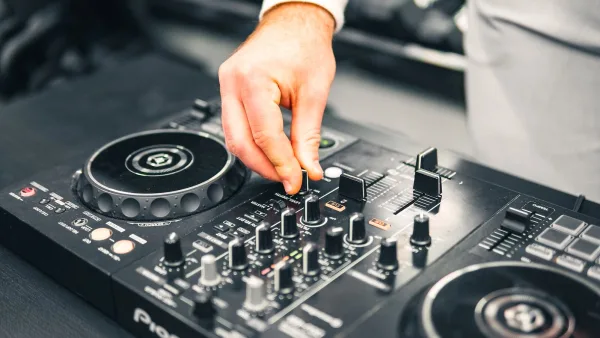
| Direct drive | The motor sits directly under the platter | Fast startup, strong torque and speed stability — a DJ favourite |
| Idler drive | A rubber wheel links motor and platter (mostly vintage gear) | Robust and punchy, but can pass through more vibration |
Neither belt nor direct drive is objectively "better" — plenty of superb hi-fi decks use belts, and plenty of serviceable direct-drive units exist outside the DJ booth. Build quality and motor control matter more than the label.
Manual, automatic and semi-automatic
- Manual — you cue and lift the tonearm yourself. Simpler mechanism, more involvement.
- Automatic — it starts, plays and returns the arm on its own. Handy if you're prone to distraction (guilty).
- Semi-automatic — you start it, the mechanism handles the return.
Standalone decks vs all-in-one players
A standalone deck needs an amp and speakers somewhere in the chain but usually offers a proper, upgradeable tonearm and cartridge. An all-in-one, suitcase-style player packs speakers and amplification into the same box — brilliant for convenience, though many use fixed, non-replaceable styli that aren't kind to your records over time.
The modern extras: Bluetooth and USB
Plenty of current decks add Bluetooth output for wireless speakers or headphones, and USB ports for digitising your collection onto a laptop. Both are genuinely useful, but worth knowing that Bluetooth playback isn't purely analogue — the signal gets converted to digital before it heads off wirelessly. Sony, for instance, has a pair of Bluetooth-equipped automatic models, the PS-LX3BT and PS-LX5BT, on the way for 2026, which tells you this feature set isn't a passing fad.
Speeds, cartridges and the parts that wear
Most records spin at 33⅓ rpm (albums) or 45 rpm (singles and some EPs), with older 78 rpm shellac discs needing a different stylus and cartridge setup entirely — don't assume a modern LP stylus will do that job.
Cartridges mostly come in two flavours: moving-magnet (MM), common and easy to swap, and moving-coil (MC), pricier and fussier about matching phono inputs. The stylus itself is a consumable — it wears down and needs replacing eventually, so a vinyl player with a swappable stylus will always cost you less to keep running.
A few care habits worth adopting
- Handle records by the edges and label, never the playing surface.
- Brush the record with a carbon-fibre or anti-static brush before every play.
- Store records upright, never leaning in a stack.
- Keep the stylus clean with a proper stylus brush, moving back to front only.
- Close the dust cover when it's not in use, away from heat and damp.
The bottom line
A vinyl player is really just a small, elegant chain of mechanical and electrical parts working together — groove, stylus, cartridge, preamp, amp, speakers. Once that clicks, every spec sheet gets a lot less intimidating. If you're actually shopping, our complete buyer's guide walks through what to check before you spend anything, and our round-up of the best vinyl players for the money breaks the market into sensible price tiers. Coming at this completely fresh? Start with our beginner's guide instead — it strips all of this back to the essentials.



Comments