


Mpc Sampler article
Mpc Sampler: A Complete Guide
It's not just a box that records sound — it's an entire workflow. Here's what an MPC sampler actually does, where it came from, and why producers still reach for it.
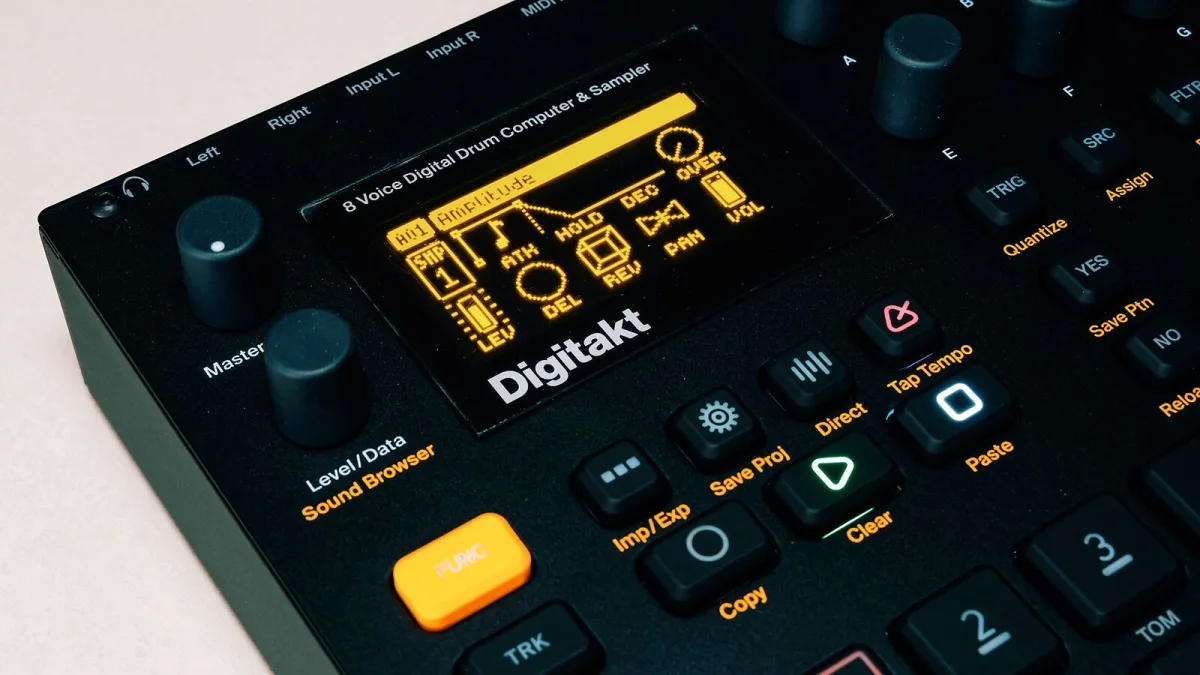
Every genre from hip-hop to house has a piece of gear it can't quite shake, and for sample-based production, that's the Akai MPC. An MPC sampler isn't just a box that records sound — it's an entire workflow for capturing, chopping, performing and arranging music, built around a grid of tactile pads that's barely changed in spirit since the 1980s. Here's what it actually does, where it came from, and why producers still reach for it.
What an MPC sampler actually does
At its core, the sampler is the part of an MPC that records audio into the machine so you can play it back, chop it and rebuild it into something new. You connect a source — a turntable, a mic, a synth, a mixer — record the incoming signal, then trim, loop, pitch-shift or time-stretch the result before mapping it across the pads. From there it plugs straight into MPC sequencing, so a sampled break or vocal snippet can become a fully arranged track without ever leaving the machine.
A quick history: from the MPC60 to MPC3
The concept goes back to the late 1980s, when drum-machine designer Roger Linn teamed up with Akai to build the original MPC60 — a machine that combined velocity-sensitive pads, sampling and sequencing in one box, at a point when that combination barely existed anywhere else. The MPC3000 and MPC2000/2000XL that followed became genuine studio workhorses through the 1990s and 2000s, and later computer-integrated models like the MPC Renaissance kept the workflow alive as production moved onto laptops.
Today's standalone hardware runs Akai's current MPC3 operating system, alongside desktop MPC software and a newer, compact MPC Sample product built specifically around sample-focused work. MPC Sample projects are compatible with any MPC running software version 3.8 or later, so the workflow now stretches across a genuinely wide range of hardware.
How an MPC sampler workflow actually runs
Strip away the specific menus and every MPC sampling session follows roughly the same shape:
- Record — capture audio from an input, either manually or automatically once the signal crosses a set threshold.
- Edit — trim silence, set loop points, adjust level, reverse or pitch the result.
- Chop — divide a longer recording into individual hits, phrases or fragments.
- Assign — map the sound, or its chopped pieces, across the pads as one-shots, a drum program, a pitched instrument or sliced regions.
- Sequence — record a pad performance, tighten or loosen the timing, add effects, and arrange patterns into a full song.
- Resample — record the machine's own output back in as a brand-new sample, ready to be chopped and reused again.
That last step, resampling, is arguably the MPC's quiet superpower: a whole processed performance can become raw material for the next idea, which is exactly the kind of self-contained loop that keeps producers working inside an MPC sampler for hours at a time.
The current MPC lineup, at a glance
| Model family | Best suited to |
|---|---|
| MPC One / One+ | Compact, pad-based standalone production |
| MPC Live II | Portable, battery-friendly production away from a desk |
| MPC X / X SE | Larger, studio-centred setups with extensive physical control |
| MPC Key 37 / Key 61 | Production built around a full keyboard |
| MPC Sample | A dedicated, compact sampling-first workflow |
Note Repeat, swing and the MPC "feel"
Two features do a lot of the heavy lifting for that recognisable MPC groove. Note Repeat rapidly retriggers a pad at a chosen rhythmic subdivision, perfect for hi-hat rolls and rapid-fire percussion fills. Swing shifts selected subdivisions slightly later in a structured way, loosening the timing into something more human than a perfectly quantised grid. Neither is unique to Akai's machines any more, but both were popularised through the MPC workflow.
Why it still matters
The MPC's sampling workflow became central to hip-hop production specifically because it let producers pull fragments from vinyl, CDs and other machines, then rearrange them into something new entirely. That same logic spread into trip-hop, house, techno, grime, R&B and plenty of pop production along the way. Producers associated with the MPC across different eras include J Dilla, DJ Premier, Pete Rock, Marley Marl, Dr. Dre, The Alchemist, Madlib, RZA, Kanye West and AraabMuzik — though most working producers move between several machines over a career, so treat any claim that a specific record was made entirely on one model with a healthy pinch of salt.
Ready to go further?
If you're weighing up which model to actually buy, our MPC sampler buyer's guide and our round-up by price tier are the natural next stops. If you're picking one up for the first time, our beginner's guide walks through your very first sample, and our list of common mistakes to avoid is worth a read before you settle into a workflow.
The bottom line
An MPC sampler setup is really a philosophy as much as a piece of hardware: capture sound, reshape it, perform it, sequence it, then feed the result back into itself. That loop has survived nearly forty years of hip-hop, electronic music and pop production largely intact, and the current MPC3 and MPC Sample generation prove it's nowhere near finished.



Comments