


Sheet Music & Learning Chords / Tabs resource
Ukulele Chords for Guitar Players
A ukulele is tuned like the top four strings of a guitar with a capo at the fifth fret. Once you see that, every shape you know transfers, with one catch.
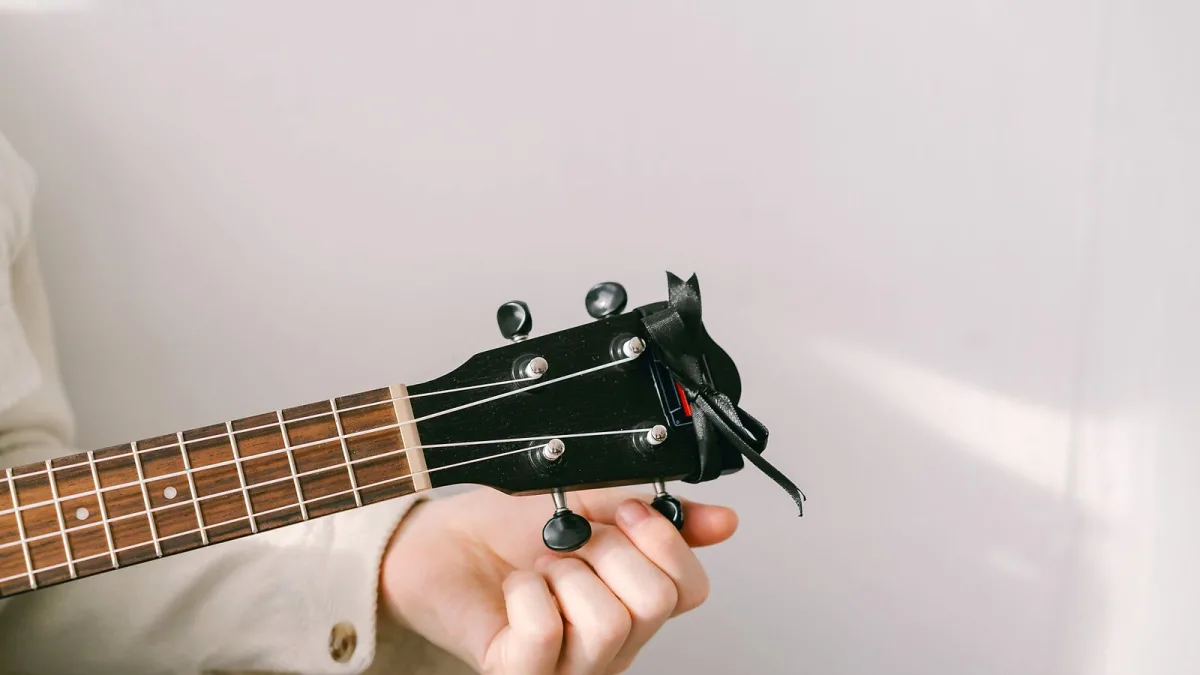
Guitarists picking up a ukulele for the first time usually make the same discovery within about five minutes: the shapes look familiar, but the chord names are wrong. Nothing has gone astray. The two instruments are related in a very specific way, and once you can name that relationship you can move between them freely.
The relationship in one sentence
A standard ukulele is tuned G, C, E, A. A guitar's top four strings are tuned D, G, B, E. Put a capo at the fifth fret of the guitar and those four strings become G, C, E and A, exactly matching the ukulele. That is the whole trick.
What that means for your chord shapes
Every shape you know on the guitar's top four strings works on a ukulele, but it sounds a perfect fourth higher, so it needs a new name. In practice:
- A guitar D shape played on a ukulele is a G chord.
- A guitar G shape becomes C.
- A guitar A shape becomes D.
- A guitar E shape becomes A.
- A guitar C shape becomes F.
The same shift applies to minors and sevenths: a guitar Em shape is Am on a ukulele, a guitar A7 shape is D7. If you prefer a rule to a list, move the chord name up four letter names, counting the starting note as one.
Try it with the easiest chord on the instrument
Fret the third fret of the bottom string of a ukulele, leave the other three open, and you have a C major chord. Guitarists will recognise that immediately as the shape of an open G on the top four strings. It is the same geometry, one fourth higher.
The catch: re-entrant tuning
On most soprano and concert ukuleles, the G string is not the lowest-sounding string. It is tuned an octave up, above the C and E strings, so the pitches run high, low, middle, high as you strum across. This is called re-entrant tuning, and it is why a ukulele sounds bright and chiming rather than like a very small guitar.
The consequence for a guitarist is that your instincts about bass notes stop applying. The lowest note in the chord is not necessarily the one your thumb is nearest, and inversions do not sit where you expect. Most players find this liberating once they stop fighting it: on a ukulele the chord is a texture rather than a stack with a root at the bottom.
If you would rather keep a conventional low end, a low-G string set is widely available and gives you a linear tuning where the pitches ascend in the usual way. Plenty of fingerstyle players prefer it.
The baritone shortcut
A baritone ukulele is tuned D, G, B and E, which is precisely the guitar's top four strings at the same pitches. There is no transposition to do at all: every shape keeps its name. If you mostly want a small, quiet, portable instrument for practising guitar chords on the sofa, a baritone is the path of least resistance.
Things that genuinely differ
- Nylon strings. They are far gentler on the fingertips than steel, and they need a light touch. Pressing as hard as you would on an acoustic guitar will pull notes sharp.
- Short scale. The frets are close together, so chords that require a stretch on guitar are often easier, while chords that need precision are harder.
- Strumming. Most ukulele playing uses the fingers rather than a plectrum, usually the pad or nail of the index finger brushing across all four strings.
- Four strings, four notes. Complex jazz voicings that spread over six strings have to be condensed, which is a genuinely interesting arranging exercise rather than a limitation.
Worth the hour
For a guitarist, becoming competent on a ukulele is a matter of an afternoon rather than a project. Learn the four or five shapes you use most, apply the transposition rule, and let go of your assumptions about where the bass note lives. The instrument gives back more than its size suggests.




Comments