


Sheet Music & Learning Chords / Tabs resource
How to Read Guitar Tab, Starting With G
Six lines, some numbers and a handful of symbols. Tab is the fastest notation a guitarist can learn, and the G chord is a good place to decode it.
Tablature, almost always shortened to tab, is the notation most guitarists actually use. It does not tell you rhythm the way standard notation does, but it tells you exactly where to put your fingers, which is the information a guitarist usually wants most. You can learn to read it in about ten minutes.
The six lines
A tab stave has six horizontal lines, one for each string. The catch that trips up every beginner is that they are drawn upside down compared with how you look at the guitar: the top line is the thin high E string, and the bottom line is the thick low E. Tab is drawn as if you were looking down at the fretboard while holding the instrument.
The lines are usually labelled down the left-hand side, from e at the top through B, G, D and A to E at the bottom.
The numbers are frets, not fingers
A number sitting on a line tells you which fret to press on that string. A 3 on the bottom line means third fret of the low E string. A 0 means play that string open, without fretting it at all. Nothing at all on a line means do not play that string.
Numbers written side by side are played one after another, as a melody or riff. Numbers stacked vertically in a column are played together, as a chord.
Reading the G chord in tab
The standard open G major chord is a good test case, because it uses fretted notes on the outside strings and open strings in the middle. In the most common fingering you fret the third fret of the low E string, the second fret of the A string, leave the D, G and B strings open, and fret the third fret of the high E string.
Stacked in a tab column that reads, from the high E line down to the low E line: 3, 0, 0, 0, 2, 3. Every string is played, which is part of why G sounds so full and why it is such a common key for acoustic songwriting.
The other G
You will also see a four-finger version where the B string is fretted at the third fret rather than left open. It gives a slightly different voicing and, more usefully, puts your hand in a shape that moves to and from C major with less effort. Neither version is more correct than the other.
G as a scale
If a tab is labelled as the G major scale rather than the chord, you are reading a run of single notes rather than a column. The notes of G major are G, A, B, C, D, E and F sharp, and seeing them laid out across the fretboard in tab is one of the clearest ways to start connecting shapes to note names.
The symbols worth knowing
- h is a hammer-on: sound the first note, then bring another finger down hard onto the second without picking again.
- p is a pull-off, the reverse: pluck the string with the fretting finger as you lift it, sounding the lower note.
- / and \ are slides up and down the neck, keeping the pressure on so the note carries.
- b is a bend, pushing the string across the fretboard to raise its pitch. A number after it tells you which pitch to bend to.
- ~ is vibrato, a repeated small bend that makes a held note sing.
- x is a muted or dead note, struck with the string damped for percussive effect rather than pitch.
- PM with a dashed line is palm muting, the side of the picking hand resting lightly on the strings at the bridge.
What tab does not tell you
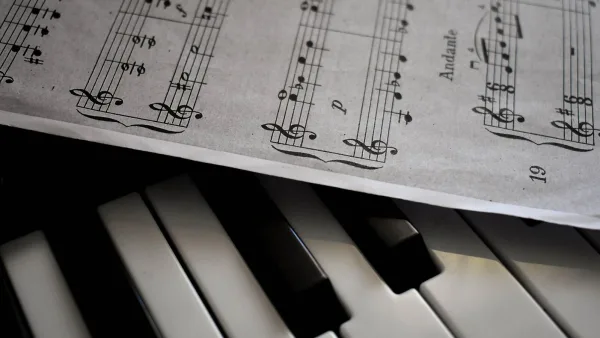
This is the honest limitation. Standard tab carries no rhythm: it shows you the notes in order but not how long each one lasts. That is why tab works best alongside the recording, and why so many players learn a part by reading the tab with one ear on the track. Some publishers print tab underneath standard notation for exactly this reason, and if you can read both, you get the best of each.
Getting started
Find the tab for a song you already know well, so your ear can supply the rhythm the notation leaves out. Work through it slowly, a bar at a time, and resist playing along at full speed until the shapes are under your fingers. Tab rewards patience more than it rewards talent.



Comments