


Yamaha P145 article
Yamaha P145 for Beginners: A Complete Guide
You don't need to understand every setting to start enjoying the Yamaha P-145. Here's the gentle version, one step at a time.

Starting out on the Yamaha P-145? You've picked a properly sensible first piano, and you really don't need to know everything about it before you begin. Let's take it gently, one bit at a time.
Why This Is a Kind Instrument to Learn On
The Yamaha P-145 has a full 88-key keyboard with weighted action, meaning the keys push back against your fingers the way a real acoustic piano's keys do — heavier at the bottom of the keyboard, lighter at the top. That matters more than it sounds, because it means the muscle memory you build now will transfer properly if you ever play an acoustic piano later. You're not learning on a "toy" version of the real thing.
Getting Comfortable at the Keys
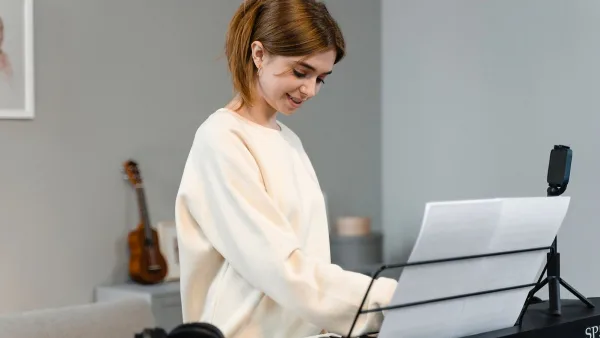
Before you worry about voices, modes or settings, just get used to sitting at the instrument. Set it up on a stable stand at a height where your forearms sit roughly level with the keys, not reaching up or hunching down. Start with the default piano sound — there's no need to explore the other nine voices on day one, or ever, if you don't want to.
If the touch feels too heavy or too light for you, there's a touch-sensitivity setting you can adjust between hard, medium, soft or fixed. Most beginners are perfectly happy with the default, but it's there if something feels off.
Practising Without Driving the Household Round the Bend
One lovely thing about a digital piano is the headphone output. Plug in a pair and you can practise for as long as you like, at any hour, without anyone else in the house hearing a note. It's genuinely worth doing from the very start — it takes the pressure off, and pressure is the last thing a beginner needs while they're still finding their way around the keys.
Simple Habits That Actually Help
You don't need a strict practice regime to make progress, but a few small habits go a long way:
- Sit with your back reasonably straight and your wrists roughly level with the keys, not drooping below them.
- Warm up with a few slow scales or simple exercises before diving into a full piece.
- Keep early sessions short — fifteen focused minutes most days beats one exhausting hour once a week.
- Play something you actually enjoy occasionally, not only exercises. Motivation matters as much as technique at this stage.
None of this requires a deep understanding of every setting on the P-145. It's simply about building a comfortable, repeatable routine around the instrument.
A Nice Trick If You Have a Teacher
The instrument has something called Duo mode, which splits the keyboard into two identical halves covering the same notes. That means you and a teacher (or a patient parent) can sit side by side and play exactly the same passage together, note for note, without getting in each other's way. It's a small feature, but it makes early lessons feel a lot less intimidating.
What You Genuinely Don't Need to Worry About Yet
- Polyphony — the piano can sound 64 notes at once. As a beginner you will not come close to running out.
- The extra voices and reverb settings — fun to explore eventually, but entirely optional while you're learning the basics.
- The three-pedal question — the single sustain pedal that comes in the box is all you need for a good while. A fuller pedal setup can wait until you're working on more advanced repertoire.
- Bluetooth features — if you have the BT version, streaming audio is a nice extra, not something you need to master before you play your first scale.
A Gentle Word on Sticking With It
Progress on any piano feels slow at first, and that's completely normal — it isn't a sign you've chosen badly. Short, regular sessions with the headphones on, using the default piano sound and Duo mode with a teacher if you have one, will get you further in a month than the occasional long, ambitious session ever will.
Once the basics feel comfortable, it's worth reading our wider P-145 explainer to see what else the instrument can do, our buyer's guide when you're thinking about a proper stand or a better pedal, and our common mistakes to avoid so you can sidestep a few habits that catch nearly every beginner at some point.
The Bottom Line
You don't need to understand every setting on the Yamaha P-145 to start enjoying it. Sit comfortably, use headphones without guilt, and let the rest of the features introduce themselves to you gradually, as and when you actually need them.



Comments