


Electro article
The History of Electro
From a 1982 block-party record to Detroit's cold machine funk — here's how electro actually took shape, city by city.
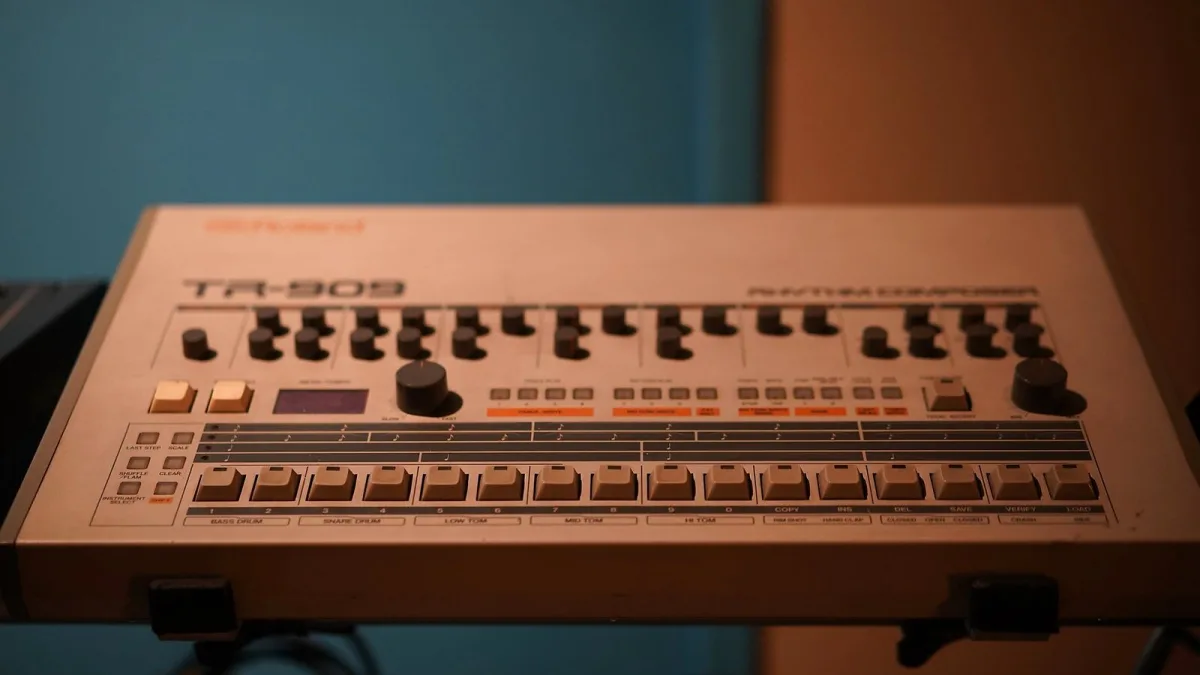
Every genre has an origin story, but few are as tangled as electro's — a music built from three separate traditions colliding almost by accident in the early 1980s, then splintering again almost as soon as it took shape. Tracing it properly means following the sound from New York to Detroit to Miami and back out into Europe.
The Roots: Funk, Hip-Hop and a German Import
Nothing about electro emerged in isolation. It drew its syncopation and bass-heavy groove from American funk, its breakbeat culture and DJ-led approach from the earliest years of hip-hop, and its icy, sequenced electronics from Kraftwerk — the German group whose vocoder vocals and mechanical rhythms supplied a sound nobody in American dance music had quite reached for before. Add in the arrival of affordable drum machines and synthesizers, and small groups of producers suddenly had the tools to build entire tracks alone.
1982: A Record Changes Everything
Afrika Bambaataa & the Soulsonic Force's "Planet Rock", released in 1982 and produced with Arthur Baker, is widely treated as electro's founding document. It fused hip-hop's block-party energy with Kraftwerk's melodic and timbral ideas, and it did so on the newly released Roland TR-808 drum machine — a machine that had, at that point, barely sold. Its deep kick and metallic cowbell became the genre's calling card almost overnight.
New York's Electro-Funk Years
The years immediately after "Planet Rock" saw a wave of New York records chase the same energy. Warp 9's "Nunk" (1982), Hashim's "Al-Naafiysh (The Soul)" (1983) and Newcleus's "Jam on It" (1983) each built on the same ingredients — programmed drums, synthesizer hooks, vocoder or processed vocals — while pushing the sound in slightly different directions. Mantronix's "Fresh Is the Word" (1985) later sharpened the drum programming further and folded in turntable scratching, closing out the period's most productive run.
Detroit Turns the Sound Colder
Detroit took the same raw materials somewhere else entirely. Juan Atkins and Richard "3070" Davis, recording as Cybotron, released "Clear" in 1983 — a track that stripped away much of New York's party energy in favour of something more minimal, mechanical and science-fiction-flavoured. That shift is widely regarded as a direct bridge into Detroit techno, which Atkins went on to help define. Electro and techno share plenty of DNA as a result, though they aren't the same thing; the fuller distinction between the two is unpacked in electro subgenres, explained.
Miami Bass and the Sound-System Arms Race
By the mid-1980s, Miami had taken the genre's bass instincts and pushed them to their logical extreme. Miami bass emphasised huge low-end frequencies, fast tempos and party-oriented, call-and-response vocals, built explicitly for playback on powerful car and club sound systems. It became hugely influential on Southern hip-hop and later bass music, even as it drifted stylistically further from its New York starting point.
The 1990s Revival
After a quieter turn-of-the-decade stretch, Detroit brought electro roaring back in the 1990s through artists including Drexciya, Aux 88 and Dopplereffekt, often released through the wider Underground Resistance orbit. This revival leaned into the genre's darker, more conceptual side — Drexciya's aquatic science-fiction mythology being the most famous example — and cemented Detroit's status as electro's second home. For a closer look at the artists behind this era, see the best electro artists to know.
Electro's European Turn
From the 1990s onward, European producers — among them Anthony Rother — extended the sound into darker, club-focused territory, often blending it with techno, industrial and acid influences while holding onto the robotic, futurist character the genre had carried from the start.
Where That History Leaves Us Today
Electro never disappeared so much as scattered into other things. Its drum programming and bass philosophy fed directly into techno and Miami bass; its vocoder vocals resurface constantly in pop production; and its founding records still circulate as reference points for producers working in hardware-based, rhythm-first electronic music. If you're coming to this history fresh, A Beginner's Guide to Electro is a good companion piece for the sound itself, while Essential Electro Albums Explained turns this same timeline into a practical listening list.
What's clear from tracing it chronologically is that electro was never one single moment — it was a chain of cities each answering the last, from a 1982 block party record all the way to Detroit's cold machine funk and beyond.




Comments