


Electro article
Electro Subgenres, Explained
Electro subgenres genuinely diverged over the decades — here's how New York, Detroit, Miami and European electro actually differ.

Say "electro" to five different people and you might get five different mental images — a 1982 New York block party, Detroit's colder machine funk, or something darker coming out of a European club. That's because electro subgenres genuinely diverged from one another over the decades, even while sharing the same drum-machine DNA. Here's how to tell them apart.
What Actually Counts as an Electro Subgenre?
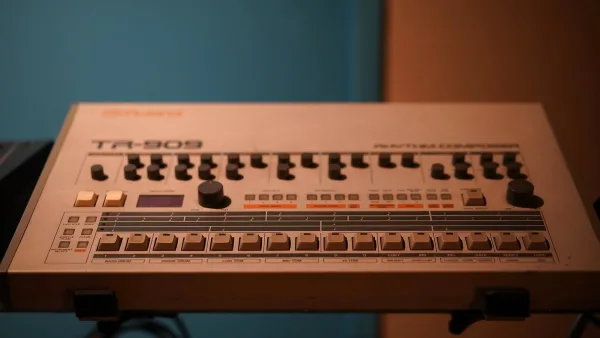
Before splitting things apart, it helps to know what stays constant. All of the electro subgenres below keep the same basic toolkit — a programmed drum machine, a short synthesised bassline, and often a vocoder somewhere in the vocal chain. What changes between them is geography, mood and just how far each scene pushed those ingredients from the original New York template.
Electro-Funk: The Original New York Sound
This is where it all began: programmed drums, a synth bassline, vocoder or processed vocals, and a hip-hop-adjacent energy built for block parties and clubs. Afrika Bambaataa & the Soulsonic Force's "Planet Rock" (1982) and Newcleus's "Jam on It" (1983) are the clearest examples — upbeat, playful and closely tied to early hip-hop's DJ and dance culture.
Detroit Electro
Detroit's producers took the same tools somewhere colder. Where New York's records aimed for the dancefloor and the party, Detroit's leaned into minimal arrangements, darker synth timbres and science-fiction themes. Juan Atkins and Richard Davis's Cybotron project, particularly 1983's "Clear", is the pivotal record here — and it fed directly into the birth of techno, which Atkins went on to help define. Later Detroit-associated acts, including Drexciya, Aux 88 and Dopplereffekt, carried this strand through a 1990s revival.
Miami Bass
By the mid-1980s, Miami had built its own branch entirely around low end. Miami bass emphasised huge sub-bass frequencies, fast tempos and party-oriented, call-and-response vocals, engineered specifically for powerful car and club sound systems. It's arguably the subgenre that strayed furthest from its New York starting point, and it went on to shape Southern hip-hop significantly.
European Electro
From the 1990s onward, European producers — Anthony Rother among the more notable — extended the sound into darker, club-focused territory, often blending it with techno, industrial and acid influences. This strand tends to keep the genre's robotic, futurist character while moving further from the vocal-led, hip-hop-adjacent structure of the earliest New York records.
How These Compare to Techno and House
It's worth being precise here, because the boundaries get blurred a lot in casual conversation:
| Style | Typical rhythm | Vocal approach |
|---|---|---|
| Electro (any subgenre) | Syncopated, funk-derived, often broken | Vocoder, spoken or minimal |
| Techno | Steady four-on-the-floor kick | Usually minimal or absent |
| House | Steady four-on-the-floor kick, often with a swung hi-hat | Often soulful, sung vocals |
The overlap between electro and techno in particular comes from a shared Detroit lineage, not from being the same style with two names.
Why the Split Happened
Genre boundaries are historically porous, and plenty of artists move between labels depending on who's writing about them. But broadly, the split between these electro subgenres tracks geography and mood: New York kept the sound danceable and vocal-led; Detroit stripped it back and pointed it toward techno; Miami chased raw low end; and Europe pushed it into darker, more experimental territory once the original scenes had matured. For the full timeline behind each shift, see The History of Electro.
Where to Hear Each One
If you want a guided way into these different strands, The Best Electro Artists to Know groups key names by scene, and Essential Electro Albums Explained does the same for full-length records. Newer listeners may prefer to start with Electro for Newcomers: Where to Start before tackling the regional differences head-on.
The Bottom Line
None of these electro subgenres exist in a vacuum — they're really one continuous conversation between cities, each answering the last. Once you can hear the difference between New York's party energy, Detroit's machine coldness and Miami's bass obsession, the rest of the genre's history makes a lot more sense.



Comments