


Bass with Amplifier article
Everything You Need to Know About Bass with Amplifier
Plug a bass into a guitar amp and you'll hear the problem straight away. Here's the honest rundown of how bass amplifiers actually work, and what the specs really mean.
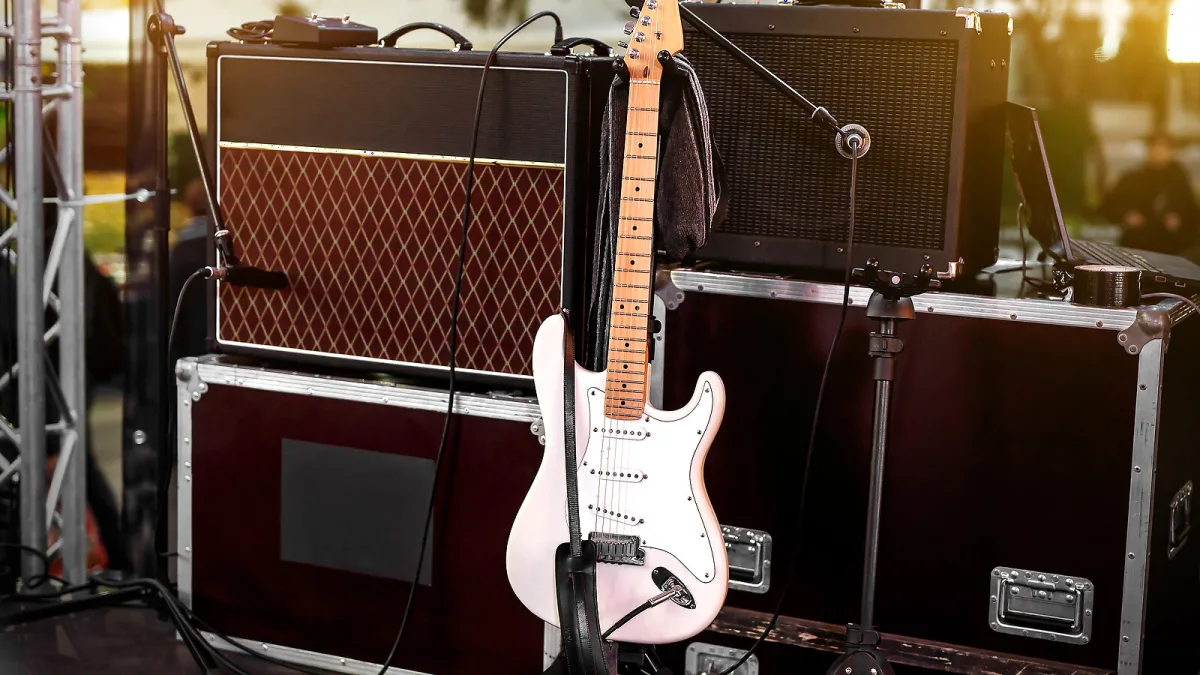
Plug a bass straight into a guitar amp and you'll hear why the two instruments need different kit: the low end turns to mush, the speaker flaps about, and half the note's weight just disappears. A proper bass amplifier is built for that job from the ground up. Here's the honest, no-nonsense rundown of what a bass amp actually does, the formats you'll come across, and how the pieces fit together — so you know what you're looking at before you spend a penny.
What a bass amplifier actually does
A bass guitar's pickups put out a tiny electrical signal. On its own, that signal couldn't move a speaker cone if its life depended on it. The amplifier's job is to take that signal, shape its tone, and boost it enough to drive a speaker — turning string vibration into the low-end sound you actually hear and feel in a room.
You'll see two main shapes this takes:
- Combo amp — preamp, power amp and speaker all built into one cabinet. Grab it, plug in, done.
- Head and cabinet — a separate amplifier "head" that you connect to one or more external speaker cabinets. More flexible, and the standard setup once you're gigging regularly.
Beyond those, you'll also find pedalboard-friendly preamp/power-amp units, digital modelling amps that emulate a whole rack of classic gear, and the more old-school tube designs that plenty of players still swear by.
Tube, solid-state and Class D — what's the difference?
This is where a lot of the confusion in bass amplifier shopping starts, so let's clear it up properly.
| Type | How it works | What you get |
|---|---|---|
| Tube (valve) | Vacuum tubes in the preamp and/or power section | Warm compression and harmonic character, but heavier and needs occasional upkeep |
| Solid-state | Transistor circuitry throughout | Lighter, reliable, generally cheaper to run |
| Class D | A modern, highly efficient solid-state design | Very light and powerful heads that have largely taken over the touring world |
| Hybrid | Tube preamp paired with a solid-state power section | A bit of valve flavour without the full weight penalty |
None of these is objectively "best" — it's a trade-off between weight, tone and budget. A player chasing vintage rock or blues character often leans toward tube or hybrid; anyone hauling their own gear to gigs tends to appreciate just how light a Class D head is by comparison.
Power: how many watts do you actually need?
This is the single most argued-over spec on any bass amplifier, and the truth is that wattage alone doesn't tell you how loud something will feel. Speaker efficiency, cabinet design and how hard your drummer hits all matter just as much. That said, here's a sensible starting point:
- Bedroom practice: 10–50 watts, often with a headphone output for quiet hours.
- Rehearsal or a small open-mic set: roughly 100–300 watts, depending on the room and the rest of the band.
- Club gigs with a louder band: 300–500 watts or more, usually alongside a bigger cabinet.
- Big stages: higher-powered systems, though the venue's PA typically does the heavy lifting for the audience.
More watts mainly buys you headroom — the ability to stay clean under pressure rather than clip and distort. A well-designed 200-watt rig can comfortably out-punch a poorly designed 500-watt one, so don't treat the number on the box as gospel.
Speakers, impedance and why the manual matters
Cabinets come in a range of speaker sizes — 8, 10, 12 and 15 inches being the common ones — and as a rough rule of thumb, bigger speakers tend toward a fuller, rounder low end while smaller ones respond faster and push more midrange presence. It's a tendency, not a law; cabinet design plays a big part too.
Then there's impedance, measured in ohms (Ω) — essentially the electrical load your speaker cabinet presents to the amp. Get this wrong and you can damage the amplifier, so a couple of rules are worth committing to memory:
- Never run a cabinet load below the bass amplifier's stated minimum impedance.
- Many bass heads deliver their maximum rated power at 4 ohms, while a lot of cabinets are rated at 8 ohms — check both before pairing them.
- Always use a proper speaker cable between head and cabinet, never an instrument cable.
Tone-shaping features worth knowing
Beyond raw power, the features that actually shape a bass amplifier's day-to-day sound are the EQ section, gain and master volume controls, and often a built-in compressor to even out your dynamics. A DI (direct injection) output is another one worth understanding early — it sends a balanced signal straight to a mixing desk, which matters more than you'd think at a modern gig, since the front-of-house PA is frequently doing more of the audience-facing work than your amp on stage.
If you're weighing up your first proper purchase, our complete buyer's guide to bass amplifiers goes deeper on which specs are worth paying for. New to the instrument entirely? The beginner's guide to bass amplifiers is the better starting point.
A brief bit of history
Bass amplification as we know it really took off after Fender launched the Precision Bass in 1950. Fender followed it with the Bassman — originally a 50-watt tube amp with a 15-inch speaker — and as rock got louder through the 1960s and 70s, players moved from small combos toward separate heads and large cabinet stacks to keep up. The Ampeg SVT became something of a benchmark for power and tone during that era, and its reputation still carries weight with players chasing classic rock low end today.
How it all fits your genre
The amp and cabinet you'd choose shifts a fair bit depending on what you play. Motown and soul favour a clean, rounded low end with tidy midrange; hard rock and metal want strong upper-mid presence with plenty of headroom; funk needs fast transient response for those percussive slap parts; reggae and dub lean on deep, extended low end. None of this is fixed in stone, but it's a sensible starting compass.
The bottom line
A bass amplifier isn't just "a louder box" — it's a full signal chain, from preamp through EQ and power section to the speaker cabinet, and every link affects how your instrument actually sounds and feels. Get the impedance right, buy enough headroom for where you'll actually play, and treat wattage as a guide rather than a scoreboard. If you want recommendations by budget and style, have a look at the best bass amplifiers for the money, and once you've settled on a rig, our piece on common bass amplifier mistakes to avoid is worth a read before your first gig.





Comments