


Bluetooth Speaker article
Bluetooth Speaker Explained: Features, Types and Tips
The Bluetooth speaker has become the default way most people listen to music, but there's a fair bit going on beneath those fabric grilles. Here's the full picture.

Walk into any café, park, or kitchen these days and you'll almost certainly hear one humming away in the corner — the Bluetooth speaker has quietly become the default way most people listen to music at home and on the move. But there's a fair bit going on beneath those fabric grilles, and knowing what's actually happening helps you get more out of whatever you've got. Here's the full picture.
What Is a Bluetooth Speaker, Exactly?
A Bluetooth speaker is a self-contained amplifier and driver (or multiple drivers) that receives audio wirelessly from your phone, tablet, laptop, or any other Bluetooth-enabled device. The connection uses the 2.4 GHz radio band — the same spectrum as your Wi-Fi, microwave, and a fair portion of the modern world's wireless clutter.
The key thing to understand is that the audio isn't simply "streamed" in the way video is. It's encoded on the source device, transmitted as a radio signal, and decoded by the speaker's chipset before the amplifier even sees it. That encoding and decoding step is where a lot of the sound-quality story lives.
How Bluetooth Versions Affect Performance
You'll often see speakers advertised as "Bluetooth 5.3" or similar. The version number matters for a handful of practical reasons:
- Range: Bluetooth 5.x pushes the usable range from the traditional 10 metres to 30–40 metres in open conditions. Walls still attenuate the signal significantly, but you'll notice the difference in a large open-plan space.
- Stability: Newer versions handle interference more gracefully — handy in a crowded flat where every neighbour's router is competing for the same airspace.
- Power consumption: Each generation sips a little less battery, which adds up over a day of listening.
The version alone doesn't determine sound quality, though. That comes down to the audio codec.
Audio Codecs: The Hidden Sound-Quality Story
Bluetooth audio is compressed before it's transmitted. The codec determines how tightly, and how intelligently, that compression works.
- SBC — the universal fallback. Every Bluetooth speaker and source device supports it. Quality is decent, latency around 170 ms.
- AAC — Apple's preferred codec; iPhones transmit AAC natively. Noticeably better than SBC on compatible speakers.
- aptX / aptX HD — Qualcomm's codec, popular on Android devices. aptX targets CD-like quality; aptX HD pushes further.
- aptX Low Latency (aptX LL) — drops delay to around 32 ms. Useful if you're watching video or playing games where lip-sync matters.
- LDAC — Sony's high-resolution audio codec, transmitting up to 990 kbps. The highest-quality wireless option available, though it works only between LDAC-capable devices.
The catch: both source and speaker must support the same codec. An LDAC speaker paired to an iPhone falls back to SBC or AAC. Worth checking before you buy.
Types of Bluetooth Speaker
The category covers an enormous range of form factors, each suited to different contexts.
Portable / Handheld
Typically cylindrical or brick-shaped, battery-powered, and designed to travel. Battery life ranges from 8 to 24 hours depending on size and volume. Waterproofing (see below) is common in this class.
Desktop and Shelf Speakers
Larger enclosures with more room for bigger drivers and, in many cases, mains power. These prioritise sound quality over portability and often include passive radiators — inert membranes that resonate sympathetically to extend bass without adding a separate powered driver.
Waterproof and Outdoor Models
Rated by the IP (Ingress Protection) scale. The two numbers tell you dust and water resistance separately: IPX4 handles splashes, IPX7 survives submersion to one metre for thirty minutes, and IP67/IP68 covers both dust and deep water. If you're taking a speaker near a pool or in a kayak, check the full IP code rather than just assuming "water-resistant" means waterproof.
Party Speakers
High-wattage units — often 50 watts RMS and above — built for outdoor gatherings. Brands such as JBL (PartyBox series) and Sony (SRS-XP series) include LED light shows and support for multiple-speaker setups. They're heavy, but that's the price of moving air in an open space.
Smart Speakers with Bluetooth
Amazon Echo, Google Nest, and Apple HomePod devices all support Bluetooth alongside their primary Wi-Fi streaming. These blur the line somewhat — the Bluetooth is often secondary to their connected features — but they're worth knowing about if you're building a home audio setup.
What Determines How a Bluetooth Speaker Sounds?
Beyond the codec, the acoustic hardware does the heavy lifting:
- Driver size: Larger drivers move more air, which generally means more bass. A 90 mm woofer will always out-thump a 40 mm unit at the same price point.
- Wattage (RMS): Look at the RMS figure, not the peak power. Five to ten watts RMS suits a small room; twenty to forty watts fills a larger space; fifty-plus is for outdoors. Peak wattage figures in adverts are largely marketing.
- Frequency response: A typical portable manages around 80 Hz–20 kHz. A good one gets closer to 60 Hz at the low end — you'll hear the difference on bass-heavy music.
- Distortion: At high volumes, cheaper drivers break up. If you like listening loud, check for THD (total harmonic distortion) specs — below 1% at reference volume is the target.
Connectivity Features Worth Knowing
Modern Bluetooth speakers have moved well beyond a simple wireless connection:
- NFC pairing: Tap your Android phone to the speaker for an instant connection — no menu diving required.
- Multipoint: Connect to two Bluetooth sources simultaneously. Useful for switching between a laptop and a phone without re-pairing.
- Aux input: A 3.5 mm socket for wired connection when Bluetooth isn't available or practical.
- Party modes: JBL's PartyBoost, Sony's Party Connect, and Ultimate Ears' PartyUp all let multiple same-brand speakers synchronise for a bigger sound.
- USB passthrough charging: Some models (the JBL Charge series being the obvious example) act as a power bank for your phone.
If you find yourself regularly switching devices, multipoint support alone is worth the slight premium it commands on mid-range models. For a deeper dive into what to prioritise when spending your money, take a look at our complete Bluetooth speaker buyer's guide.
Bluetooth Speaker Battery Life in Practice
Advertised battery figures are typically measured at a moderate (often 50–60%) volume. At full pelt outdoors, expect 30–40% less. A few habits help preserve the cells over years of use:
- Don't store the speaker at 100% charge for long periods — 40–80% is healthier for lithium cells.
- Modern USB-C models often include fast charging; check whether the bundled cable actually supports it.
- Turn off Bluetooth on both devices when you're done — leaving both searching for each other nibbles at battery on both sides.
Who Makes Good Bluetooth Speakers?
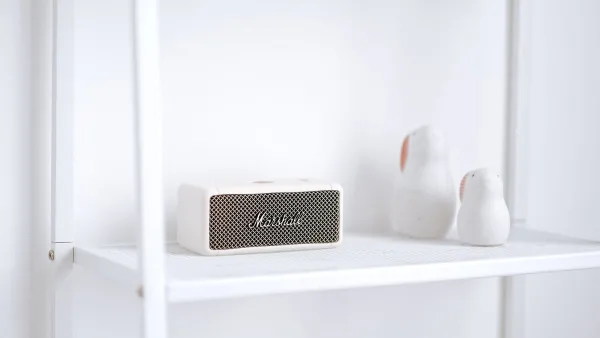
A few names come up consistently at each price tier. JBL (a Harman brand) offers solid mid-range options across its Flip, Charge, and Xtreme lines. Sony's SRS-XB and ULT Field ranges are strong, particularly if your source device supports LDAC. Bose (SoundLink Flex, SoundLink Max) remains a reference point for anyone prioritising audio consistency over raw bass. Marshall's Emberton and Tufton models appeal to those who want a bit of guitar-amp character in their speaker design. At the value end, Anker's Soundcore Motion range punches notably above its price point.
If you're just starting out and feeling slightly overwhelmed by the options, our beginner's guide to Bluetooth speakers walks through exactly where to start.
The Bottom Line
A Bluetooth speaker is, in essence, a small, wireless listening room you can carry in a bag. Understanding the codec chain, the IP rating, the RMS wattage, and the pairing features turns what could be a bewildering purchase into a fairly logical one. Once you know what each number means, the right speaker for your life becomes considerably easier to spot.





Comments