


Electro Harmonix article
A Guide to Electro Harmonix
From the LPB-1 to the Big Muff, here's what Electro-Harmonix actually is, how its pedals work, and why the name still carries so much weight on a pedalboard.
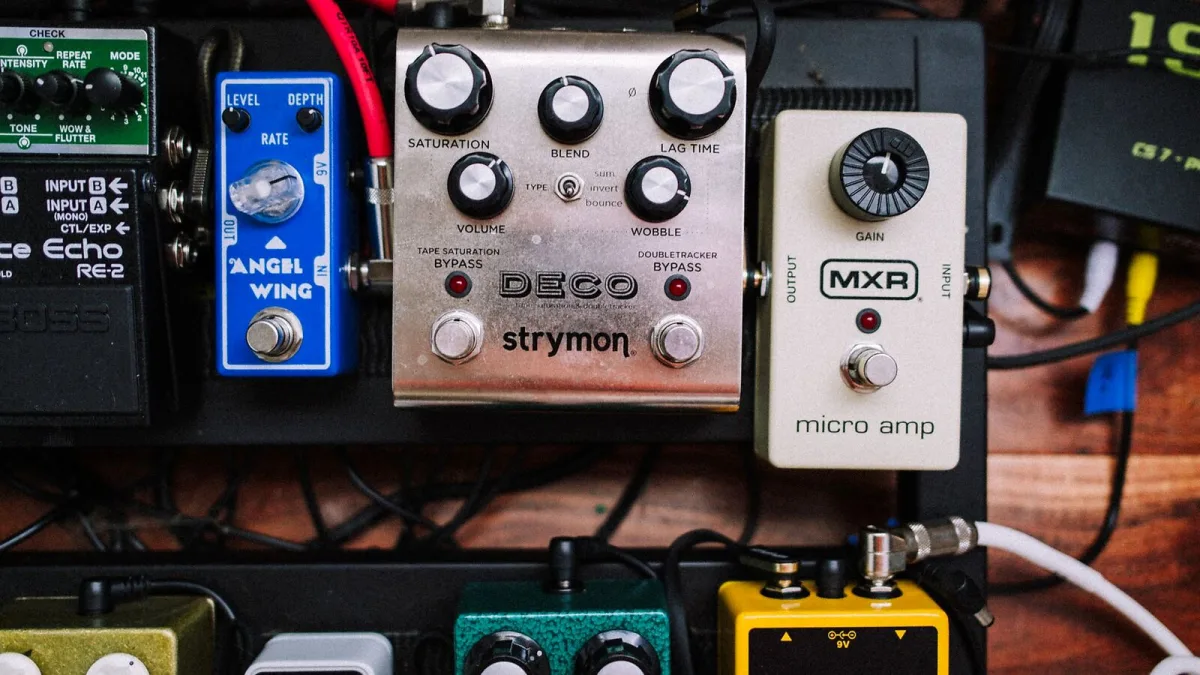
Electro-Harmonix don’t so much fit into the story of the guitar pedal as write half of it. Since 1968, the New York company has turned fuzz, phase, flange and delay into everyday words on a pedalboard, and its designs still turn up under the feet of bedroom players and festival headliners alike. This guide sets out what the brand actually is, how its pedals work, the main families you’ll come across, and the brief history that explains why the name still carries so much weight.
Who Are Electro-Harmonix?
Electro-Harmonix, usually shortened to EHX, is an effects pedal manufacturer founded in New York City in 1968 by Mike Matthews. He started the company with a reported $1,000 and a knack for spotting what guitarists actually wanted: cheap, characterful ways to push a clean valve amp into something louder, dirtier and more interesting. That instinct has never really left the company, even as its catalogue has grown to well over a hundred pedals covering guitar, bass, keyboards and vocals.
How EHX Pedals Shape Your Tone
Most EHX pedals do one of a handful of jobs: they boost a signal, distort it, modulate it, delay it, or process its pitch. A booster simply raises the output level, which can drive an amplifier’s front end harder without you touching the amp itself. A fuzz or distortion circuit reshapes the waveform, clipping it in ways that add harmonics, sustain and grit. Modulation effects such as phasers and flangers use short, moving delays to create sweeping, swirling textures, while true delay pedals repeat the signal at a set interval, sometimes with modulation layered on top for a warmer, less exact echo. More recently, real-time pitch-shifting and polyphonic processing have joined the catalogue too, tracking multiple notes at once rather than treating a chord as a single signal — a genuinely harder engineering problem than it sounds. EHX has built products in every one of these categories, in both analogue and digital form, which is part of why the brand feels so broad.
The Electro-Harmonix Family: Key Pedal Types
New players often assume the brand means one thing — usually fuzz — but the range stretches much further than that. The table below groups the main families by what they actually do.
| Effect type | Known for | What it does |
|---|---|---|
| Fuzz / sustain | Big Muff Pi | Heavy compression, long sustain, a scooped midrange and a thick, saturated attack. |
| Phaser | Small Stone | A sweeping, watery modulation created by shifting the signal’s phase. |
| Flanger | Electric Mistress | A more metallic, jet-like sweep, closely related to phasing but more pronounced. |
| Delay | Memory Man | Analogue repeats, often softened or wobbled by built-in modulation. |
| Digital delay / looping | 16-Second Digital Delay and later loopers | Longer, cleaner repeats and the ability to record and layer phrases live. |
| Boost | LPB-1 Linear Power Booster | Raises signal level to drive an amp harder, without reshaping the tone itself. |
A Brief History: From a $1,000 Idea to a Pedalboard Staple
Mike Matthews launched Electro-Harmonix in 1968, not long after working on the Foxey Lady fuzz for Guild. The company’s first major hit, the LPB-1, showed guitarists that a cheap box could push a valve amp into overdrive without buying a new, higher-gain head. From there came the Big Muff Pi, the Small Stone, the Electric Mistress and the Memory Man — the designs that still anchor the brand’s reputation today.
The story isn’t one of unbroken success. EHX ran into serious financial trouble and effectively closed in the mid-1980s. Matthews went on to found New Sensor Corporation, associated with Sovtek valve production, and used that base to revive the company through the 1990s, initially leaning on Russian manufacturing before rebuilding a stronger New York operation. The 2000s brought the compact Nano and XO pedal formats, plus a real push into digital delay, looping, pitch-shifting and polyphonic processing — all signs of a company still adding chapters rather than resting on a handful of classic circuits.
“There were only like three companies that made pedals — now there are thousands,” Mike Matthews told Gear Patrol in a 2021 interview, reflecting on how far the effects market has grown since EHX’s earliest days.
Why the Name Still Matters
Part of the appeal is how democratic EHX has always felt. These were never boutique, hand-numbered pedals for players with deep pockets; they were built to be affordable enough for a gigging musician to actually own one. That’s also why the brand’s fingerprints turn up across such different corners of guitar music — sources link the Big Muff to players as different as Jimi Hendrix and David Gilmour, and to bands including the Smashing Pumpkins, Sonic Youth, Dinosaur Jr. and Mogwai. Worth saying plainly: an artist being associated with a pedal doesn’t confirm the exact model, era or setting they used, and plenty of players stack several fuzzes, amps and studio tricks to get a signature sound. Even so, that spread — psychedelic rock to shoegaze to noise — says something real about how flexible the underlying circuits are.
It also helps that the catalogue was never frozen in 1975. A newcomer flicking through the current range will find the familiar analogue names sitting alongside loopers, tuners, synth pedals and bass-specific designs, so “classic” and “current” aren’t opposites here — they’re the same company, still working.
Where to Take This Next
Once you know roughly what EHX makes and why it has lasted, the next useful step depends on what you’re actually trying to do. If you’re about to spend money, our EHX buyer’s guide covers the specs and pitfalls worth knowing before you commit. If you’d rather start from a shortlist, the best EHX pedals for the money breaks the range down by what each family suits. Complete newcomers may prefer to start with our beginner’s guide to EHX, and anyone about to buy second-hand should read the mistakes most buyers make first.
The Bottom Line
Electro-Harmonix has spent more than fifty years turning odd, characterful circuits into pedals ordinary guitarists could actually afford, and that combination of accessibility and personality is still the best way to understand the brand. Whether you’re chasing the Big Muff’s wall of fuzz, the Memory Man’s wobbly echoes, or one of the newer digital and polyphonic designs, EHX remains one of the few companies where the history and the current catalogue are equally worth exploring.




Comments