


Vibraphone article
Vibraphone Explained: Features, Types and Tips
How a vibraphone is built, how its motor creates that shimmering vibrato, and how it went from a 1920s invention to a jazz essential.
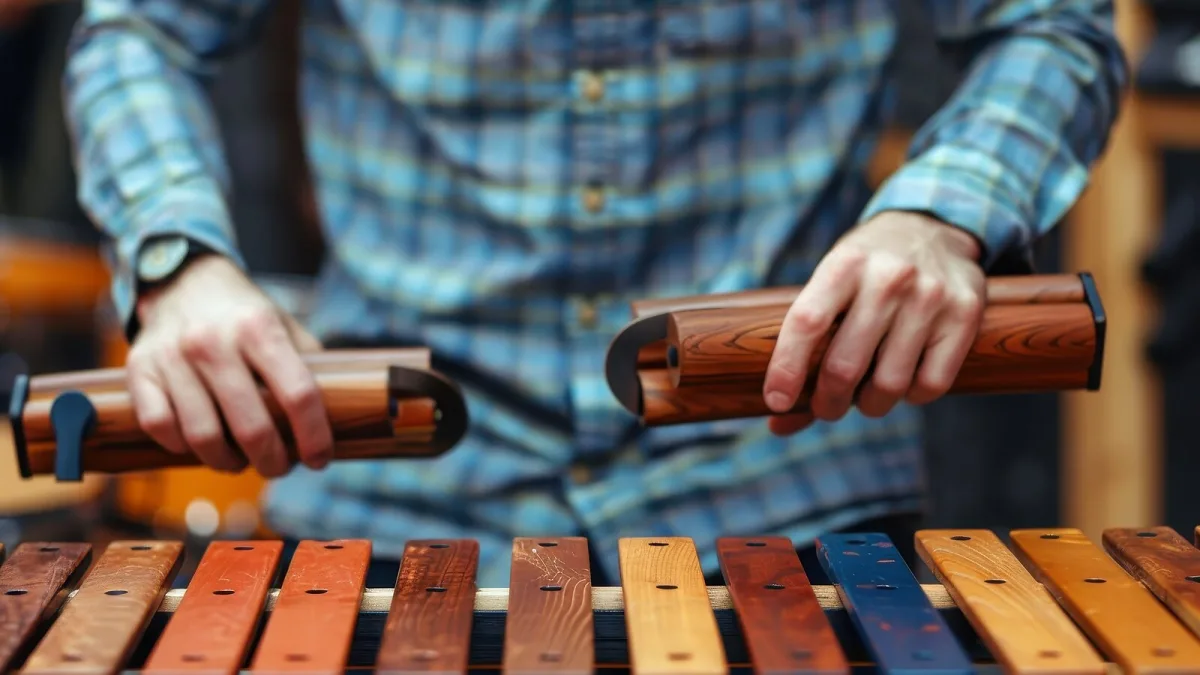
The vibraphone is one of those instruments that looks simple — a row of metal bars over some tubes — until you actually look at what's happening underneath. There's a small motor, a set of spinning discs, a foot pedal doing real mechanical work, and a surprisingly precise bit of engineering behind that shimmering, bell-like sound. Here's what it is, how it's built, and why it became jazz's favourite pitched percussion instrument.
What Is a Vibraphone?
A vibraphone is a pitched idiophone — a fancy way of saying its bars produce sound by vibrating themselves, rather than through strings or air columns. The bars are laid out like a piano keyboard, with the "black key" bars raised, and they're generally made from an aluminium alloy rather than the wood used on a marimba or xylophone. That metal is the whole reason a vibraphone sustains and shimmers the way it does.
A traditional instrument spans roughly three octaves, F3 to F6, across 37 bars, though modern concert models often stretch further. Underneath each bar sits a tubular resonator, tuned to reinforce that bar's fundamental frequency and give it real volume and depth.
How That Shimmering Vibrato Actually Works
This is the part I find genuinely clever. Inside each resonator tube is a small rotating disc, all connected to a single motor via a shaft running the length of the instrument. As the discs spin, they periodically open and close the top of each tube, changing how much the resonator reinforces the bar's sound.
The result is a pulsing effect everyone calls "vibrato" — though technically it's amplitude modulation, a change in volume rather than pitch. Players can usually adjust the motor's speed, or switch it off entirely for a flatter, more focused tone. It's a small mechanical detail that defines an enormous amount of the instrument's character.
Construction: Bars, Resonators and Pedal
Put the whole instrument together and you get:
- Tuned aluminium bars, arranged in two rows
- A resonator tube beneath each bar
- A motor-driven rotating disc inside each resonator
- A damper rail running beneath the bars
- A foot-operated sustain pedal
- A wheeled supporting frame
The pedal works much like a piano's sustain pedal: press it and notes ring and blend together; release it and the damper rail cuts them off, producing short, detached notes. Good pedal control is arguably as important to the instrument's sound as which mallets you use.
A Brief History: From Leedy to Lionel Hampton
The vibraphone's commercial story starts in the early 1920s. Hermann Winterhoff of the Leedy Drum Company is credited by the Grinnell College Musical Instrument Collection with inventing it in 1921, though other accounts place its recognisable market form closer to 1924, with Deagan later establishing many of the features — aluminium bars, a foot pedal — that became standard.
Red Norvo was among the earliest notable players, but it was Lionel Hampton who brought the vibraphone to a mass audience through his recordings with Benny Goodman in the 1930s. Gary Burton, who later transformed the instrument's harmonic vocabulary through four-mallet playing, put Hampton's importance simply:
"Lionel Hampton really popularized the instrument and made people take it seriously." — Gary Burton, Modern Drummer
From there, Milt Jackson brought a softer, more vocal, blues-inflected style to the Modern Jazz Quartet, Cal Tjader carried the instrument into Latin jazz, and Bobby Hutcherson pushed it into post-bop and avant-garde territory.
Vibraphone vs Marimba vs Xylophone
These three are easy to mix up on paper, but they sound and feel quite different in the hands:
| Instrument | Bar material | Character | Sustain system |
|---|---|---|---|
| Vibraphone | Aluminium alloy | Shimmering, bell-like, sustained | Resonators, motor and pedal |
| Marimba | Wood or synthetic | Warm, rounded, woody | Resonators, no motor |
| Xylophone | Wood or synthetic | Bright, short, penetrating | Shorter resonance |
If you're weighing up which of these actually suits you as a first instrument, our beginner's guide to the vibraphone is a gentler starting point than the technical detail here.
Two Mallets or Four? A Quick Look at Technique
Two-mallet playing — one mallet per hand — suits melodic lines, fast passages and traditional swing phrasing. Four-mallet playing, using two mallets per hand, opens up chord voicings, independent bass and inner voices, and genuinely piano-like harmony. The Burton grip, developed and popularised by Gary Burton, is one of the best-known ways of holding four mallets, though Stevens and traditional cross grips offer different trade-offs in reach and control.
Where You'll Hear One
Jazz remains the instrument's spiritual home, but it turns up constantly in contemporary classical writing, film scores, Latin jazz, fusion and even pop production, wherever a composer wants something between a bell and a piano chord. Its combination of full chromatic pitch and genuine sustain makes it unusually versatile for a percussion instrument.
The Bottom Line
Underneath its calm, shimmering surface, the vibraphone is a genuinely mechanical instrument — a motor, a pedal and a set of tuned metal bars working together to produce something closer to a piano than a drum. Thinking about buying one? Our vibraphone buyer's guide covers exactly what to check on a new or secondhand instrument before you commit.



Comments