


Marimba article
Marimba for Beginners: A Complete Guide
Standing at a marimba for the first time can feel daunting. It really isn't, and here's the gentle, honest path in.
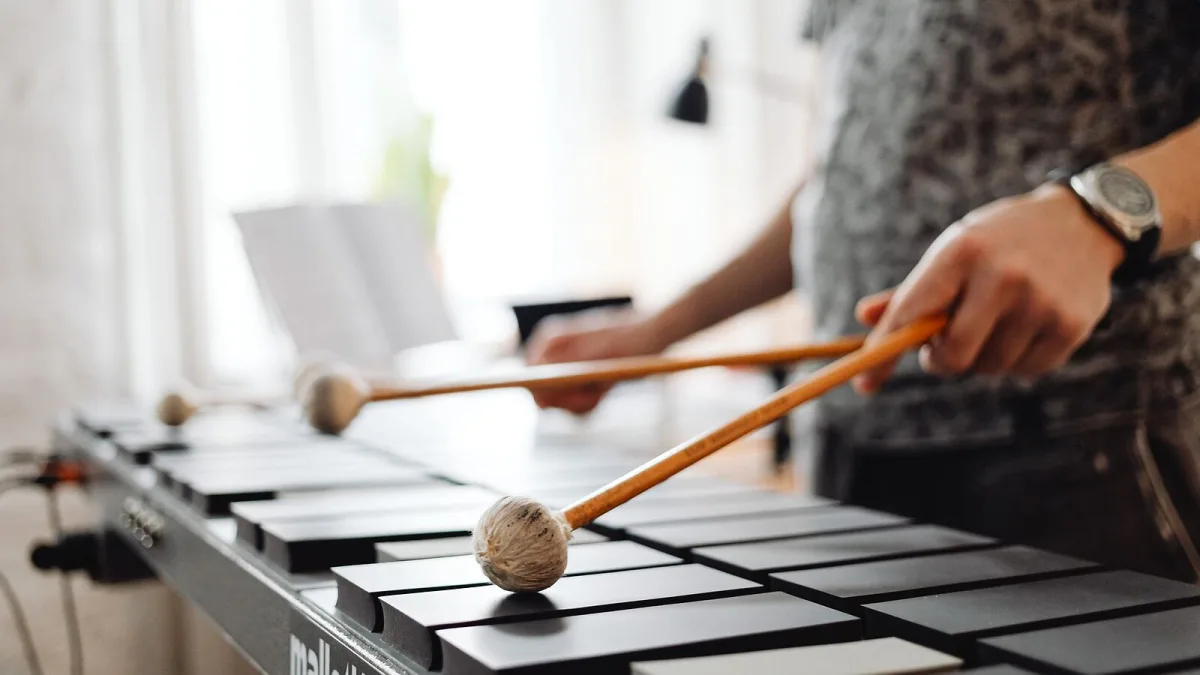
Standing in front of a marimba for the first time can feel daunting — all those bars, and people talking about holding four mallets at once. Take a breath. Every marimba player started exactly where you are now, and the early steps are far more forgiving than they look from the outside. Here is a gentle, honest path in.
You Do Not Need to Understand Everything on Day One
A marimba is simply a set of tuned wooden or synthetic bars, struck with a mallet, with a tube called a resonator under each one to give the note its warm, rounded sound. That is genuinely all you need to know before your first lesson. The history, the different bar materials, the octave ranges — all of that can wait. Right now, your only job is getting comfortable standing at the instrument and making a clean, confident sound.
Reading the Keyboard Without Panic
The layout looks busy, but it borrows directly from the piano: a lower row of longer bars and a raised back row for the equivalent of the sharps and flats. If you already know a little piano, you already half-know a marimba keyboard. If you do not, do not worry — most teachers start you on a small, central group of notes long before you are expected to range across the whole instrument.
Holding One Mallet Before You Hold Four
Almost everyone begins with a single mallet in each hand — two in total — and that is plenty to make real music with while your hands learn the feel of the bars. Focus on a relaxed grip and letting the mallet bounce off the bar rather than pressing into it; a tense wrist is the single most common thing holding new players back, far more than any lack of "natural talent."
Four-mallet playing, with two mallets held in each hand, comes later, once two-mallet control is solid. There is no rush. Plenty of confident, capable players spend a good stretch of time on two mallets before adding more, and that is completely normal.
Little Habits That Build Real Confidence
You do not need hours of practice to make steady progress. A few honest habits do more good than one long, frustrated session:
- Practise little and often — short, regular sessions beat one marathon a week.
- Let the mallet rebound naturally instead of pressing down into the bar.
- Aim near the centre of each bar rather than the very ends, where the tone is thinner.
- Slow right down when something feels awkward — speed is the last thing to add, not the first.
- Celebrate a clean, even sound before you worry about playing anything impressive.
Finding Somewhere to Learn
You do not need to work this out alone. A school music department, a local music service, a community music hub or a private percussion teacher are all sensible starting points, and most will have taught complete beginners before — you will not be their first nervous first lesson. If lessons are not immediately available where you live, some teachers now offer video lessons, which work perfectly well for the basics covered here, provided you can still get regular access to an instrument to practise on between sessions.
What a Typical First Few Weeks Might Look Like
Nobody's early weeks look identical, but a fairly typical path runs something like this: getting comfortable with posture and grip, playing simple patterns on a small group of central notes, gradually widening that range, and slowly introducing basic reading or pattern-following alongside it. There is no fixed timetable, and a good teacher will pace this around you rather than a syllabus. If progress feels slower than you expected, that is far more often about a teaching pace than any lack of ability on your part.
Worries Every Beginner Has (and Why They Are Normal)
"What if I hit the wrong note in front of people?" You will, occasionally, and so has every marimba player who ever performed. "What if I damage the bars?" Ordinary, sensible playing with the mallets your teacher recommends will not harm a well-made instrument; it is only excessive force with the wrong, overly hard mallet that risks the bar surface, and a good teacher will steer you away from that early on. "Do I need my own marimba straight away?" Not at all — most beginners learn on a school, studio or teacher's instrument for a good while before buying anything themselves.
When You Are Ready to Learn More
Once the basics feel steady under your hands, it is worth understanding a little more about how the instrument itself works — our plain-English overview of the marimba covers that without assuming prior knowledge. And when the question of buying your own eventually comes up, our buyer's guide and our tier-by-tier look at marimbas for every budget will both be waiting, with nothing to rush into before then.
The Bottom Line
Learning the marimba is a patient, forgiving process, not a test you can fail. Start with two mallets, a relaxed wrist and short, regular practice, and let everything else — the ranges, the grips, the repertoire — arrive in its own time. You are allowed to enjoy the early, wobbly stage; almost every good player looks back on it fondly.



Comments