


Marimba article
Marimba Explained: Features, Types and Tips
Ever wondered what actually makes a marimba sound the way it does? Here's how the bars, resonators and ranges fit together, explained without the jargon.
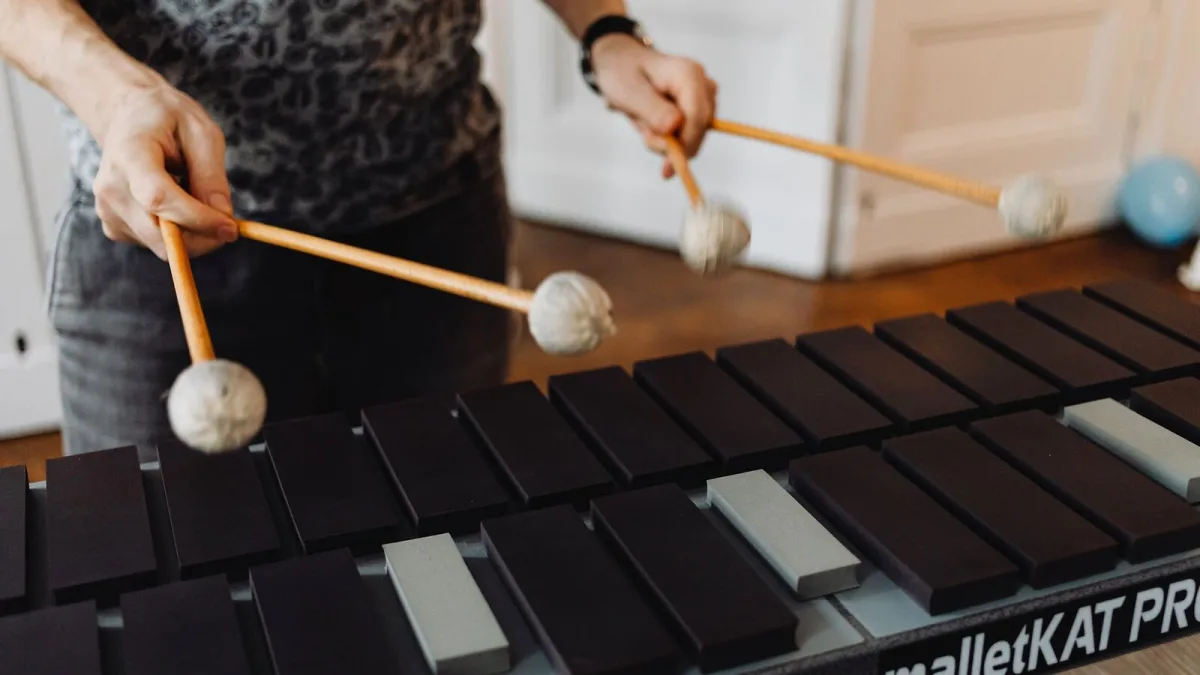
Look past the piano-like rows of wooden bars and the marimba is really a family of tuned drums standing on end. It is one of the most expressive instruments in the percussion section, capable of a warm, singing tone that few other keyboards can match. This guide explains what it actually is, how it makes that sound, the types you will come across, and the terms worth knowing before you go any further.
What Is a Marimba?
A marimba is a pitched percussion instrument built from tuned bars, struck with mallets to produce a note. Technically, it belongs to a family called idiophones — instruments that produce sound from the vibration of their own body, rather than a string or a column of air set moving by something else. The bars are arranged in two rows, mimicking the white and black keys of a piano, with the raised back row covering the sharps and flats.
Beneath every bar sits a tube called a resonator. Its job is not simply to make the note louder; a well-matched resonator reinforces the bar's fundamental pitch and shapes the balance of overtones that gives it its rounded, resonant character.
How a Marimba Produces Sound
The bars
Each bar is carved, mostly on its underside, to tune it to an exact pitch. Lower notes need longer, wider and thicker bars; higher notes use shorter, narrower ones. The carved arch on the underside also refines which overtones ring alongside the main note, which is part of why a well-made bar sounds so much richer than a flat plank ever could.
The resonators
The resonator tube beneath each bar is tuned to match it, reinforcing the fundamental frequency and adding sustain and projection. On modern concert instruments these are usually aluminium; older and regional designs have used gourds or wooden boxes instead. Because very long, straight tubes become impractical at the bottom of the range, the lowest resonators are often curved, widened or otherwise modified to keep the low notes speaking properly.
Marimba vs Xylophone, Vibraphone and Glockenspiel
It shares its keyboard layout with several relatives, and it is easy to mix them up at a glance. The table below sets out the main differences.
| Instrument | Bar material | Typical sound | Key distinguishing feature |
|---|---|---|---|
| Marimba | Wood or synthetic | Warm, rounded, resonant | Lower range, larger bars and tubular resonators |
| Xylophone | Wood or synthetic | Bright, hard-edged | Higher, more penetrating register |
| Vibraphone | Metal | Sustained, shimmering | Motor-driven resonators and a sustain pedal |
| Glockenspiel | Metal | Very bright, bell-like | Small metal bars, high register |
A xylophone is the marimba's closest cousin — both are barred idiophones — but the marimba's lower register and larger resonators are built for a fuller, darker sound rather than a bright attack.
Types and Ranges: Octaves Explained
Marimbas are usually described by how many octaves they span, since that determines how much repertoire a player can reach without transposing. A five-octave instrument, the largest in common use, typically runs from C2 up to C7 and carries 61 bars with 61 matching resonators. Smaller ranges remain very common for school, ensemble and practice use:
- 4.0 octaves — C3 to C7
- 4.3 octaves — A2 to C7
- 4.5 octaves — F2 to C7
- 5.0 octaves — C2 to C7
None of these is a lesser marimba; the right range simply depends on the repertoire a player needs. Our complete buyer's guide goes through how to match a range to your own playing before you commit to anything as large, and as heavy, as a full five-octave frame.
Bar Materials: Rosewood, Padauk and Synthetic
Traditional bars are cut from Honduran rosewood, prized for its density and warmth, or from padauk, a related hardwood some makers favour for its stability. Synthetic composite bars have become popular alongside them because they resist changes in humidity and temperature far better than wood, though players and makers still disagree on which sounds better. Neither camp is simply right; it is a genuine trade-off between tonal preference and day-to-day practicality, which is worth testing in person rather than taking on trust.
Mallets and Grip Styles
A marimba is only as good as the mallets played on it. Softer, yarn-wound heads bring out a darker tone and suit the low register; harder heads give a clearer attack useful higher up. Most marimba playing beyond the basics uses four-mallet technique — two mallets in each hand — which opens up chords and independent melodic lines that two mallets simply cannot reach.
Three grips dominate: the Stevens grip, which crosses the mallet shafts in the palm for fine independent control; the Burton grip, borrowed from vibraphone playing and popular for its simplicity; and the Musser grip, an older style still taught in some traditions. No single grip is objectively superior — suitability depends on hand size, repertoire and, often, whoever taught you first.
A Brief History of the Marimba
The marimba's roots trace back to African tuned-bar instruments carried to Central America, where, by the nineteenth century, distinctive local marimbas had developed larger, chromatic keyboards and wooden box resonators. The modern concert marimba is not a direct copy of any single traditional instrument; it evolved through changes to its keyboard layout, tuning, resonator design and frame construction over the following century.
Performer and designer Clair Omar Musser did much to shape the instrument and its technique in the twentieth century, and later figures such as Keiko Abe, Nancy Zeltsman and Gordon Stout built the solo and chamber repertoire that gave it a serious concert-hall identity, well beyond its origins as an ensemble instrument.
Where You Will Hear a Marimba Today
You will find marimbas in orchestras and wind ensembles, in dedicated percussion chamber groups, on solo recital stages, in contemporary composition, and in school and community music programmes the length of the country. If you are weighing up whether it is the right instrument to take up yourself, our beginner's guide covers first steps in plain terms, and our round-up of marimbas by budget tier is a useful next stop once you know roughly what you are after.
The Bottom Line
A marimba's character comes from the partnership between a carefully tuned wooden or synthetic bar and its matching resonator, built into a keyboard large enough to cover several octaves of genuinely warm, singing tone. Understanding that relationship — and knowing your ranges, materials and mallet grips — is the groundwork for everything else, whether you are buying your first instrument or simply want to understand what you are listening to.



Comments