


Instruments Tambourine roundup
Instruments Tambourine: A Complete Buyer's Guide
Headed or headless, steel or bronze, mounted or handheld — a clear-headed look at what actually matters when you're choosing a tambourine.

Walk into a well-stocked percussion section and you will find a wall of tambourines that all look roughly similar and sound anything but. Some are built for an orchestra pit, others for a pub gig, and a few are really only good for classroom use. Here is what to actually check before you buy one, based on how the instrument is built and what each choice does to the sound.
Start With the Job You Need It to Do
Before comparing specific features, be honest about the setting. A tambourine that sits perfectly under an acoustic guitar will disappear behind a loud rock band, and a tambourine chosen for volume can sound harsh in a quiet room. Ask yourself:
- Will it be played live, in a studio, in worship, or in an orchestral setting?
- Does it need to cut through a full band, or blend into a small acoustic group?
- Will it be mounted on a stand, or shaken and struck by hand?
Everything else in this guide is really just a way of answering those three questions with a specific tambourine, rather than whichever one happens to be nearest the till.
Headed or Headless?
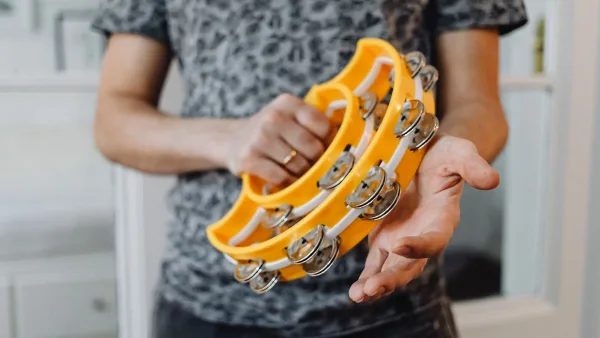
This is the single biggest fork in the road when buying a tambourine. A headed model has a natural skin or synthetic drumhead stretched across the frame, which adds a genuine drum tone and supports techniques such as the thumb roll. A headless model is just the frame and jingles, giving a brighter, more immediate sound with nothing to tune or maintain.
| Choose headed if… | Choose headless if… |
|---|---|
| You play orchestral, gospel or folk parts that need rolls and rim strokes | You mainly need a crisp jingle sound for pop, rock or studio overdubs |
| You want a warmer, rounder tone alongside the jingles | You want the lightest possible instrument with nothing to maintain |
| You are comfortable checking head tension and condition over time | You would rather avoid drumhead maintenance entirely |
Jingle Material: The Detail That Actually Changes the Sound
The jingles are doing most of the work, so their material is worth checking closely rather than treating as a footnote.
- Steel jingles tend to be bright and cutting — useful when you need to be heard over a full band.
- Brass jingles are generally warmer and a little softer than steel.
- Bronze jingles are often the darkest and most sustained option, favoured for a richer, less aggressive sound.
These are strong tendencies rather than fixed rules; the shell, the exact jingle shape, and your own playing all shift the outcome. Where possible, shake a few options in the shop rather than buying purely on spec.
Single Row or Double Row of Jingles?
A single row of jingles gives a lighter, more controlled sound with clearer articulation between hits — useful for precise orchestral or studio parts. A double row is louder and denser, which suits live band settings where you need to be heard without hitting harder. Neither is an objectively better tambourine; it depends entirely on the setting you settled on earlier.
Shell Material and Build Quality
Wood shells are common on mid-range and professional instruments and generally offer a fuller resonance. Plastic and composite shells are lighter, often cheaper, and can be a sensible choice for a first instrument, a travel model, or classroom use where durability matters more than tonal subtlety. Whatever the material, check that the jingles are securely mounted and move freely without rattling loose in their slots — a good sign the instrument was built with proper attention to tolerances.
Mounted vs Handheld
If you play drum kit and want to add a tambourine part without a spare hand, look for a model designed to fit onto a stand or hi-hat clamp. If you play it directly — folk, Latin or worship styles especially — a handheld tambourine built for continuous shaking and close hand control will serve you far better than a mounted instrument pressed into hand use.
Names Worth Knowing
Established percussion manufacturers such as Remo, Latin Percussion, Meinl Percussion, Pearl and Grover Pro all produce well-regarded tambourines across different price points, from classroom-friendly models to professional orchestral instruments with carefully voiced jingles. Rather than chasing a specific model number, use the criteria above to work out what you actually need, then compare current options from a manufacturer whose reputation fits your budget.
Budget vs Professional
An entry-level tambourine is usually built with a plastic or thin composite shell, machine-punched jingles and basic hardware — perfectly serviceable for practice, classroom use or the occasional gig. A mid-range instrument typically upgrades the shell material and jingle finishing for a more even tone across the whole ring. At the professional end, expect hand-selected or hand-tuned jingles, a solid wood shell and noticeably tighter build tolerances, all aimed at consistency take after take rather than raw volume.
None of this means an expensive tambourine automatically suits you better. A session player recording delicate acoustic tracks may prefer a modest, dry-sounding model over a loud professional one, so buy for the part you actually need to play, not the price tag.
Before You Buy
Once you have settled on headed or headless, jingle material, and single or double row, our overview guide is a good way to sanity-check how the whole instrument fits together. And once your new tambourine arrives, our setup and playing guide covers grip, angle and basic strokes, while our list of common tambourine mistakes is worth a read before your first session, not after it.
The Bottom Line
There is no single best tambourine, only the best one for a given room and a given part. Match headed or headless to your technique, match jingle material and row count to how loud you need to be, and choose a shell that suits your budget and how it will be handled day to day. Get those three decisions right and almost any reputable brand will serve you well.



Comments