


Djembes Drums roundup
The Best Djembes Drums for the Money
There's no single best djembe — just the right type for the job. Here's how to match one to a beginner, a drum circle, a serious student or a school.

There's no single "best" djembe — there's a best djembe for what you're actually doing with it. A drum that's perfect for a weekly community drum circle would be the wrong choice for a serious student studying traditional technique indoors, and vice versa. Rather than chasing one winner, here's how to match the right type of drum to the right player, by category rather than by price tag alone.
For the Complete Beginner or a Child
Start smaller and lighter than you think you need. A compact djembe with a stable, well-fitted head and a comfortable rim is far more encouraging to practise on than a big, heavy drum that's a chore to hold between the knees. Synthetic-shell models from brands like Remo or Toca's entry-level range are sensible here: they're forgiving of knocks, don't need much maintenance, and won't be ruined by a forgotten practice session in a cold conservatory.
For a Community Drum Circle
Durability and consistency matter more than tonal subtlety when a drum's going to be passed between different hands week after week, often outdoors or in draughty halls. A synthetic-shell, synthetic-head djembe — Remo's Acousticon-shell range and Meinl's weather-resistant models both fit this brief — will hold its tuning through temperature swings that would leave a goatskin head sounding flat or, worse, at risk of splitting.
For Serious, Traditional Study
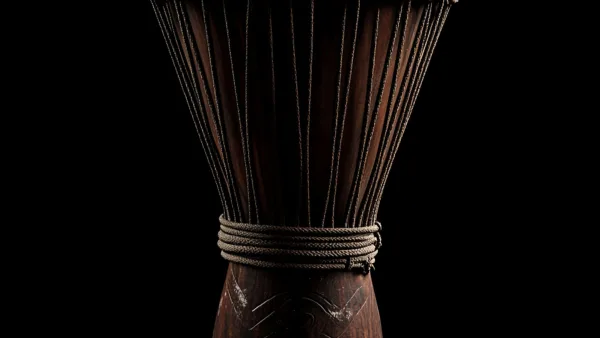
If you're learning technique properly, ideally with a teacher connected to a real playing lineage, a traditional hardwood-shell, goatskin-headed, rope-tuned drum is worth the extra care it demands. The tonal contrast between bass, tone and slap is simply more expressive on a good goatskin head than on most synthetic equivalents, and serious students generally find that extra responsiveness worth the retuning and weather-awareness it asks of you in return.
For Travel and Portability
A lighter, smaller-diameter drum in a padded gig bag is the obvious choice if it needs to survive being checked onto a flight or squeezed into a car boot alongside everything else. Weight adds up fast with a full-size hardwood shell, so a compact synthetic model, or a smaller traditional drum from a maker who builds specifically for travel, will save you a genuinely surprising amount of hassle.
For Outdoor Performance or School Use
Anything that lives outdoors, gets rained on occasionally, or gets handled by dozens of different students across a school year needs to prioritise resilience over refinement. Synthetic shells and heads, built by manufacturers like Meinl and LP specifically with education and outdoor use in mind, are the sensible pick — they're built to survive being knocked about, which a hand-carved traditional drum simply isn't designed for.
For a Professional or Ensemble Player
At this level, projection, even tuning and a genuinely responsive head across all three sounds matter more than convenience. A well-built traditional djembe, or a premium instrument from a specialist maker with a strong reputation, tends to reward the extra attention it needs with a sound that simply carries further and cuts through a full ensemble more cleanly than a budget or synthetic option.
For Buying One as a Gift
A djembe makes a genuinely thoughtful gift, but resist the urge to buy purely on looks. A beautifully carved shell with a poorly seated head will disappoint far more than a plainer drum that's properly built and easy to play. Stick to a smaller, synthetic or well-made entry-level model unless you know the recipient is already committed to learning, and consider including a basic tuning check or a lesson voucher alongside it — a djembe that sounds flat out of the box is a discouraging start for anyone new to the instrument.
For Recording and Studio Work
In a studio, the priorities shift again: you're after evenness and control rather than raw stage projection. A well-tuned traditional djembe with a clean, consistent bearing edge tends to record more predictably, since an unevenly tensioned head can produce odd overtones that a stage mix might hide but a close microphone absolutely will not. Whatever drum you use, spend the time getting the tuning genuinely even around the whole rim before you press record — it matters more to the recorded sound than the specific shell or brand.
What "Best" Doesn't Mean Here
To be upfront about it: this isn't a lab-tested shootout with measured frequency response and blind listening panels, because that kind of independent, verified testing simply isn't available for djembes the way it might be for, say, studio monitors. What follows instead is a practical steer, grounded in how these instruments are actually built and used, toward the type of drum that suits a given situation — not a ranked league table of specific models.
Quick Reference
| You are… | Look for |
|---|---|
| A beginner or child | Small, light, synthetic, stable head |
| Running a drum circle | Durable synthetic shell and head |
| A serious traditional student | Hardwood shell, goatskin head, rope tuning |
| Travelling regularly | Lightweight, compact, padded case |
| Buying for a school | Synthetic, weather-resistant, low maintenance |
| Playing professionally | Premium build, even tuning, strong projection |
The Bottom Line
None of these categories is the universally "best" djembe — each one is simply the right tool for a specific job. If you're still working out which category fits you, our complete guide to the instrument explains the anatomy and sound behind these recommendations, and our buyer's guide covers the shell, head and tuning trade-offs in full detail before you spend anything.



Comments