


Celesta article
Common Celesta Mistakes to Avoid
Every quirk in how a celesta behaves traces back to a specific mechanical cause. Here are the mistakes that come up again and again.

I like taking gear apart to see why it behaves the way it does, and a celesta rewards that curiosity more than most instruments — every quirk in how it's played or recorded traces back to a specific mechanical or acoustic cause. Here are the mistakes that come up again and again, and the actual reason each one happens.
Forgetting the Octave Transposition
The written note and the sounding note sit a full octave apart, and it's an easy detail to forget mid-session, especially if you're switching between this and a piano part in the same rehearsal. The fix isn't memorising a rule so much as training your ear — play a familiar phrase a few times and let the octave lift become something you hear automatically rather than something you calculate.
Playing Celesta Like a Piano, Dynamically
Pushing harder on a celesta doesn't buy you proportionally more volume the way it does on a piano; it mostly just hardens the attack. Players used to piano dynamics often overplay a celesta part trying to "project" over an ensemble, when the actual solution is orchestration — thinning the texture around it — not more physical force at the keyboard. It's a mechanical limitation, not a technique problem, so no amount of practice will make forceful playing produce genuinely more volume.
Miking It Too Close
Close-miking captures hammer noise, action clatter and mechanical detail that most recordings don't actually want. Because the instrument's charm depends heavily on its resonators and the room around it, a more distant pair of microphones usually captures a far more flattering, natural picture than anything placed right on top of the plates.
Confusing It With a Glockenspiel or Toy Piano
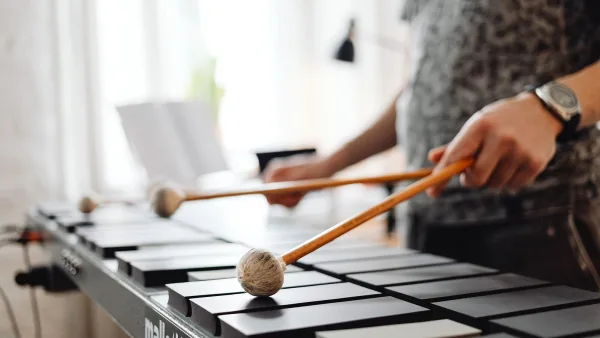
These get mixed up constantly, and the mechanisms are genuinely different. A glockenspiel is struck with handheld mallets rather than played from a keyboard; a toy piano uses crude metal rods rather than tuned steel plates over proper wooden resonators. If you're writing a part, specifying the wrong one to a player or a sample library will get you a noticeably wrong sound, not a close approximation.
Assuming Every Shimmering Recording Is the Real Thing
Liner notes and session credits don't always distinguish between an acoustic celesta, a keyboard patch, a sampler and a glockenspiel standing in for the part. Treat a claim that a specific pop or film recording features a real acoustic instrument with some scepticism unless it's confirmed by actual credits or a documented interview, not just because the sound resembles one.
Ignoring Celesta Tuning and Regulation Until It's Obvious
Uneven plate tuning or a noisy, inconsistent action is far more noticeable on an exposed, delicate instrument like a celesta than it would be buried in a busy mix elsewhere. Regular servicing by someone who actually understands the mechanism matters more here than on most keyboard instruments, precisely because there's nowhere for a fault to hide. A general piano technician without specific celesta experience may not know what to listen for, so it's worth asking directly before booking one.
Burying It in a Dense Arrangement
Its upper partials sit in exactly the same frequency territory as glockenspiel, harp harmonics and high piano notes, so stacking all of those together in a thick arrangement is a reliable way to lose the celesta part entirely. Give it its own moment, or thin out what's around it, rather than assuming it'll cut through on its own.
| Mistake | Why it happens | Fix |
|---|---|---|
| Forgetting the octave shift | Notation convention, easy to overlook | Train your ear with familiar phrases |
| Overplaying dynamics | Piano habits don't transfer directly | Thin the orchestration instead |
| Miking too close | Captures unwanted mechanical noise | Use a more distant pair of mics |
| Mixing it up with a glockenspiel | Superficially similar shimmering tone | Learn the mechanical differences |
| Assuming a sound is the real thing | Credits rarely specify | Check documented sources |
If any of this has you wanting the fuller technical picture, our complete explainer covers the mechanism properly. New to actually playing one? Our beginner's guide starts from the fundamentals, and if you're weighing up buying or hiring one, our buyer's guide covers that decision honestly.
The Bottom Line
Nearly every celesta mistake on this list comes down to treating it like a small piano rather than the specific mechanical instrument it actually is. Understand what's physically happening inside it, and most of these errors sort themselves out without much conscious effort.




Comments