


Mpc One article
The Ultimate Guide to Mpc One
No laptop, no plugins loading, just pads, a screen and a beat. Here's what Akai's standalone workstation actually offers.
No laptop, no plugins loading, no faff — just pads, a screen and a beat. That's the whole pitch behind the MPC One, Akai's compact standalone production workstation, and honestly, it delivers. Whether you're chopping samples for a hip-hop loop or sequencing a rack of modular gear, here's everything actually worth knowing about it.
What Actually Is the MPC One?
It's a standalone sampler, sequencer and synthesiser rolled into one desktop-sized box — genuinely "no computer required," as Akai's own tagline puts it. It's built around 16 velocity- and pressure-sensitive RGB pads, a 7-inch multitouch display, and a quad-core processor doing the heavy lifting underneath. You can sample, chop, sequence, mix and perform entirely on the hardware, or plug it into a computer and use it as a controller for Akai's MPC software when you want a bigger screen and more storage to play with.
The Hardware, Broken Down
| Spec | Value |
|---|---|
| Pads | 16 velocity- and pressure-sensitive RGB pads |
| Display | 7-inch multitouch colour screen |
| Processor | Quad-core |
| RAM | 2GB |
| Internal storage | 2GB (original model) |
| Audio I/O | Two 1/4-inch inputs, two 1/4-inch outputs |
| MIDI | Five-pin MIDI in and out |
| CV/Gate | Four 3.5mm TRS jacks, eight CV outputs |
That 2GB of onboard storage on the original MPC One is tight by modern standards, so an SD card or USB drive isn't optional if you're building any kind of real sample library — it's basically part of the setup from day one.
How the MPC Workflow Actually Works
MPCs don't think in quite the same terms as a typical DAW, and getting your head around the vocabulary early saves a lot of confusion later. It breaks down like this: a program is your sound source — a kit, an instrument, a sampled patch. A track is a sequence lane that controls a program, a plugin or an audio source. A sequence is a musical section built from multiple tracks, and a project is the whole song — every sequence, sample and setting bundled together. Once that clicks, building an eight-bar loop, layering in a breakdown section, or arranging a full track out of muted and unmuted patterns starts to feel genuinely intuitive.
Sampling and Drum Programming on the MPC One
The pads are where this workstation earns its reputation. Sample-based beatmaking, finger drumming, hip-hop, house, techno, experimental production — it's built for all of it. A typical sampling session runs through recording a source, trimming and normalising it, chopping it into regions, assigning the chops across pads, sequencing them, then layering filters and effects before resampling the result. The touchscreen makes waveform editing and sample trimming far more direct than scrolling through menus on a smaller display, which is exactly where a lot of budget samplers fall down by comparison.
- Record beats in real time or step-enter them one note at a time
- Quantise fully or partially, keeping as much human feel as you want
- Layer samples, adjust velocity and timing, and apply swing
- Use the four Q-Link controls and the data encoder for fast, tactile parameter tweaks
How It Compares: the One+ and the Newer G2
Akai's kept the format going since the original launch, and the differences matter for anyone comparing new versus used. The One+ update, introduced in 2023, keeps the same 16-pad layout, 7-inch screen and I/O, but jumps to 16GB of internal storage (roughly 7.8GB usable after the OS and factory content), adds Wi-Fi for wireless plugin updates and Splice/Ableton integration, and supports 128 MIDI tracks alongside eight stereo audio tracks. There are also reports of a newer One G2 variant with 64GB of storage and 4GB of RAM, though full specifications, pricing and territory availability weren't confirmed in the sources checked for this piece — worth verifying directly on Akai's current product pages before you buy based on that model specifically.
Where It Sits Against the Competition
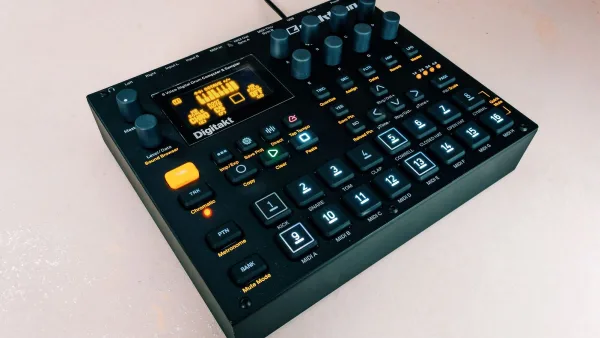
Within Akai's own range, it sits between the pricier, more feature-loaded MPC X and the battery-powered, speaker-equipped MPC Live II — smaller and cheaper than one, less portable than the other. Outside the family, it's most commonly compared with Native Instruments' Maschine+, Elektron's Digitakt, the Roland SP-404MKII and Ableton Push. Each of those takes a genuinely different approach to sequencing and sampling, so the right comparison really depends on your workflow rather than treating them as interchangeable boxes.
Strengths and the Honest Limitations
On the plus side, the MPC One offers standalone operation, a compact footprint, a strong pad-based workflow, touchscreen editing, and MIDI plus CV/Gate connectivity that turns it into a genuine hub for a hybrid hardware setup. On the downside: that limited internal storage on the original model, only two audio inputs and outputs, no battery, no built-in speakers, and menu depth that can slow you down once you're deep into detailed editing. None of it's a dealbreaker, but go in knowing both sides.
If you're weighing up whether to actually buy one, our full buyer's guide covers the practical decision-making, and if this is your first standalone sampler full stop, the beginner's guide is a gentler way in. The MPC One earns its reputation the honest way: it just gets out of your way and lets you make beats.



Comments