


Audio Technica Turntable roundup
Audio Technica Turntable: A Complete Buyer's Guide
Forget the model-number soup for a minute. Here's how to work out which Audio-Technica turntable genuinely fits how you'll use it, and the buying mistakes worth dodging.

Every crate-digger I know has an opinion on turntables, and half of them are wrong for you specifically. Audio-Technica's range is one of the easiest to get lost in — loads of model numbers, a few that look nearly identical, and a couple of genuinely important differences hiding underneath. So let's skip the history lesson and get straight to the bit that matters: how to work out which Audio-Technica turntable actually fits how you'll use it.
Start With How You'll Actually Use It
Before you look at a single spec sheet, answer this: are you playing records for pleasure, mixing them, or trying to get old vinyl onto your laptop? That one question rules out most of the range in seconds.
- Just want to press play and enjoy an album — you want something automatic and uncomplicated.
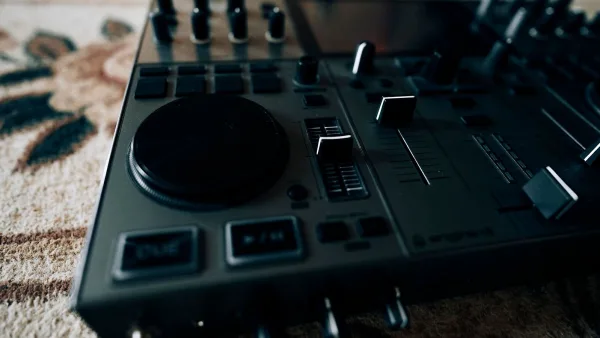
- Want to blend, cue and scratch — you need a manual, direct-drive deck built for handling.
- Want to digitise an old collection — you need USB output, full stop, no exceptions.
- Want it to disappear into a wireless setup — Bluetooth is non-negotiable for you.
Drive Type: What It Means for Your Money
Audio-Technica turntables use either belt drive or direct drive, and this single spec quietly tells you what a deck is for. Belt-drive models pass the motor's spin to the platter through a rubber belt — cheaper to build, generally quieter, and perfectly fine for a deck that just sits there playing records. Direct-drive models couple the platter straight to the motor, giving instant start-up and rock-solid speed even when you're nudging the platter by hand, which is exactly why DJ-style decks use it.
Don't pay extra for direct drive if you'll never touch the platter mid-song. It's a genuinely useful feature, but only for a specific job.
Automatic or Manual: Be Honest With Yourself
This is where I see people talk themselves into the wrong purchase. A fully automatic Audio-Technica turntable lowers and lifts the tonearm for you at the touch of a button — brilliant if you're new to vinyl or just want an easy life. A manual deck asks you to cue the tonearm yourself, which sounds intimidating but takes about a day to get comfortable with, and it usually buys you more control over tracking force and cartridge choice further down the line.
If you've never owned a turntable before, there's no shame whatsoever in choosing automatic. Our beginner's guide to Audio-Technica turntables goes through exactly why that's the sensible starting point.
Check the Connections Before You Buy
This is the bit people forget to check, and it causes more disappointment than any spec on the box.
| Connection | What it needs | Who it's for |
|---|---|---|
| Switchable PHONO/LINE output | An amp with a phono input, or any line/AUX input | Most buyers — the flexible default |
| USB output | A computer and recording software | Anyone digitising records |
| Bluetooth | A paired wireless speaker or headphones | Buyers without a hi-fi amp at all |
Almost every current Audio-Technica model has a switchable built-in preamp, meaning the PHONO/LINE toggle on the back lets it work with either a dedicated phono input or an ordinary AUX socket. Get this switch wrong after you've bought the deck and you'll think it's faulty when it isn't — a PHONO signal into a LINE input sounds thin and quiet, and the reverse can overload the input entirely.
Cartridge and Stylus: What You Can Upgrade Later
The stylus is the needle; the cartridge is the housing that turns its movement into an electrical signal. On simpler, fully automatic decks, the cartridge is usually built in as a sealed unit — you can replace a worn stylus, but you're not meant to go swapping cartridges. On models built for DJs, such as the AT-LP120XUSB, you get a proper removable headshell and a standard-mount cartridge (the AT-VM95E, in that case), which you genuinely can upgrade as your ears get pickier.
If cartridge tinkering appeals to you now, buy into that kind of deck from day one — retrofitting flexibility onto a sealed entry-level unit simply isn't how they're designed.
Matching a Model to Your Budget
| Priority | Look for |
|---|---|
| Cheapest sensible entry point | A belt-drive, fully automatic model with a switchable preamp |
| Digitising vinyl | The USB-equipped version of that same automatic platform |
| Wireless listening | A Bluetooth-equipped automatic model |
| More serious hi-fi listening | A manual, belt-drive model without DJ features |
| DJ practice or vinyl archiving | A manual, direct-drive model with pitch control and USB |
For the full technical picture — drive types, speeds, cartridge naming and how the whole range fits together — our Audio-Technica turntable overview is worth reading alongside this guide.
Buying Mistakes to Dodge
- Buying direct drive you'll never use. It's a genuine benefit for DJ-style handling, not a universal upgrade.
- Ignoring the preamp switch. Check whether your amp or speakers already have a phono input before assuming you need the built-in one.
- Choosing manual out of pride. If you're not sure, automatic is a perfectly respectable, popular choice.
- Forgetting about the stylus. It's a consumable on every model, however much the deck costs, and a worn one damages your records.
- Assuming every model does 78 rpm. Only the higher-end, DJ-oriented models in the range offer that third speed.
Which One Should You Buy?
If in doubt, buy for how you'll actually use the thing, not for the model with the longest spec list. An automatic, belt-drive Audio-Technica turntable covers the vast majority of buyers perfectly well; only reach for direct drive, a removable headshell or Bluetooth if you have a specific, genuine need for it. Get the connection type right, budget for a spare stylus somewhere down the line, and you'll be spinning records happily for years.



Comments