


Audio Technica At2020 roundup
The Best Audio Technica At2020s for the Money
The AT2020 family has more than one variant, and the way you pair and use one makes a bigger difference than the sticker price suggests.

The AT2020 is a single microphone, but the way you use it and what you pair it with can make an enormous difference to what you actually get out of it. This piece is about getting the most from your money — whether that means picking the right AT2020 variant for your workflow, choosing the accessories that genuinely matter, or understanding where this microphone earns its keep and where something else would serve you better.
Which AT2020 Variant Gets You the Most?
Audio-Technica makes more than one version of this microphone, and the differences are not trivial.
AT2020 (XLR) — Best for Studio Workflows
The XLR AT2020 is the version that belongs in a studio chain. It has the full 20 Hz–20 kHz frequency response, requires 48-volt phantom power from your interface, and gives you a proper balanced analog signal to work with. If you already have an audio interface or plan to buy one, this is where to put your money. The XLR version is more flexible long-term — you can upgrade your interface, add a dedicated preamp or insert hardware processing, and the microphone remains at the centre of that chain.
AT2020USB — Best for Direct-to-Computer Recording
The AT2020USB connects straight to a computer with a USB cable and requires no interface or phantom power supply. It records at 16-bit/44.1 kHz with a 20 Hz–16 kHz frequency response. The convenience is real — plug in and record — but the trade-off is reduced flexibility. You cannot route it through an outboard preamp, you are locked to the USB audio class driver, and the narrower frequency response is a genuine, if modest, limitation. For podcasters, streamers and anyone who values simplicity over maximum signal-chain flexibility, it is a reasonable choice. For anyone building a studio around quality recordings, the XLR model is worth the extra setup.
Best Use Cases: Where the AT2020 Earns Its Keep
Not every microphone suits every source. Here is where it consistently delivers.
Vocals and Voice-Over
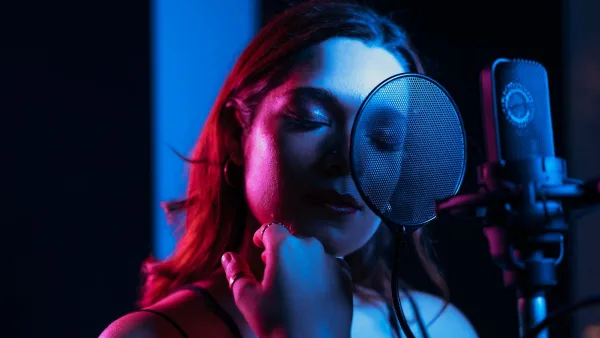
This is where the microphone is most widely used, and rightly so. The presence lift in the upper frequencies adds clarity and intelligibility to speech and sung vocals — a characteristic that translates well in podcasts, demos, voice-overs and home-studio recordings. A pop filter and a moderately treated recording space (even a duvet hung behind the singer counts) are the two additions that make the most practical difference.
Acoustic Guitar
Pointed at the neck-body join around the 12th fret, the AT2020 captures acoustic guitar with good detail and natural transients. Aiming directly at the sound hole tends to over-emphasise the boom; moving toward the bridge emphasises pick attack. The high SPL tolerance means it handles fingerstyle and strummed playing cleanly without needing to back off the gain excessively.
Guitar Amplifiers
The 144 dB maximum SPL rating means it can be used close to a guitar amplifier speaker cone without the capsule clipping. The limitation is usually the preamp or interface input stage, not the microphone. Standard placement rules apply: start with the microphone close to the cone, slightly off-centre, and adjust position to taste.
Brass and Percussion
The microphone's high SPL tolerance and clear upper-frequency response make it a workable option for brass instruments and overhead percussion in home and project studios where dedicated drum-room setups are not available.
Best Accessories: What Actually Makes a Difference
The microphone comes with a basic stand mount. Here is what is worth adding.
- Pop filter: Non-negotiable for vocals. A simple nylon mesh filter at 5–10 cm from the capsule removes plosive problems that no amount of post-processing will fix as cleanly. This is not an optional extra — it is a necessary part of the vocal recording chain.
- Shock mount: The included mount transfers vibrations from desk taps, foot traffic and nearby equipment through to the capsule. A third-party shock mount fitted to a boom stand isolates the microphone and reduces low-frequency rumble in recordings. Worth the small outlay if your recording environment has any vibration issues.
- Boom stand: A desk stand is convenient but limits positioning. A boom stand lets you position the AT2020 optimally for the source — whether that is overhead for a guitar, at the correct angle for vocals, or pointed at an amplifier at floor level.
- Quality XLR cable: Not the most expensive cable in the store, but a decent balanced cable rather than a bargain-bin afterthought. A poorly made cable introduces noise and contact problems that a good microphone cannot compensate for.
Where the AT2020 Is Not the Best Tool
Honest assessments require this section. The AT2020 has a 20 dB self-noise figure — usable for most home-studio work but noticeably above the quietest modern condensers, some of which measure below 5 dB. For very quiet sources — solo acoustic classical recording, distant room ambience, intimate whispered voice-over — the noise floor becomes audible before the signal does. In those cases, something like the Rode NT1 (rated at 4.5 dB SPL self-noise) would be a more appropriate choice, despite its higher cost.
The fixed cardioid pattern also means you have no choice on source separation. Where a figure-of-eight or omni pattern would be useful, this microphone cannot deliver it. For home-studio use this rarely matters, but it is a limitation to know about.
For the full technical rundown on what the AT2020 is, including its exact specifications and how the XLR and USB versions compare, see the complete overview. If you are in the buying process, the buyer's guide walks through the decision in detail. And if you have just bought one, the beginner's guide has you covered for the initial setup.
Getting the Most from Your Budget
The AT2020 performs well above its price when it is matched to the right use case and supported by decent accessories. The microphone itself is only part of the equation. A solid interface, a pop filter, a decent stand and some basic acoustic treatment in your recording space will do more for your recordings than a microphone upgrade alone. Start there, and the AT2020 will continue to earn its place in your setup long after it has paid for itself.




Comments