


Piano Sheet Music article
Common Piano Sheet Music Mistakes to Avoid
The same mistakes come up again and again in piano learning. Here is an honest guide to the most common ones — and how to avoid every single one of them.
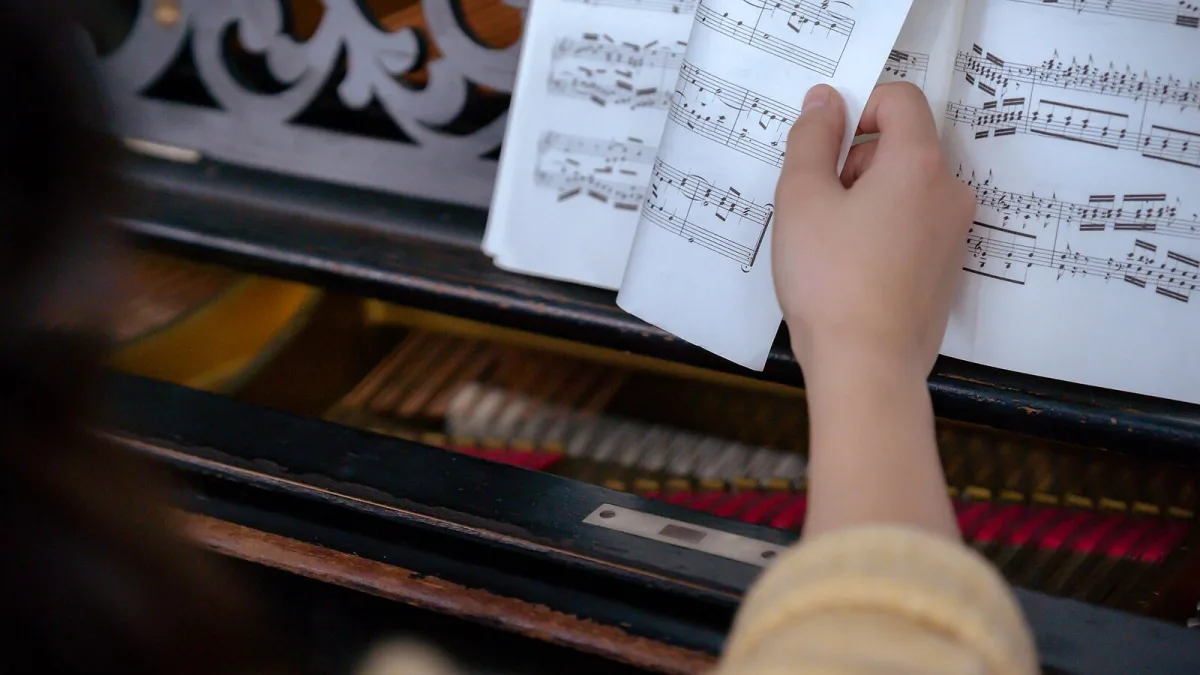
After years of teaching piano, certain patterns come up again and again — the same errors, the same habits that slow progress, the same frustrations that could have been avoided. Many of them relate directly to how learners engage with their notation, rather than their actual playing ability. This guide addresses the most common ones, so you can sidestep them and get on with what actually matters: the music.
Mistake 1: Choosing Music That Is Too Difficult
This is probably the most widespread error in piano learning, and it is entirely understandable. Everyone wants to play the piece they love. The problem is that working on music significantly above your current level tends to produce frustration, poor technique, and a sense of failure — none of which help you learn.
The honest test: can you play through a piece slowly, with both hands together, making only occasional small errors within a week of starting it? If not, it is probably too difficult for now. That does not mean you cannot work toward it — keep it as a goal, but find a stepping-stone piece at a more manageable level and build the skills it requires. Piano sheet music that is slightly challenging but achievable produces real, sustained progress.
Mistake 2: Skipping Hands-Separate Practice
Putting both hands together before either is independently secure is one of the most reliable ways to make slow progress. When you combine hands too early, both hands slow each other down, errors become entrenched, and the brain has to manage two insecure tasks simultaneously instead of one solid one.
The more methodical approach — and it does take patience — is to practise each hand until it runs cleanly before combining them. Once both hands are solid separately, combining them is usually much quicker than expected. Learners who work this way consistently progress faster than those who dive straight into two-handed playing.
Mistake 3: Ignoring Fingering
Fingering — which fingers you use for which notes — is not optional guidance printed on the score for decoration. It is the product of careful consideration by the editor, designed to allow smooth passage through the phrase. Ignoring it and using whatever finger falls naturally on a note often works in isolation but creates problems when the music moves on to the next bar.
Spend a few minutes working out fingering for tricky passages before you try to play them up to speed. Once you have committed to a fingering and played it repeatedly, it becomes extremely hard to change. Getting it right early saves a great deal of relearning later. If the printed fingering does not suit your hand size, find a consistent alternative — but do not leave it to chance.
Mistake 4: Practising Too Fast, Too Soon
Speed is the enemy of accurate learning. When you play faster than you can think ahead, errors get embedded and technical shortcuts become habits. Notes get missed, rhythms drift, and dynamics disappear entirely.
A useful rule of thumb: practise at the tempo where you can play every note correctly, every time. For many learners, this means starting much slower than feels comfortable — uncomfortably slow. Use a metronome. Set it at a tempo where accuracy is achievable, play through the passage five or ten times cleanly, and then increase by five beats per minute. This approach is slower in the short term and dramatically faster in the long term.
Mistake 5: Not Marking the Score
Some learners treat their notation as if it is precious and should not be written on. In a practice context, this is a mistake. Pencilling fingerings directly onto the score, circling passages that need extra attention, and marking dynamics you keep forgetting are all things experienced pianists do as a matter of course.
Use pencil so you can erase and revise as your playing develops. A heavily annotated score is evidence of thoughtful work, not carelessness. The only thing worth preserving without marks is a clean copy for performance — your practice copy is a working document.
Mistake 6: Ignoring Dynamics and Phrasing
When learners are working hard to get the right notes at the right time, the markings on piano sheet music that indicate volume (forte, piano, crescendo) and phrasing (phrase marks, slurs, staccato dots) often get left until later. The problem is that "later" frequently never arrives, and the piece gets learned with a flat, unexpressive delivery that becomes very hard to change.
Dynamics and phrasing are part of the music, not decoration. Try to incorporate them from the first slow run-through. Even a very simple dynamic shape — loud here, soft there — immediately makes a piece more musical and more satisfying to play. It also helps with memorisation, because the musical shape gives the brain something to organise the notes around.
Mistake 7: Only Playing Through, Never Stopping to Fix
There is a tendency among learners — particularly those who find stopping and repeating frustrating — to play through a piece from beginning to end rather than isolating and fixing the moments that go wrong. The effect is that the confident passages get over-practised and the difficult passages never improve.
A more effective approach: when something goes wrong, stop, identify the exact moment of difficulty, and work on just that bar or phrase in isolation. Play it slowly, correctly, five times in a row. Then put it back into context. Whole run-throughs are useful occasionally for seeing how a piece sits together; they should not be the primary mode of practice.
Mistake 8: Using Unreliable Sources
With so much notation available online, it is tempting to use whatever comes up in a search. Free transcriptions of copyrighted contemporary music are often inaccurate — poorly notated, incorrect in pitch or rhythm, and sometimes in the wrong key. Learning from an inaccurate score means learning the wrong piece.
For classical music, IMSLP provides reliable, properly engraved editions of standard repertoire — copyright has expired on the vast majority of the classical piano canon. For contemporary music, purchase from legitimate publishers (Musicnotes, Sheet Music Plus, publisher websites) and you will get accurate, professionally prepared scores. It is worth the small outlay.
A Note on Patience
Every one of these mistakes is driven by impatience — the urge to sound good quickly, to move on, to get to the interesting parts. Piano learning rewards a different instinct: the willingness to work slowly, carefully, and methodically on something manageable before reaching for something harder. The musicians who make consistent, sustainable progress are almost always the ones who have developed this quality of patience with themselves.
For a comprehensive introduction to finding and working with notation, the ultimate guide to piano sheet music covers the full landscape — grading systems, sources, and reading the basics.
Bottom Line
The mistakes above are all fixable, and recognising them is the first step. Choose piano sheet music at the right level, work hands separately, respect the fingering, practise slowly with a metronome, mark your score, and pay attention to dynamics from the start. None of these are particularly exciting prescriptions — but they work. The players who follow them are, without exception, the ones who improve most reliably over time.




Comments