


Tuning the Piano article
Tuning the Piano Explained: Features, Types and Tips
Chords losing their shine? Here's what piano tuning really involves, from equal temperament to why the top and bottom of the keyboard are deliberately “stretched”.
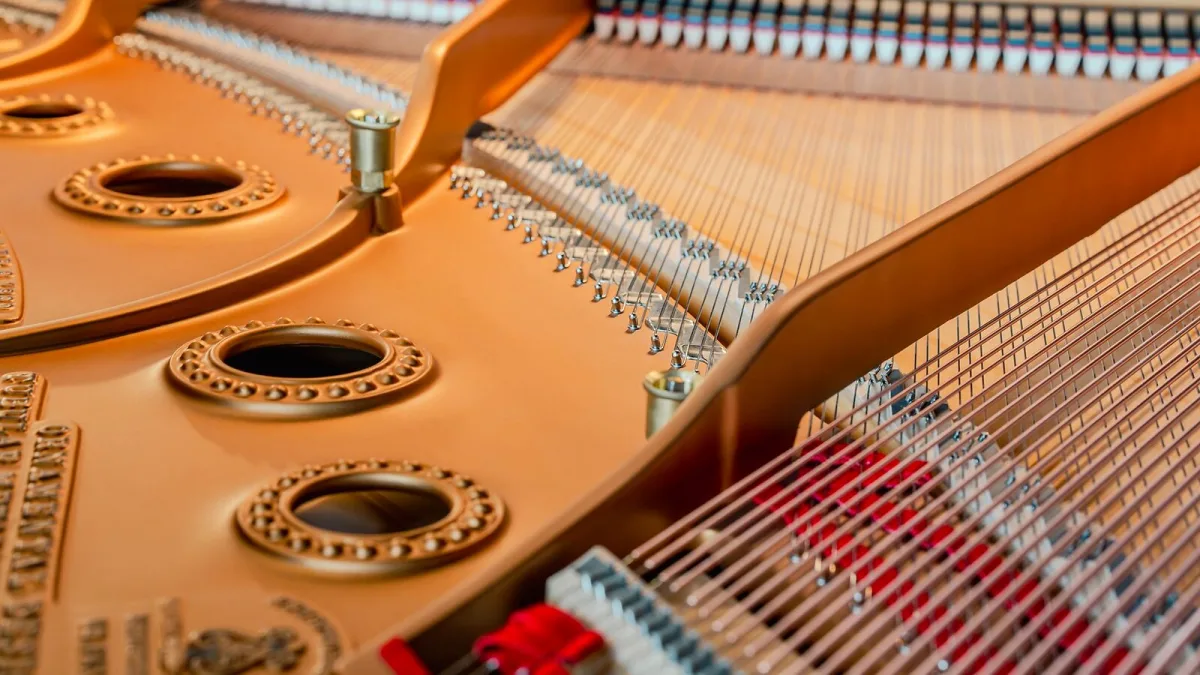
A piano that's fallen out of tune doesn't sound broken so much as tired — chords lose their shine, octaves waver, and even a simple scale can sound faintly off. Piano tuning is the maintenance job that puts that right: adjusting the tension in every string so the instrument's pitch is accurate and consistent from the bottom of the keyboard to the top. This guide explains what actually happens during a tuning, why it's more involved than turning a few pegs, and what's worth listening for between visits.
What Actually Happens When a Piano Is Tuned
Every note on a piano is produced by one, two or three tightly wound strings striking against a soundboard. Turning the tuning pin that anchors each string changes its tension, and therefore its pitch — tighter raises the note, looser lowers it. A technician works through the whole instrument with a specialised lever, listening for the exact point where each string sits at the correct frequency.
Most notes share their pitch across two or three strings, known as a unison. If you've ever heard a note that seems to "waver" or shimmer instead of ringing cleanly, that's usually a unison slipping out of step rather than the whole piano being wildly off. Bringing those strings back into close agreement is as much a part of piano tuning as setting the overall pitch.
Equal Temperament: The Modern Standard
Nearly every modern piano is tuned to twelve-tone equal temperament, which divides the octave into twelve identical semitones. It's a compromise: no single interval is left perfectly pure, but every key is playable and none sounds unusably sour. That's what lets a pianist move from C major to F sharp minor in the same piece without the instrument suddenly sounding wrong.
It wasn't always this way. Earlier keyboard temperaments — meantone, Werckmeister, Vallotti and others — distributed their compromises unevenly on purpose, giving certain keys a distinctive colour. You'll still hear these historical temperaments used for period performance and early-music recordings, but they're a specialist choice that needs agreement between performer and technician, not a default setting.
Why the Ends of the Keyboard Are "Stretched"
Here's something that surprises a lot of owners: a well-tuned piano isn't tuned to mathematically perfect octaves. Piano strings are stiff rather than perfectly flexible, so their overtones run slightly sharp compared with an ideal string — a property technicians call inharmonicity. Because the ear compares those overtones as much as the fundamental note, a mathematically exact octave can actually sound narrow on a real piano.
To compensate, technicians widen — or "stretch" — the octaves as they move away from the centre of the keyboard: the bass is tuned slightly flatter than pure equal temperament would suggest, and the treble slightly sharper. Exactly how much stretch a piano needs depends on its own scale design and string lengths, so there's no single curve that fits every instrument.
Aural Tuning vs Electronic Tuning
Most professional work today blends two approaches. Electronic tuning devices — the Sanderson Accu-Tuner is a well-known example — measure a piano's own inharmonicity and calculate a tuning curve customised to that instrument, which is a genuine advantage over a generic reference tone. But no screen can judge how a unison actually sounds, or whether a chord holds together musically across the keyboard. That's still down to a trained ear, which is why most technicians combine electronic measurement with aural judgement rather than leaning on either alone.
Curious whether you could ever try this yourself? Our beginner's guide to piano tuning and our step-by-step look at how a tuning session actually runs both go into that honestly.
Tuning, Voicing and Regulation Aren't the Same Job
"Tuning" gets used loosely to cover almost any piano service call, but it's only one part of keeping an instrument healthy. This table sets out how it differs from its two closest relatives.
| Service | What it adjusts | When it's needed |
|---|---|---|
| Piano tuning | String tension and pitch | Routine maintenance, typically twice a year |
| Voicing | Hammer tone and dynamic response | When the sound turns harsh, thin or uneven note to note |
| Regulation | The mechanical action — keys, hammers, dampers | When the touch feels uneven or notes fail to repeat cleanly |
A piano that's badly off pitch may also need a preliminary pitch raise — a rougher first pass bringing the whole instrument close to standard pitch — before a fine tuning will actually hold.
How Often Does a Piano Need Tuning?
Steinway & Sons, among others, recommends scheduling a visit "at a minimum of six-month intervals," and that twice-yearly rhythm is a sensible baseline for most households. An instrument that's played heavily, used for teaching, or kept somewhere with big swings in humidity and temperature may need more frequent attention, while a neglected piano that's drifted well off pitch can sometimes need more than one pass in the same appointment just to stabilise.
If you're weighing up what to look for when you book someone, our buyer's guide to piano tuning covers the practical side, and our round-up of the best options for the money compares DIY tools against professional visits.
The Bottom Line
Piano tuning is a precise, slightly counter-intuitive craft — it isn't just "getting all the notes right" but building a tuning curve suited to one particular instrument, its strings and the room it lives in. Understanding the basics won't make you a technician, but it will help you recognise when your piano needs attention, and ask sharper questions when it does.




Comments