


Keytar article
Keytar Explained: Features, Types and Tips
Part keyboard, part guitar — here's what a keytar actually is, where it came from, and how the self-contained and MIDI-controller types differ.

If you've ever watched an eighties concert clip and wondered why the keyboard player is striding across the stage with their instrument slung like a guitar, you've met the keytar. It's a genuine hybrid: keyboard on one end, guitar-style body and strap on the other. This guide explains what a keytar actually is, where it came from, and what to look for if the idea of playing keys while standing at the front of the stage appeals to you.
What Is a Keytar?
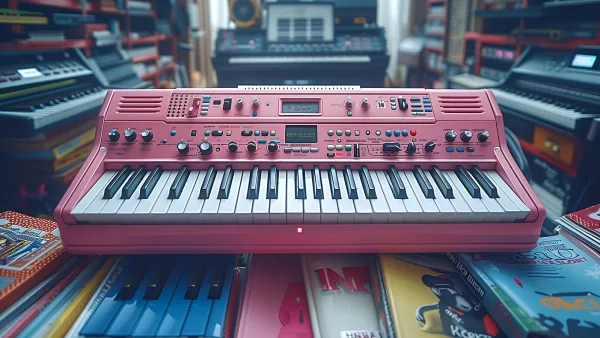
The name itself gives the game away — it's a portmanteau of "keyboard" and "guitar". A keytar is a keyboard instrument built to be worn on a strap and played standing up or moving around, rather than seated behind a stand. Broadly, keytars fall into two families:
- Self-contained instruments — with their own built-in synthesizer, so the sound comes straight out of the instrument.
- MIDI controllers — which send performance data to an external synth, sound module or computer rather than making sound themselves.
A Brief History of the Keytar
The instrument grew out of the portable-synthesizer boom of the late 1970s and early 1980s, when keyboardists began looking for the same stage presence guitarists had always enjoyed. The Moog Liberation, introduced around 1980–81, is widely regarded as one of the earliest commercially successful keytars, establishing the basic shape: a compact keyboard on a strap, with performance controls positioned near the player's left hand.
Through the 1980s the keytar became closely tied to the visual language of synth-pop, new wave and funk, with performers including Jan Hammer, Herbie Hancock, Howard Jones, Prince, Devo and Jean-Michel Jarre all associated with mobile keyboard performance, even if the exact instruments and models varied. Interest in the format tends to return whenever musicians revive that era's sound or want a more physically engaged live show.
Keys, Range and Expression
Most keytars use 37 or 49 keys, rather than the 61 or 88 you'd find on a stationary keyboard. Thirty-seven keys keep the instrument light and easy to swing around; forty-nine gives you more room for melodies and chords at the cost of a little extra bulk. Look out for these performance controls, which matter more on a keytar than on a keyboard you never move:
| Control | What it does |
|---|---|
| Pitch bend | Glides notes up or down for expressive lead lines |
| Modulation | Adds vibrato or filter movement |
| Ribbon controller | A touch-strip for pitch or parameter control without leaving the keys |
| Aftertouch | Responds to extra pressure after a key is pressed, for evolving sounds |
| Program/octave buttons | Change sounds or shift range mid-song |
Not every model offers every control — Korg's RK-100S 2, for example, is specified without aftertouch, while Roland's AX-Edge includes it, alongside a vocoder and microphone input for vocal effects layered over the keys.
Self-Contained or MIDI Controller?
A self-contained keytar, like the RK-100S 2 with its internal synthesis engine, is genuinely simpler on stage: switch it on and you have sound. A MIDI-controller keytar is lighter and more flexible, but only as good as the sound module or computer it's plugged into, and it introduces one more link in the chain that can fail on a gig night. Neither approach is wrong — it depends on how much you want your rig to do on its own.
Connectivity and Battery Life
Beyond the keys, check what a given keytar can actually connect to: MIDI output for external gear, audio output for a mixer or amp, a headphone jack for quiet practice, and sometimes a microphone input for vocoder effects. Battery operation is common and genuinely useful on an instrument you're wearing — one less cable to trip over — with something like eight hours from a set of alkaline cells being typical, though always worth confirming for the specific instrument you're considering.
Not Just a Stage Prop
It's easy to dismiss the format as pure spectacle, and a keytar does trade away some practicality — a smaller key range, less physical stability than an instrument on a stand, and a bit more fatigue over a long set. But the trade genuinely changes what a performer can do: moving to the front of the stage, facing the audience directly, and bringing keyboard parts into the same physical space as the guitarist and singer. That's precisely why the format has never quite gone away, even outside its 1980s heyday.
Where You'll Hear One Today
Away from the 1980s revival circuit, you'll find the format wherever a performer wants a keyboard sound at the front of the stage rather than tucked behind an amp: touring pop and rock acts, theatrical productions, and electronic artists building a more physical, guitar-like show around synthesizers and vocoders. Manufacturers such as Roland and Korg continue developing current models rather than treating the design purely as nostalgia, adding wireless operation, expressive controllers and onboard synthesis aimed at real stage use rather than novelty value alone.
The Bottom Line
Understood properly, a keytar isn't a novelty item bolted onto a keyboard — it's a deliberate trade of range and stability for mobility and stage presence. If you're now weighing up buying a keytar, our buyer's guide and round-up of the best options go into the practical choices, while our beginner's guide and common mistakes to avoid are worth a read before your first gig with one.




Comments