
Read next

Pianos & Keyboards Article
How Many Keys Are on a Piano Keyboard?
Why a piano has 88 keys, how the repeating pattern of black and white keys works, and whether a 61-key or 76-key instrument is enough for what you want to play.
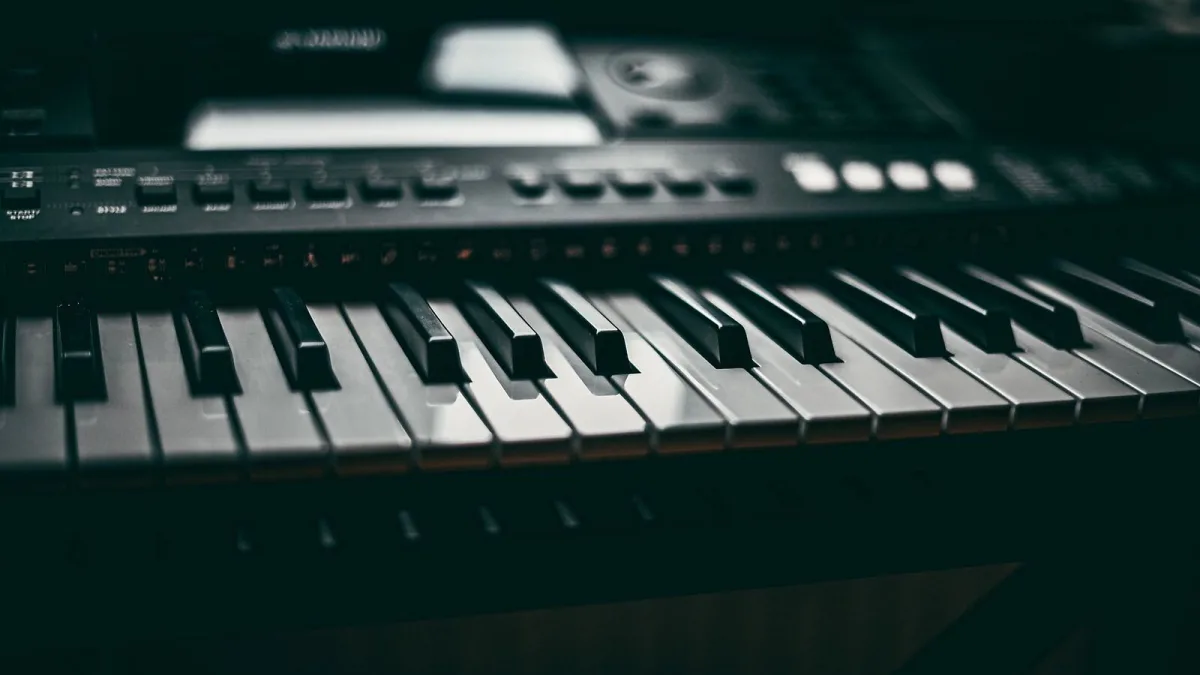
A full-size acoustic piano has 88 keys: 52 white and 36 black. They run from the A below the lowest C, written as A0, up to the highest C, written as C8, which is a little over seven octaves. That number has been the standard for well over a century, and understanding why makes the rest of the keyboard easier to read.
The repeating pattern
Western music divides the octave into twelve steps, called semitones, and the keyboard lays those twelve steps out in a pattern that repeats all the way up. Within each repetition there are seven white keys and five black keys.
The black keys are grouped in twos and threes, and that grouping is the navigation system. The white key immediately to the left of any group of two black keys is a C. Once you can find C anywhere on the instrument, you can find every other note by counting from it, which is why pianists can play an unfamiliar keyboard in the dark.
Middle C
Middle C, written C4, sits near the centre of an 88-key instrument and is the note standard notation is built around: it is the ledger line between the treble and bass staves. On a smaller keyboard it will not be physically in the middle, so look for the pattern rather than the position.
Why black keys have two names
The black key between C and D can be called C sharp or D flat depending on the key of the music. They are the same key on the piano but different names, chosen so that written music stays readable. This is called an enharmonic equivalent, and it is one of those ideas that seems pedantic until you start reading in keys with several sharps or flats.
Why 88?
The range settled where it did because it comfortably covers essentially everything composers wrote for the instrument. Earlier pianos had considerably fewer keys, and as composers wrote to the edges of the available range, makers extended it. Eighty-eight turned out to be past the point of diminishing returns: the highest and lowest notes are already at the limits of where the ear distinguishes pitch clearly. A handful of extended-range concert grands add extra keys at the bass end, but they remain unusual.
How many keys do you need?
Digital keyboards come in several standard sizes, and the right one depends entirely on what you intend to play.
- 88 keys. The full range. Necessary for classical repertoire, for anyone taking graded exams, and for anyone who wants what they practise on to match what they will sit down at elsewhere.
- 76 keys. Covers the great majority of pop, rock and jazz parts while being meaningfully lighter and shorter. A sensible compromise for a gigging player.
- 61 keys. Five octaves. Fine for learning, for songwriting and for most synth and organ parts, but you will run out of room in classical pieces.
- 49 keys and smaller. Really studio controllers rather than instruments to learn on, though very convenient for programming and for small spaces.
Key count is not the whole story
How the keys feel matters as much as how many there are. On an acoustic piano each key throws a hammer at a string, and the weight you feel is that mechanism. Digital instruments imitate it to varying degrees:
- Fully weighted or hammer action reproduces that resistance most closely and is what to look for if you will ever play an acoustic piano.
- Semi-weighted adds some resistance to a sprung key, a middle ground often found on stage keyboards.
- Synth action is light and fast, which suits organ and synth playing but builds none of the finger strength piano technique depends on.
Touch sensitivity is the other thing to check: the keyboard should play louder when you strike harder. Without it, dynamics are impossible, and dynamics are most of what makes piano playing expressive.
In short
Eighty-eight keys, 52 white and 36 black, built from a twelve-note pattern that repeats roughly seven times. If you are buying to learn seriously, weighted keys matter more than any other feature, and an 88-key instrument removes the question of whether you will outgrow it.



Comments