


Alesis Keyboard article
Alesis Keyboard for Beginners: A Complete Guide
Good habits established in the first few weeks are the foundation of piano playing — this guide walks through setup, posture, hand position and the first practical exercises in order.
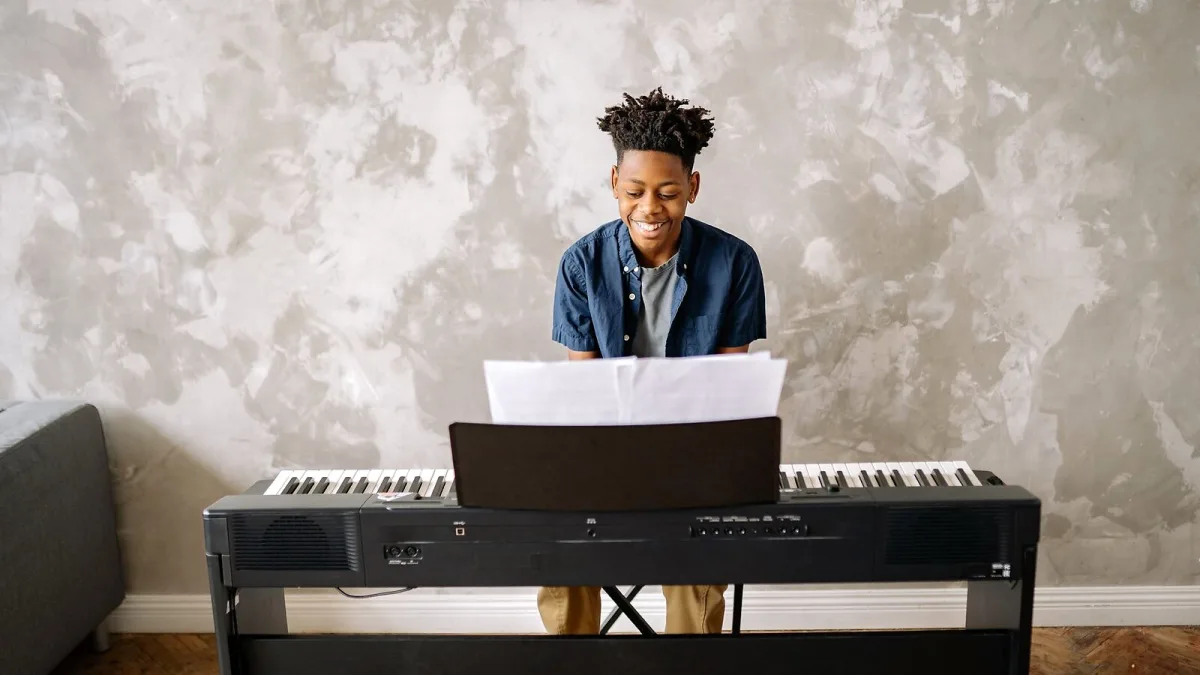
Learning to play an Alesis keyboard follows the same path as learning any keyboard instrument — good posture, correct hand position, understanding of how the keys relate to written music, and consistent daily practice. Every technique you develop on an Alesis keyboard transfers directly to acoustic playing. What the instrument itself offers is a starting point that is more accessible and less expensive than an acoustic piano, with enough tactile response (on the Recital and Recital Pro) to build technique that transfers to acoustic playing later.
This guide assumes you have a Recital or Recital Pro — the Alesis keyboard instruments most appropriate for genuine beginners — and covers the practical first steps from setting up to making your first sounds.
Setting Up the Instrument
Position the instrument at a height where your forearms are approximately level with the keyboard surface when seated. A piano stool or height-adjustable chair is ideal; a dining chair that puts you too low forces poor wrist angle. Sit centrally — the middle D of a 61-key instrument should be in front of your body's midline. If using the Recital Pro, connect headphones or an amplifier before switching on, as the instrument has no built-in speakers. Connect a sustain pedal to the pedal input if available — nearly all piano music uses the sustain pedal, and establishing this habit from the start matters.
Connect the power adaptor and switch on at the instrument's power button. The Recital and Recital Pro both power on with a piano voice selected by default — no additional setup is needed to start playing. If connecting via USB to a computer for use with apps or a DAW, the connection is class-compliant (plug and play on most operating systems).
Hand Position and First Notes
Correct hand position on an Alesis keyboard is the same as on any piano: curved fingers, relaxed wrists, thumbs resting lightly on the keyboard surface rather than extending outward. The keys should be pressed from the finger tip's slightly rounded pad, not the flat. Avoid collapsing the knuckle joints — the hand should look as if it is resting over a ball. This position is not intuitive at first and requires conscious attention until it becomes habitual — typically two to four weeks of daily five-minute practice.
Start with Middle C (the C nearest the centre of the keyboard). Learn its position, play it with the right thumb, then learn the C major scale (C-D-E-F-G-A-B-C) using fingers 1-2-3-1-2-3-4-5. This scale, on a single hand, is the basis of most beginner-level piano exercises and teaches finger independence and thumb-passing technique at the same time.
Using the Built-in Features
An Alesis keyboard in the Recital range includes a metronome function accessible from the instrument's front panel. Use it from the first session — playing in time develops internalised rhythm, which is harder to correct later than technique. Start at 60 BPM or slower and practise at that tempo until the passage is comfortable before increasing. The layer function (available on both Recital models) lets you combine two voices simultaneously — a useful feature for exploring texture, but one to use sparingly when practising technique since it can mask imprecision.
How to Get Started on an Alesis Keyboard
- Set up the instrument at the correct height and position — sit centrally with forearms approximately level with the keyboard surface; use a height-adjustable stool rather than a fixed-height chair for the correct seated position.
- Connect headphones or an external amplifier if using the Recital Pro — the Recital Pro has no built-in speakers; set up your monitoring before powering on.
- Plug in a sustain pedal to the dedicated input — most piano repertoire uses the sustain pedal; establish this habit from the first session rather than adding it later.
- Learn the correct hand position before playing any pieces — curved fingers, relaxed wrists, upright knuckle joints; practise holding this position over the keys for a minute before each session until it becomes natural.
- Start with Middle C and the C major scale on one hand — this establishes the most important positional and thumb-passing skill before any music reading is needed.
- Switch on the metronome and practise at 60 BPM or slower — playing slowly and accurately develops correct technique; practising quickly with mistakes embeds errors that take much longer to correct.
For a full comparison of Alesis models before buying, our buyer's guide covers every decision. Our features overview explains the specifications in detail.





Comments