


Math Rock article
The History of Math Rock
From disputed post-punk precursors to Louisville, Pittsburgh, Chicago and beyond, here's how math rock's scattered history actually fits together.
Every genre has a moment where the label sticks, even if nobody involved was thinking about labels at the time. Math rock's story runs through the American underground of the late 1980s and early 1990s, pulling from post-punk, hardcore, progressive rock and jazz before settling into something distinct enough to earn its own name. Here's how it actually came together.
Before the Name Existed
Depending on which history you read, the roots go back further than the genre's usual starting point. Some accounts trace early stirrings to mid-1980s post-punk experimentation — Black Flag's My War, along with bands like Nomeansno and Massacre, are frequently cited as important precursors, using abrupt dynamics and rhythmic disruption that would later become genre hallmarks. Others place the genre's real emergence firmly in the early 1990s. Both readings have a point: this wasn't a single invention so much as several scenes independently arriving at similar ideas.
Louisville's Quiet Bombshell
Louisville, Kentucky's Slint released Spiderland in 1991, and it remains one of the genre's most cited foundational records — tense, asymmetrical and dynamically unpredictable in ways that few rock records had attempted before. Its influence stretched well beyond math rock itself into post-rock and quiet/loud indie songwriting more broadly, but within the genre's own history it's treated as close to a founding text.
Pittsburgh's Precision Machine
Where Slint dealt in space and tension, Don Caballero, out of Pittsburgh, went the other direction entirely: intricate, technically demanding guitar-and-drum interplay built on syncopation and relentless precision. Don Caballero became one of the genre's defining instrumental acts, and their approach — treating the drums as a lead voice rather than mere accompaniment — shaped how a generation of bands thought about rhythm section writing.
Chicago's Wider Lens
Meanwhile in Chicago, Tortoise were blending post-rock, minimalism, jazz and electronic textures with a rhythmic sophistication that overlapped heavily with what its guitar-driven peers were doing, even if the results sounded quite different on the surface. Tortoise's presence is a useful reminder that the genre's boundaries were porous from the very start — plenty of bands moved fluidly between labels depending on who was doing the classifying.
The Genre Splinters
By the late 1990s and into the 2000s, math rock's core ideas had scattered into genuinely different directions:
- Battles took interlocking rhythm into more electronic, loop-based, studio-oriented territory.
- Hella, a Sacramento duo, pushed guitar-and-drums interplay to extremes of speed and density.
- American Football, with their self-titled 1999 album, connected math-rock-derived clean guitar writing to emo and indie rock, helping define what later became known as Midwest emo.
That American Football record is worth dwelling on. It's commonly cited as a crossover moment rather than a straightforward math-rock album — the emotional, vocal-led songwriting sits alongside intricate instrumental parts, and it's more accurate to call it a bridge between scenes than proof that emo and math rock are simply the same thing.
Going International
The genre's influence didn't stay confined to the American underground. Japan in particular developed a strong, internationally recognised instrumental rock scene, with bands like toe bringing detailed guitar writing, melodic phrasing and sophisticated drumming to an audience well beyond their home country. Whether Japan currently hosts the "biggest" such scene isn't something the available evidence firmly settles, but its importance to the genre's ongoing life is not in serious doubt.
Crossovers That Kept the Story Moving
None of this history stayed in a neat box, and that's part of why it's genuinely interesting to trace. Tera Melos, out of Sacramento, pushed the same rhythmic ideas into noise and improvisation. Bands like At the Drive-In brought angular, rhythmically unstable playing into post-hardcore without ever fully signing up to the label, while Minus the Bear picked up related guitar techniques despite mostly staying in conventional meters. June of 44 sat within the same loose network of post-hardcore and instrumental bands trading ideas across scenes. None of these acts are interchangeable, but their overlapping influences show how porous the whole underground network really was.
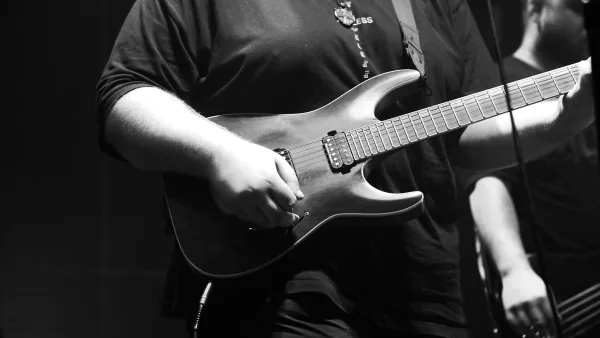
Instruments and setups told a similar story of overlap. Bands typically leaned on two electric guitars, bass and drums, favouring bright, articulate tones over heavy distortion so that interlocking parts stayed distinguishable rather than blurring into mush. Delay, reverb and looping turned up often, tapping-friendly guitar necks became common, and no single amplifier or pedal ever came to define the sound the way a few guitar tones define, say, shoegaze.
Why the History Stays Contested
Ask five people when math rock actually began and you may get five different, defensible answers. Some histories foreground Slint and Don Caballero as the true starting point; others give equal or greater weight to earlier post-punk and progressive-rock precursors. The genre was never trademarked or formally declared, which is exactly why its origin story keeps shifting depending on who's telling it.
The Bottom Line
From Louisville's tension to Pittsburgh's precision to Chicago's wider palette, math rock's history is really a story of several scenes discovering overlapping ideas at roughly the same time. For a plainer explanation of what actually makes the genre tick, our beginner's guide is the place to start, and our guide to the genre's best artists covers the bands mentioned here in more depth. If you'd like to hear where the story led musically, our essential albums guide is the natural next stop.




Comments