


Math Rock article
A Beginner's Guide to Math Rock
Interlocking rhythms, odd meters and instrumental interplay explained simply, so you know exactly what you're listening for.
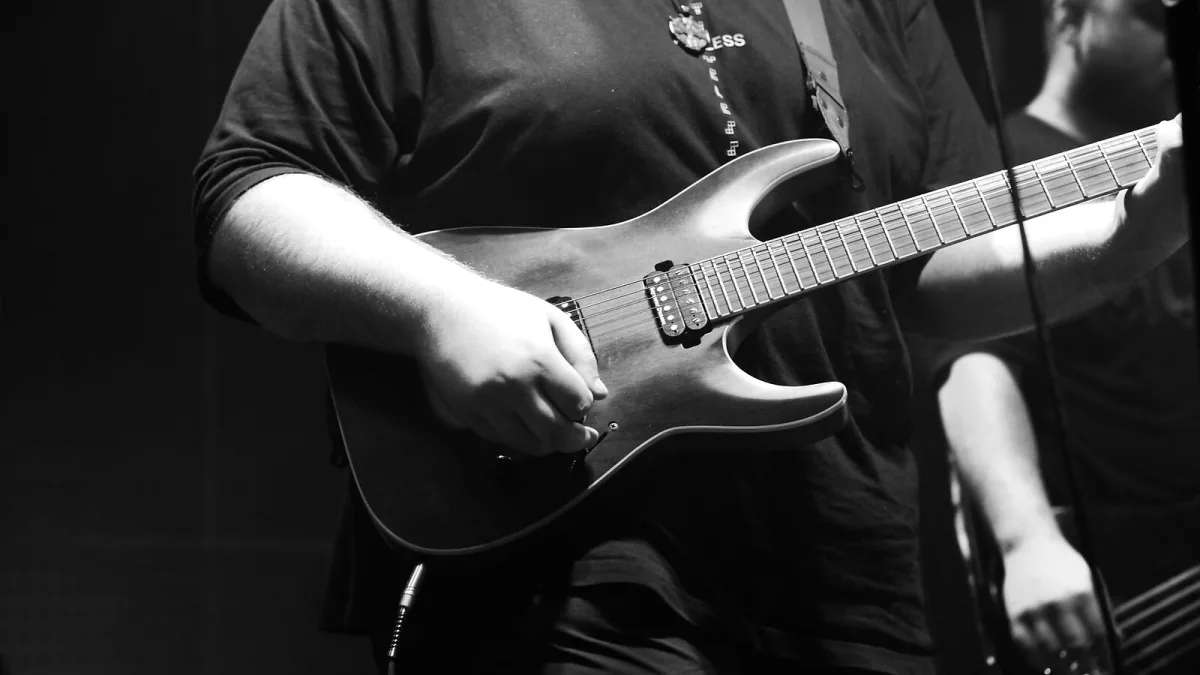
There's a particular thrill in hearing a band lock into a rhythm that shouldn't work on paper and somehow feels completely natural. That's math rock in a sentence: a strand of experimental rock built around interlocking rhythms, odd meters and instrumental interplay, where the beat itself becomes as important as any riff or vocal line. It's less a tightly defined genre than a way of thinking about how a band's parts fit together.
What Actually Makes It Tick
The name isn't about formal mathematics — it's a nod to how calculated and structurally intricate the music can sound. Bands build songs from interlocking rhythmic units: one guitar might repeat a five-beat figure, the bass emphasises a different grouping entirely, and the drums imply yet another pulse underneath. Eventually the parts realign into a larger cycle, and that moment of alignment is often the whole point of the song.
Crucially, math rock doesn't require constant odd time signatures to qualify, and a song doesn't need to sound overtly technical either. Some of the genre's most loved records are quiet, melodic and emotionally direct rather than showy. What unites them is a sense that rhythm and interaction between instruments are compositional tools in their own right, not just a backdrop for a tune.
Where It Came From
Math rock grew out of the American underground in the late 1980s and early 1990s, and its exact starting point is genuinely disputed — some histories trace it to mid-80s post-punk experimentation, others to a more clearly defined early-90s movement. Either way, it drew on several overlapping traditions at once:
- Progressive rock — odd meters, extended forms, instrumental ambition.
- Post-punk and art rock — angular guitar writing and a resistance to conventional song structure.
- Hardcore and noise rock — abrupt dynamics and rhythmic disruption.
- Minimalism — repeated patterns that gradually shift and reconfigure.
- Jazz and fusion — syncopation, polyrhythm and musicians genuinely listening to each other.
What You'll Actually Hear
A handful of devices turn up again and again once you know to listen for them:
| Device | What it sounds like |
|---|---|
| Metric displacement | A repeated riff stays the same while the accent shifts against the bar |
| Polyrhythm | Two or more patterns implying different pulses at once |
| Stop-start structure | The whole band cuts off together, making silence part of the groove |
| Tapping | Both hands used on the fretboard for rapid, wide-ranging guitar patterns |
| Alternate tunings | Ringing open strings and unusual chord shapes |
| Counterpoint | Guitar, bass and drums acting as independent voices rather than doubling one riff |
Math Rock and Its Neighbours
It sits close to a few other styles, and the boundaries genuinely blur:
- Versus progressive rock: prog tends to foreground long-form composition, virtuosity and orchestration; math rock leans harder into tight rhythmic interaction and stripped-down rock instrumentation.
- Versus Midwest emo: the two overlap heavily in clean guitar arpeggios and unusual tunings, but Midwest emo typically places more weight on vocal expression and introspective songwriting.
A Word on Odd Time Signatures
You'll hear terms like 5/4 or 7/8 thrown around a lot, and they're less intimidating than they sound. A time signature just tells you how many beats sit in a bar and what note value counts as one beat. In 5/4, players usually feel the bar as a group of three beats followed by a group of two — count it as "ONE-two-three, ONE-two." In 7/8, a common grouping is two-two-three, counted as "ONE-two, ONE-two, ONE-two-three." The grouping shapes the feel far more than the raw number does, which is why two songs can technically share a time signature and sound completely different.
You don't need to count along to enjoy any of this, for what it's worth. Plenty of listeners simply feel the pattern lock into place without ever doing the arithmetic, and that's a perfectly valid way in. Musicians tend to approach it the other way round, building fluency in straightforward 4/4 first before layering odd groupings on top, one small step at a time rather than all at once.
The Gear Behind the Sound
There's no single guitar or pedal that defines the genre. Most bands favour clear, articulate tone over heavy distortion, since overlapping rhythmic parts need to stay separable rather than blur together. Delay and reverb can emphasise repeating patterns nicely, but too much ambience muddies the very interlocking detail that makes the music work in the first place.
How to Actually Listen to It
Next time a track pulls this trick, try asking yourself a few simple questions rather than analysing every bar. Where's the main pulse sitting? Are the accents genuinely shifting the meter, or just moving around within a stable one? How do the guitar parts relate to each other — are they doubling up, or running independently? Is the bass reinforcing the guitar, or quietly doing its own thing underneath? And when the band suddenly stops together, what does that silence do to the groove? None of these questions have a "correct" answer waiting at the end. They're just a way of training your ear to notice what's actually happening, which, honestly, is most of the fun.
The Bottom Line
It rewards close listening more than almost any other rock subgenre — the pleasure is in noticing how the parts fit. If you want the full story of how it developed, our history of math rock traces it from its post-punk roots onward, and the best math rock artists to know introduces the bands who defined it. If you'd rather just start listening, our newcomers' guide is the gentler way in.




Comments