


Synth Pop article
A Beginner's Guide to Synth Pop
That icy melody, that robotic-but-danceable pulse — here's what actually makes a song synth-pop, and where the sound came from.
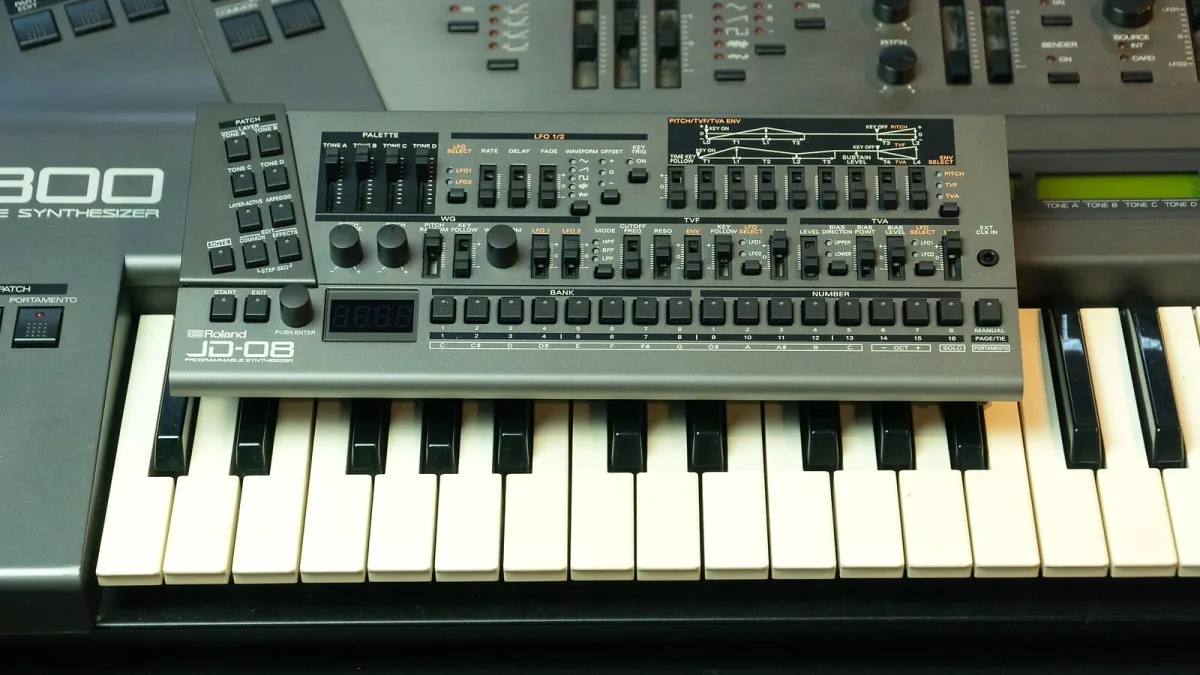
Synth-pop is one of those genres everyone can hum before they can define. That icy little melody, that robotic-but-somehow-danceable pulse, that sense of a song being built rather than played — it's instantly recognisable and surprisingly slippery to pin down. So let's actually pin it down.
What Actually Makes a Song Synth-Pop?
Strip it back to its bones and you find three things working together. First, proper pop songwriting — memorable melodies, tight structures, a chorus that lands. Second, electronic arrangement — synthesizer hooks, programmed or electronic drums, sequenced basslines, synthetic textures doing the job guitars and live drums usually do. Third, a distinctive mood — futuristic, romantic, detached, sometimes faintly dystopian, depending on who's behind the desk. Miss any one of those three and you've usually drifted into a different genre entirely.
The Toolkit: Synths, Drum Machines and Sequencers
Most of this sound comes from subtractive synthesis — you start with a harmonically rich waveform from an oscillator, then shape it with a filter, an envelope and often an LFO for movement. You don't need to understand the maths to hear the results: a typical bassline is usually simple and repetitive, built to sit tightly with the kick drum; leads tend to be melodically direct rather than showy; pads fill space without ever burying the vocal. It's economical music by design — every part earns its place, and adding more layers isn't automatically an improvement.
Where It Actually Came From, Briefly
Synth-pop didn't arrive from nowhere in 1980. Kraftwerk's machine-like repetition, Giorgio Moroder's sequenced disco basslines, Wendy Carlos's expressive electronic scoring and Yellow Magic Orchestra's pop experimentation all fed into it, alongside the art-rock electronics of Roxy Music and David Bowie. British post-punk musicians, increasingly able to afford synthesizers, picked up the thread and ran with it between roughly 1979 and 1984. Our full history of the genre covers that story properly if you want the whole arc.
The Sound in Practice
| Artist | What their sound is like |
|---|---|
| Gary Numan | Stark, severe, deliberately mechanical |
| The Human League | Minimal hooks, accessible and direct |
| Depeche Mode | Increasingly dark, rich and elaborate |
| Duran Duran | Polished, rhythmic, thoroughly commercial |
| Pet Shop Boys | Precise, programmed, quietly witty |
Notice how differently these acts use the same basic tools. That's the point — it's a broad label, not a strict production formula. For a proper rundown of who to actually listen to, our guide to the best artists in the genre goes much deeper.
This Genre's Cousins
You'll often see synth-pop mentioned alongside electropop, synthwave, futurepop and electroclash. These are related — they share the same electronic DNA — but they're not identical to the classic early-1980s sound, and treating them as interchangeable will get you some funny looks from genre purists. Our breakdown of its subgenres untangles exactly where the lines sit.
Why It Still Matters
Synth-pop's biggest legacy isn't any single hit — it's the idea that a synthesizer could be the lead instrument in mainstream pop, not just a novelty sound effect. That idea runs straight through electropop, dance-pop and most modern chart production. If you're ready to actually start listening, our newcomer's starting guide gives you a proper first path in, and our pick of essential albums is there once you're hooked.



Comments