


Gregorian Chant article
A Beginner's Guide to Gregorian Chant
A single line of melody floating up into a stone church with no accompaniment at all. Here's a gentle introduction to Gregorian chant, one idea at a time.

If you've ever stepped into an old stone church and heard a single line of melody float up into the roof with no accompaniment at all, you've probably heard something close to this tradition. It can sound mysterious at first, but it's built on a few simple ideas, and once you know them, the rest opens up gently.
What It Actually Is
Gregorian chant is a body of unaccompanied sacred song used in the Roman Catholic liturgy, sung in Latin, with everyone performing the same single melodic line together rather than singing in harmony. Despite the name, it wasn't personally written by Pope Gregory I — the repertoire grew gradually over centuries, shaped by earlier Roman and Frankish traditions, and was passed down by memory long before it was written on paper.
Don't worry if that feels like a lot at once. The main thing to hold onto is this: one melody, one voice or many voices singing it together, no instruments, and words that shape where the melody goes.
Where You'll Actually Hear Gregorian Chant
This isn't concert music written to be admired from a seat — it has a job to do inside the Mass and the Divine Office (the church's daily round of prayer). You'll find it at the entrance of Mass, between the readings, before the Gospel, during Communion, and running right through the Kyrie, Gloria, Credo, Sanctus and Agnus Dei. Knowing that helps explain why it sounds the way it does — it's there to serve the words and the moment, not to show off.
Three Simple Gregorian Chant Textures to Listen For
You don't need any music theory to start noticing this. Just listen for how many notes sit under each syllable:
- Syllabic — roughly one note per syllable, easy to follow the words
- Neumatic — a small handful of notes per syllable, a little more decorated
- Melismatic — many notes stretched over a single syllable, often quite beautiful and free
A single chant can move between all three, so don't expect one texture to last the whole piece.
Reading the Notation, Gently
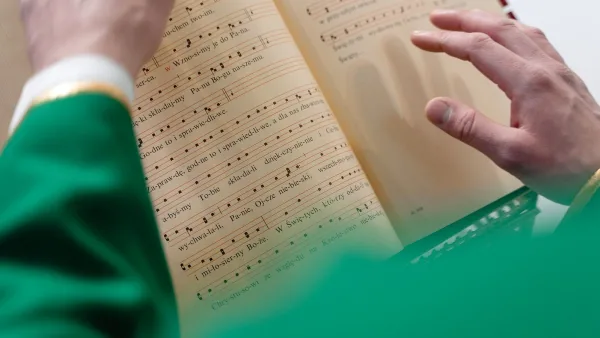
Older chant books use square notes on a four-line staff rather than the five-line staff you might already know. It looks unfamiliar at first, but the logic is simple: the shapes show pitch and grouping, a small sign called a custos hints at the next note coming at the end of a line, and a C or F clef tells you where "do" sits. You really don't need to master this on day one — just knowing it exists takes away most of the mystery.
A Gentle First Listening Method
- Choose a short, mostly syllabic chant to begin with.
- Read the Latin text aloud first, slowly, before you listen.
- Notice where the phrases naturally end and where you'd take a breath.
- Listen without expecting a regular beat — let the words lead.
- Play it again and see how much more you notice the second time.
The Solesmes Story, in Brief
Much of what we hear today comes down to one abbey. The monks of Solesmes, in France, spent well over a century studying old manuscripts and rebuilding a performance tradition that had drifted over time. Their editions and their gentle, flowing style of singing became the reference point most people picture when they imagine plainchant — though scholars still debate the finer points of rhythm, and other approaches exist too.
A Word on Latin
Don't let unfamiliar Latin put you off. Most communities use ecclesiastical Latin, an Italianate pronunciation that's genuinely not hard to say aloud once you've heard it a few times. Reading the text before you listen, as suggested above, does most of the work — you're not learning a foreign language, just learning to say a handful of words clearly and calmly.
The Bottom Line
Give yourself permission to find Gregorian chant strange at first. It rewards patience rather than quick judgement. Once you're ready to meet the people and communities who kept it alive, our guide to the best artists to know is a natural next step, and our newcomer's listening guide offers a calmer, more practical way in if you'd rather just press play.



Comments