


Breakbeat article
A Beginner's Guide to Breakbeat
The breakbeat is the sound of a drum pattern that doesn't behave itself — and it generated decades of innovation. Here's the essential guide to what it is, where it came from and what it became.
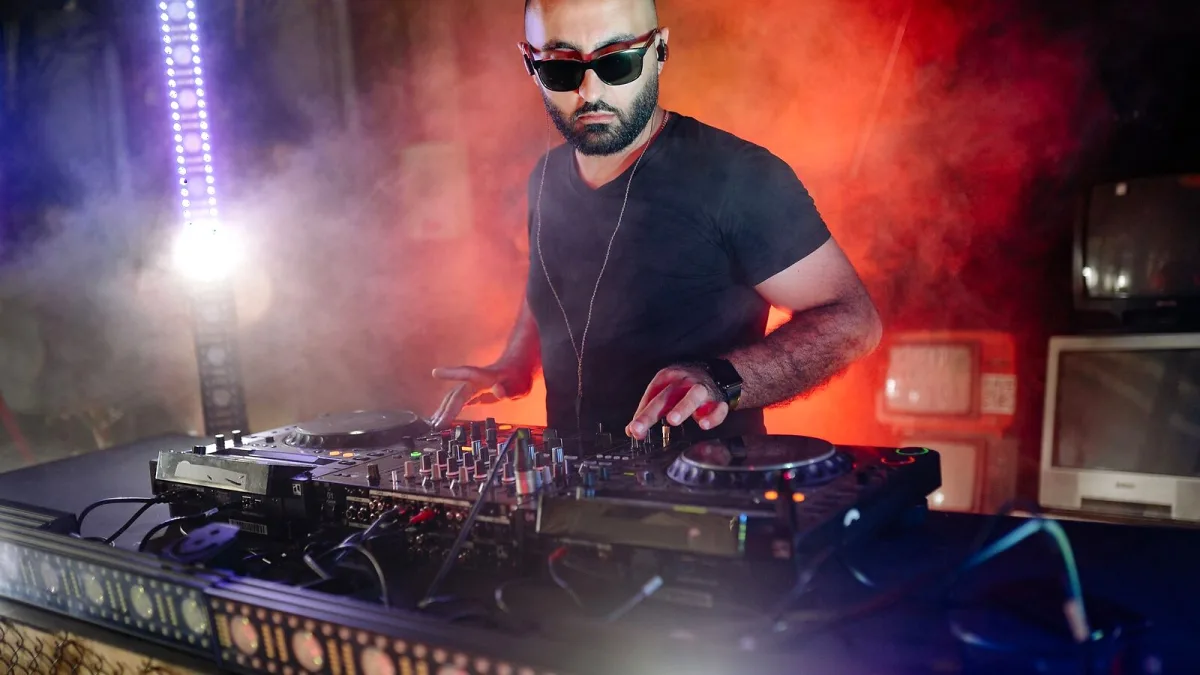
The breakbeat is the sound of a drum pattern that doesn't behave itself — syncopated, swinging and full of gaps where you expect a beat to be. It is both a specific rhythmic technique and the umbrella for a whole family of electronic and hip-hop music built around it. If you've heard jungle, drum & bass, big beat, hip-hop or trip-hop and wondered what they have in common, the answer is usually this rhythmic idea.
What Is a Breakbeat?
In its simplest form, this is a drum pattern taken from — or modelled on — the break section of a funk, soul or jazz recording. The "break" is the moment in a track where the arrangement strips back and the drummer is heard most clearly, often with most other instruments dropping out.
DJs noticed these sections worked brilliantly for dancers. Producers noticed they could be sampled, looped and built upon. What started as a DJ technique became the rhythmic foundation of entire genres.
The key characteristic is syncopation — accents falling between rather than on the main beats of the bar, creating a swinging, restless feel rather than the steady thud of four-on-the-floor dance music. The two things are genuinely different. Four-on-the-floor is clockwork; breakbeat swings.
Where Did Breakbeats Come From?
The origin story centres on DJ Kool Herc in the Bronx in the early 1970s. Herc developed a technique where he used two copies of the same record to extend the break indefinitely, switching between turntables as the section ended on one. This let breakdancers keep moving without the music moving on. He called it the merry-go-round technique.
The records themselves were largely funk and soul — James Brown, Jimmy Castor, Sly and the Family Stone. Their drummers had played with loose, human timing and plenty of swing, and that organic feel is exactly what made their breaks so valuable.
The Amen Break
No discussion of the genre is complete without mentioning the Amen Break — a roughly six-second drum passage from The Winstons' 1969 recording "Amen, Brother." It was sampled so extensively across hip-hop, jungle and drum & bass that it became one of the most recognised rhythmic patterns in electronic music history. The same looped snare roll, kick hits and cymbal shuffles appear across decades of records, pitched up, slowed down, chopped and filtered in every direction imaginable.
Breakbeat in the Studio
Affordable sampling technology changed everything. Machines like the Akai MPC60 and the E-mu SP-1200 in the 1980s let producers capture a drum break, slice it into individual hits, and rearrange, pitch and loop those slices. The break was no longer just a section of someone else's record — it became raw material for entirely new compositions.
Modern producers work the same way in software. A drum loop is loaded into a DAW, sliced at each hit transient, and the individual slices rearranged, filtered, compressed and layered. The goal isn't to replicate the original recording; it's to use that drummer's feel as the rhythmic engine for something new.
The Genre Family Tree
From that single technique came a remarkable range of genres:
- Hip-hop: The origin point. Looped breaks beneath rapping and sampling.
- Electro: Drum patterns with machines and synthesizers. More robotic, more mechanical.
- Breakbeat hardcore: The UK rave scene circa 1991–93. These rhythms running fast beneath warehouse-style synthesizers, stabs and piano riffs.
- Jungle: Pitched-up, chopped and processed breaks. Heavy sub-bass. A specifically British genre that emerged from breakbeat hardcore around 1993–94.
- Drum & bass: A later, often more polished development of jungle. Wider range of tempos and moods.
- Big beat: Slower, heavier, more aggressive grooves aimed at festival crowds. The Chemical Brothers, Fatboy Slim.
- Trip-hop: Downtempo, atmospheric rhythms from Bristol. Portishead, Massive Attack, Tricky.
- Breakcore: Extreme, high-tempo, heavily fragmented break manipulation.
All of these use the underlying rhythm differently — different tempos, different production aesthetics, different cultural contexts — but the rhythmic principle is shared. For a more detailed look at how the branches developed, see breakbeat subgenres explained.
What Makes a Breakbeat Sound Human?
Four-on-the-floor drum machine programming is precise to the grid. A breakbeat from a live drummer is not. Even when a break is looped and quantised, traces of the original timing remain — a snare that lands fractionally late, a hi-hat with velocity variation, a ghost note that barely registers but fills the space. This is what gives the music its character.
Preserving those imperfections is a central production skill. Quantise too hard and you lose the swing. Leave it completely unquantised and it may not sit in the mix. The skill is in the balance.
Where to Go from Here
If you want to understand the full sweep of the music, start with the history — the history of breakbeat traces the genre from Bronx DJs to UK club culture. For artists, the essential breakbeat artists covers the names you need to know. And for albums, essential breakbeat albums is a good starting point for listening. For specific tracks, the best breakbeat songs gives you an entry point.
Breakbeat is one of the most productive ideas in the history of popular music. A simple insight — that the break was the best bit — generated decades of innovation and is still generating it now.




Comments