


Marshall Speaker roundup
Marshall Speaker: A Complete Buyer's Guide
Everything worth checking before you buy a Marshall speaker, from battery claims and IP ratings to which model actually suits your room.

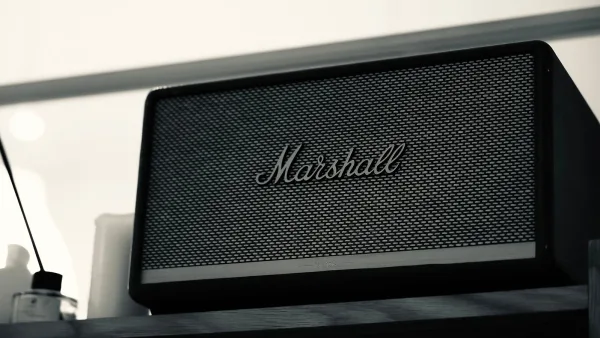
I've bought more speakers over the years than I'd care to admit to my wife, and the ones I regret are always the same kind: bought on looks, or on a marketing phrase that sounded clever in the shop and meant nothing once I got it home. A Marshall speaker is an easy thing to fall for on looks alone, so before you part with any money, let's go through what actually matters.
Start With the Question Nobody Asks First
What room is this speaker going to live in, and is it moving? That single question rules out most of the range immediately. A mains-powered home speaker that never leaves a shelf wants different things from a battery speaker that's going in a rucksack. Answer that first, and the rest of this guide gets much shorter.
Buying a Portable Marshall Speaker
If it's leaving the house, three figures matter more than any others.
- Battery life — manufacturers quote it under generous test conditions. Bass-heavy playlists, higher volumes and lit-up party features will all shorten it in practice, so treat any quoted figure as a ceiling, not a promise.
- IP rating — the two-digit code (dust, then water) tells you what the speaker actually tolerates. IP55, reported on the newer Stockwell III, covers dust ingress and low-pressure water jets — fine for rain or a splash by the pool, not a green light for swimming with it.
- USB-C behaviour — on some models the USB-C port charges the speaker only; on others it doubles as a power bank for your phone. Check the specification sheet rather than assuming, because the two features look identical from the outside.
Weight and handle design matter more than they sound. A speaker with a proper carry strap, like the Kilburn III, gets used far more often than one that's merely "portable" in the sense that it has a battery.
Buying a Home Marshall Speaker
Here the calculation changes entirely, because a home speaker never has to compromise for a battery. What matters instead:
| Model tier | Reported amplification | Best suited to |
|---|---|---|
| Acton | One Class D woofer amp plus two tweeter amps (30W woofer on the III) | A small room or a desk |
| Stanmore | A larger Class D woofer amp (50W on the III) with two tweeter amps | A living room |
| Woburn | The biggest configuration — a 90W woofer amp plus separate mid and tweeter amps | A larger room, or doubling as a TV speaker where HDMI is supported |
Those figures are specific to the III-generation models and shouldn't be assumed to carry across every revision — check the exact model you're looking at. Wattage on its own tells you less than it sounds like it should; a speaker's sensitivity, cabinet volume and how hard the signal processing is working all shape the final loudness and clarity. Newer IV-generation models add a redesigned bass port, upgraded tweeters and Dynamic Loudness processing that reshapes the tone at lower volumes — useful if you listen quietly more often than not.
Check the inputs too. Depending on the model you may get Bluetooth only, or Bluetooth plus a 3.5mm aux socket, RCA, and on some models HDMI for a television. If you're planning to run a turntable into it, confirm it has a phono stage built in or budget for a separate preamp — plugging a turntable straight into a line-level input without one will sound thin and quiet.
Connectivity and Codecs, Decoded
The spec sheet on a newer Marshall speaker throws a lot of acronyms at you. Here's what they buy you in practice:
- Bluetooth 5.3 — the current connection standard on newer models, generally more stable and power-efficient than older versions.
- LDAC / LC3 — higher-bitrate codecs that can improve streamed audio quality, but only if your phone also supports them; otherwise the pairing simply falls back to a standard codec such as AAC or SBC.
- Auracast — a broadcast-audio feature letting compatible devices share one audio stream. It solves a different problem to multipoint, which is about switching a speaker between two paired sources.
- True Stereophonic — Marshall's multidirectional sound processing. It widens a single speaker's presentation, but it isn't a substitute for genuine stereo separation from two speakers.
Read the Small Print Before You Buy
A handful of buyers get caught out every year, and it's always avoidable. Verify regional pricing and specification, since codec and feature support can differ by market even on the same model name. Read the return policy on anything ordered online, and if you're choosing between two close options, our roundup of the best Marshall speakers for the money lays the current range out tier by tier. If you want the fuller list of avoidable errors, I've written those up separately in common Marshall speaker mistakes to avoid.
The Bottom Line
Buying the right Marshall speaker is mostly a matter of being honest about how you'll use it before you look at a single spec sheet. Work out portable versus home, be realistic about battery and IP claims, and don't let a marketing term substitute for a proper answer to a straightforward question. If any of this still feels like unfamiliar territory, our guide to what one of these actually is is worth reading first, and total beginners may prefer to start with our beginner's guide instead.




Comments