


Fender article
Fender Explained: Features, Types and Tips
From the bolt-on neck up: what actually separates a Stratocaster from a Telecaster, a Precision from a Jazz Bass, and a Squier from a Custom Shop.
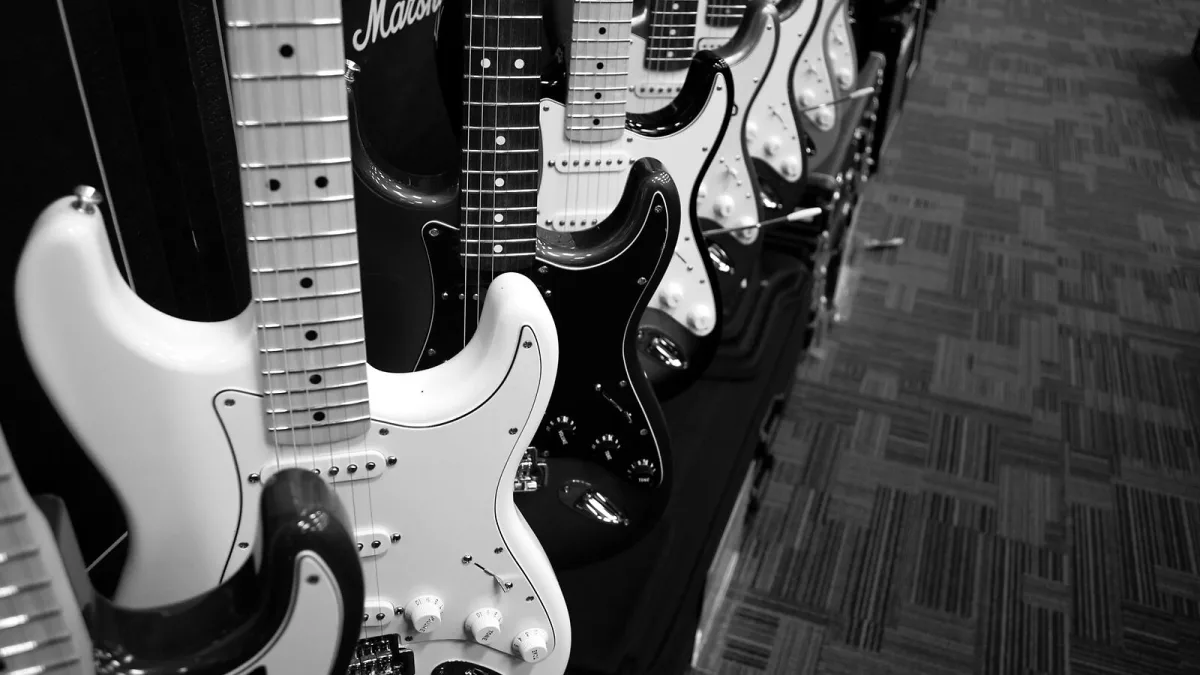
If you've spent five minutes browsing guitars online, you've seen the name Fender more times than you can count — on Stratocasters, Telecasters, budget-friendly Squiers and boutique Custom Shop pieces that cost as much as a small car. That's not an accident. Fender built its reputation on practical engineering rather than mystique, and understanding how the range actually fits together makes it far easier to know what you're looking at. This guide walks through the main Fender families, the tiers they're sold in, and a handful of technical terms worth knowing before you go shopping.
What Makes a Fender a Fender
Most classic Fender designs share one quietly important idea: a bolt-on neck, screwed to the body rather than glued in, as it is on many other brands. It sounds unglamorous, but it means necks can be swapped, adjusted or replaced far more easily than on a set-neck instrument. That practicality — modular parts, straightforward electronics, easily serviced hardware — runs through the whole catalogue, from the cheapest Squier to the priciest Custom Shop build.
The Core Guitar Family
Five guitar shapes do most of the heavy lifting in the company's history, and each has a distinct personality:
| Model | Pickups | Bridge | Known for |
|---|---|---|---|
| Telecaster | Two single-coils | Fixed | Attack, clarity, country/rock/punk |
| Stratocaster | Three single-coils | Synchronized tremolo | Versatility, five-way switching, blues/rock/funk |
| Jazzmaster | Wide single-coils | Floating vibrato | Surf, indie, alternative textures |
| Jaguar | Single-coils with metal surrounds | Floating vibrato | Short 24-inch scale, complex switching |
| Mustang | Single-coils | Vibrato or hardtail | Compact, short scale, garage/punk feel |
The Telecaster came first and remains the simplest: two pickups, a no-nonsense fixed bridge and enough bite to cut through a mix on its own. The Stratocaster added a third pickup, a five-way selector and a spring-loaded tremolo — a bridge system that lets you bend pitch by moving the whole assembly — for a broader, more expressive palette. Jazzmaster and Jaguar share an offset body and floating vibrato but differ in scale length and switching, while the Mustang keeps things short-scale and unfussy. If you're trying to decide between the shapes for your own playing, our Fender buyer's guide goes further into which one actually suits you.
The Bass Side: Precision and Jazz
Fender's influence on the electric bass is arguably even bigger than its influence on six-string guitars. The Precision Bass was one of the first genuinely successful solid-body electric basses, built around a split-coil pickup — two smaller coils wired to cancel hum — that gives it a punchy, focused low-mid growl and famously simple controls. The Jazz Bass followed with two single-coil pickups, a narrower neck and far more tonal blending between the two pickups, which is why it's the go-to choice for players who want more flexibility than a Precision offers.
Reading the Tiers
The trickiest part of understanding this brand isn't the shapes, it's the tiers — the range of price and origin that sit underneath the same model names on every current Fender:
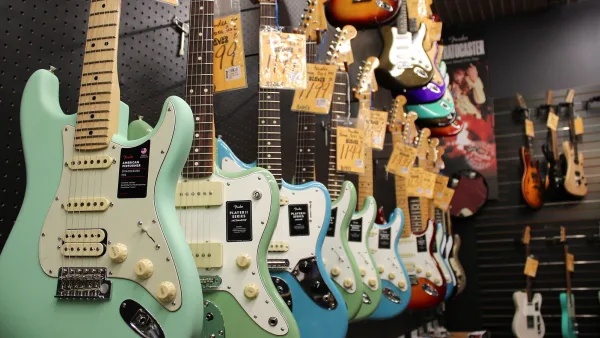
- Squier — the affordable, entry-level line.
- Player / Player II — Mexican-made instruments aimed at working musicians.
- Vintera and Classic-style ranges — historically inspired specifications, where offered.
- American Professional II — US-made, modern professional specification.
- American Ultra — higher-end models with refined playability and upgraded hardware.
- Custom Shop — vintage recreations, artist builds and fully custom specifications.
The same body shape can turn up at every one of those levels, so the model name alone doesn't tell you the whole story — the tier does a lot of the talking on fit, finish and price.
The Technical Vocabulary Worth Knowing
Scale length
Scale length is simply the vibrating length of a string, measured from the nut to the bridge. Most full-size electrics use a 25.5-inch scale, while the Jaguar and Mustang typically use a shorter 24-inch scale, which feels more compact and slightly looser in tension at the same string gauge. The recommended way to measure it is from the inside edge of the nut to the centre of the 12th fret, doubling that figure.
Pickups
Single-coil pickups — used on the Stratocaster, Telecaster, Jazzmaster and Jaguar — are prized for clarity and dynamics, though they pick up more background hum than a humbucker, a pickup design using two coils wired to cancel that noise. Some Fender and Squier models offer humbuckers for a thicker, quieter sound; neither option is objectively better, it depends on the music.
Bridges and vibrato
A Telecaster's fixed bridge is about as low-maintenance as guitars get. A Stratocaster's synchronized tremolo depends on spring balance to stay in tune, and the floating vibrato systems on a Jazzmaster or Jaguar add a distinct feel but need the bridge, springs and string gauge working in harmony. None of this is beyond a beginner, but it does explain why some models need a slightly more careful setup than others — something our piece on common Fender mistakes to avoid covers in more detail.
Why Fender Still Matters
Few brands can claim to have shaped as many genres from a handful of shapes. Telecasters run through country, rock and punk; Stratocasters through blues, funk and pop; Jazzmasters and Jaguars through surf and alternative music; Precision and Jazz basses through soul, punk and session work of every description. That range is exactly why Fender keeps coming up whichever style of music you're chasing.
The Bottom Line
The appeal comes down to consistency with variety: a small set of well-understood shapes, built to a philosophy of easy servicing, offered across tiers to suit almost any budget. If you already know roughly which model you want and need help choosing between new, used or a specific tier, our buyer's guide is the natural next stop, and nervous first-timers should take a look at Fender for beginners. Curious which models represent the best value at each price point? We've rounded them up in the best Fenders for the money.





Comments