


Powered Amps article
Powered Amps for Beginners: A Complete Guide
One job, a few shapes, and a couple of terms worth learning early — a patient, step-by-step introduction for total beginners.

If the words "power amp", "watts" and "impedance" already feel like a wall of jargon, take a breath. Powered amps do one simple job underneath all that terminology, and this guide builds your understanding of them one small, manageable step at a time.
Step One: Understand the One Job They Do
Every powered amp exists to solve the same basic problem: the signal coming out of a mixer, preamp or instrument is too weak on its own to move a speaker cone properly. The amp's job is simply to boost that signal into something strong enough to actually make sound. That's it. Everything else — classes, wattage figures, impedance — is detail on top of that one core function.
Step Two: Learn the Handful of Forms Powered Amps Take
You'll meet the idea of a powered amp in a few different shapes, and it helps to know them apart early on:
- A standalone power amp — a separate box that sits between your mixer or preamp and your speakers.
- A powered speaker — the amplifier is already built into the speaker cabinet, so there's nothing extra to wire in.
- An instrument amp — your guitar, bass or keyboard amp already has a power amp stage built in, whether it's a combo or a separate head and cabinet.
If you're just starting out, a powered speaker or a combo instrument amp is genuinely the simplest option — there's less to wire up and fewer decisions to get wrong.
Step Three: Don't Panic About "Watts"
New players often assume a bigger watts number automatically means a louder, better amp. It isn't that simple. Loudness depends on the speaker as much as the amp, and manufacturers measure watts in several different ways — continuous, program and peak power are not the same figure, and comparing amps on watts alone can be genuinely misleading. For now, just know that the number on the box is a starting point, not the whole story.
Step Four: One Word Worth Learning Early — Impedance
Impedance sounds intimidating, but the beginner version is simple: it's a matching number between your amp and your speaker, usually written in ohms. You mostly just need to check that your speaker's number falls within what your amp is designed to handle. Get this one detail right, and you'll avoid the single most common way beginners accidentally damage otherwise perfectly good gear.
Step Five: Tube or Solid-State? Don't Overthink It Yet
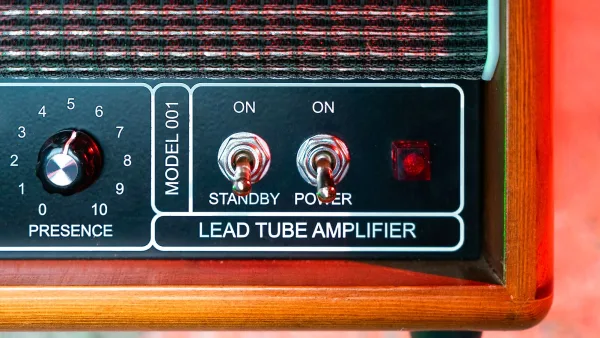
You'll see amps described as tube, solid-state or hybrid, and it's tempting to think one is simply "better." At the beginner stage, don't worry about this distinction too much. Solid-state amps are generally lighter, more reliable and easier to live with while you're learning; tube amps have a particular character some players fall in love with later on. Neither choice will hold you back early on.
A Quick Beginner's Glossary
| Term | What it means for you |
|---|---|
| Preamp | Shapes and boosts the weak original signal, before the power amp takes over |
| Power amp | Boosts that shaped signal into something strong enough to drive a speaker |
| Impedance (ohms) | The matching number between your amp and speaker — check it's compatible |
| Watts (RMS) | The most trustworthy measure of real, sustained power — ignore peak figures for now |
A Simple First Setup
For your very first setup, keep it as simple as possible: one instrument or source, one amp, one speaker or cabinet, wired with the correct cable. Resist the urge to add extra channels, bridging or multiple cabinets until the basics feel completely comfortable. There will be plenty of time to get more ambitious later.
Where to Go Next
Once the basics feel settled, our full overview of powered amps goes deeper into amplifier classes and circuit types. When you're ready to actually buy one, our buyer's guide covers the specs properly, and our step-by-step setup guide is there for when you're ready to wire everything up with confidence. It's also worth a quick read of common mistakes to avoid, so you can sidestep a few frustrations before they happen.
The Bottom Line
Learning about powered amps, in whatever form they come in, is genuinely manageable once you take it one idea at a time: understand the basic job, learn the main forms, treat wattage figures with a little caution, and get impedance matching right from day one. Confidence builds quickly from there.





Comments