


Powered Amps article
Common Powered Amps Mistakes to Avoid
Most damaged amps didn't fail from bad luck — a handful of avoidable habits, and the straightforward fix for each one.

Most damaged amps and blown speakers I've come across didn't fail because of bad luck — they failed because of one of a handful of avoidable habits. Here's what actually goes wrong most often with powered amps, why it happens, and the straightforward fix for each one. These mistakes with powered amps crop up again and again, and almost all of them are entirely preventable.
| Mistake | Why it happens | The fix |
|---|---|---|
| Assuming more watts means louder | It's the easiest spec to compare on a box | Check speaker sensitivity and real-world SPL, not just wattage |
| Ignoring impedance matching | The numbers look similar at a glance | Always confirm the amp's minimum load against the speaker's rating |
| Running a tube head without a matching cab | It's an easy step to forget in a rush | Never power up a tube head without a correctly matched load |
| Confusing peak power with RMS | Peak numbers look more impressive | Base decisions on continuous/RMS figures, not peak |
| Blocking ventilation | Rack space is often tight | Leave clear airflow around and through the unit |
| Poor gain staging | It's tempting to max out one stage for volume | Set gain gradually through each stage of the chain |
Assuming More Watts on Powered Amps Means Louder
This is the mistake I see most often, and it's an easy one to fall into because wattage is the number every listing leads with. Loudness actually depends heavily on the speaker's own sensitivity and the room it's in, not just the amp's output figure. A modest amp paired with an efficient speaker can comfortably out-perform a bigger amp on a poorly matched cabinet.
Ignoring Impedance Matching
Running a speaker load below the amplifier's minimum supported impedance asks it for more current than it's built to supply. At best, protection circuits kick in and cut your sound at the worst possible moment. At worst, you damage the amp itself. This gets more complicated the moment you wire more than one cabinet to a single channel — always work out the combined load first, not after something starts smelling warm.
Running a Tube Head Without a Matching Cabinet
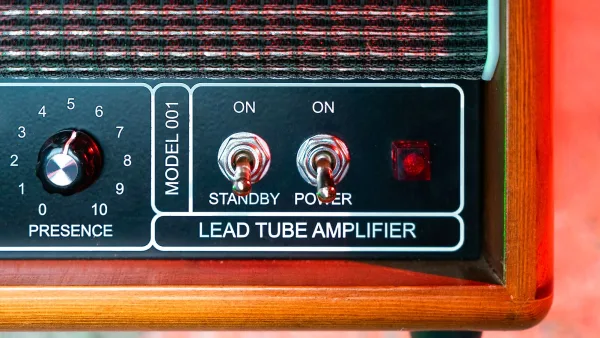
Worth its own section because the consequences are so unforgiving: tube amplifier impedance matching genuinely isn't optional. Unlike a lot of solid-state gear, a tube head typically requires a correctly matched speaker load connected before you power it up, and running one without that load can damage the amplifier itself, not just trip a protection circuit. If you're not certain your cabinet is a safe match, check the manual before you plug in, not after.
Confusing Peak Power With RMS
Manufacturers publish continuous, program and peak power figures, and they are not interchangeable. Peak power reflects a brief burst, not something the amp can sustain, and basing a buying or setup decision on that number alone sets you up for disappointment. RMS, or continuous power, is the figure that actually tells you what the amp can do reliably over time.
Blocking Ventilation
Amplifiers generate real heat doing their job, and Class AB and tube designs generate considerably more than efficient Class D circuits. Stack gear too tightly in a rack, or push a combo amp against a wall with no airflow, and thermal protection will start cutting your output at the worst possible moment, mid-song, mid-gig. Give the unit room to breathe, and check that any fan-cooled design actually has clear intake and exhaust paths.
Poor Gain Staging Through the Chain
Every stage in the signal path — source, preamp, power amp input sensitivity — has its own point where it starts clipping. Max one stage out to compensate for a quiet-sounding setup elsewhere, and you'll introduce distortion and harsh high-frequency energy that can genuinely damage a speaker, particularly a tweeter, even when the amp's wattage looks perfectly reasonable on paper. Build gain gradually through each stage instead of relying on one control to do all the work.
Two More Worth a Mention
- Using instrument cable for speaker-level signal. Speaker cable is built for the current involved; ordinary instrument or unbalanced signal cable isn't.
- Bridging channels without following the manual exactly. Incorrect bridged wiring can damage both the amplifier and the speaker it's driving.
Avoid These From the Start
If you're still shopping, our complete buyer's guide covers the specs that prevent most of these mistakes before you even own an amp. Already got one? Our step-by-step setup guide walks through safe gain staging and power-up order properly, and our overview of powered amps is worth a read if any of the terminology above still feels unfamiliar.
The Bottom Line
Almost every one of these mistakes with powered amps comes down to the same root cause: trusting a single headline number instead of understanding what's actually happening in the signal chain. Slow down, check impedance and gain staging properly, and most of this list simply stops applying to you.





Comments