


Oud Instrument article
Oud Instrument Explained: Features, Types and Tips
A deep, pear-shaped body, a fretless neck and not a fret in sight, the instrument at the heart of Arabic, Turkish and Persian music, explained properly.
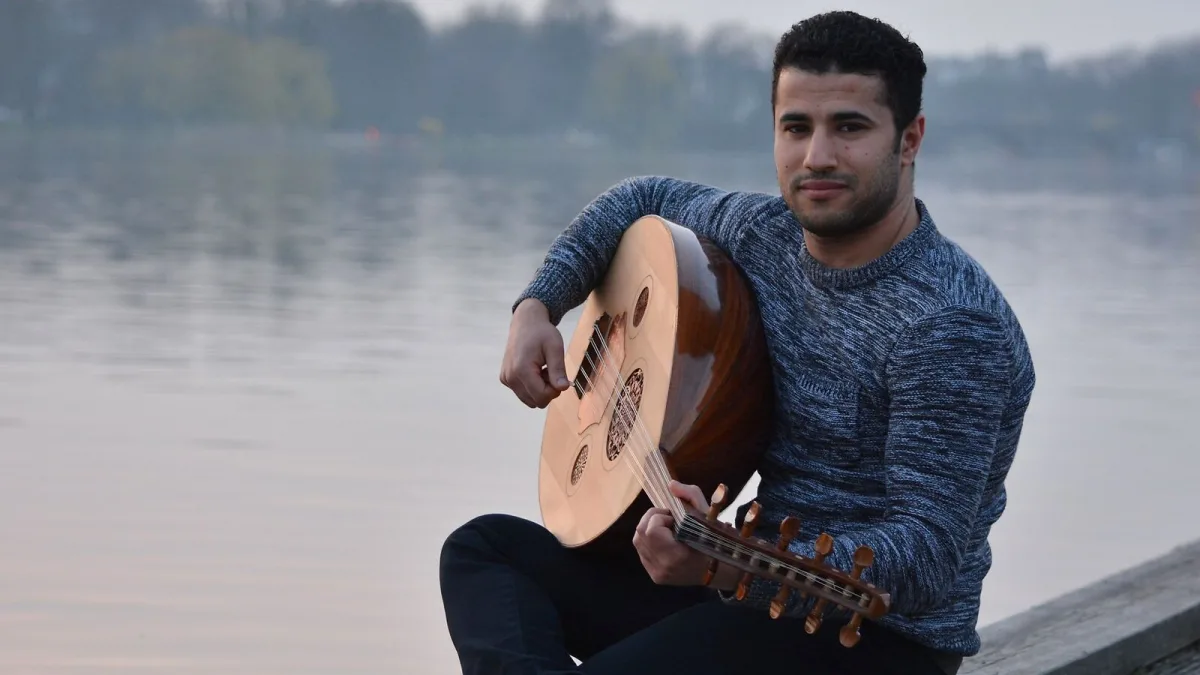
Some instruments announce themselves the moment you see them, and the oud is one of them: a deep, pear-shaped body cradled in the lap, a short neck bending sharply back into its pegbox, and not a fret in sight. Hear it played well and you'll understand why it's been central to Arabic, Turkish and Persian music for well over a thousand years. Let's look at what actually makes it work.
What an Oud Actually Is
At its core, the oud is a fretless, short-necked lute with a deep, rounded body built from thin wooden ribs joined edge to edge, rather than carved from a single block. A flat soundboard sits across the front, usually decorated with one to three carved rosettes covering the sound holes, and the strings run down to a bridge glued directly onto that soundboard. Most modern instruments carry eleven strings arranged in six courses, five paired courses plus a single bass string, though five- and seven-course designs exist too.
Where It Comes From
The oud's story runs through Mesopotamia, Persia and the medieval Arab world, tracing back to an earlier Persian lute called the barbat by at least the seventh century. Exactly where it "began" is genuinely disputed among historians, some accounts lean Persian, others point to later Arab refinement, and the honest answer is that it developed gradually through centuries of cultural exchange rather than a single invention. During the Islamic Golden Age it became central to court music and music theory alike, later spreading through North Africa, the eastern Mediterranean and Anatolia, and it's the ancestor, distantly, of the European lute.
How It's Built
The bowl-shaped body is where most of an oud's character comes from: rib count, wood choice and bracing all shape its projection and sustain, alongside a soundboard thin enough to respond but strong enough to survive string tension for decades. The neck is short compared with a guitar's, and crucially fretless, which lets a player slide continuously between pitches rather than stepping between fixed positions. The pegbox angles backward from the neck, with tuning pegs fitted into its sides rather than arranged along a straight headstock.
Strings, Courses and Tuning
A "course" simply means strings grouped together and played as one unit, usually tuned in unison. There's no single universal tuning across traditions, Arabic and Turkish players commonly use different pitch centres entirely, so any tuning you see quoted online should be treated as one system among several rather than a fixed standard. Players use a long, flexible plectrum to pluck the strings, called a risha in Arabic contexts and a mızrap in Turkish ones.
Arabic, Turkish and Persian Traditions
| Feature | Arabic oud | Turkish oud |
|---|---|---|
| Typical size | Larger | Generally smaller |
| Tonal aim | Deep, warm, rounded | Bright, clear, responsive |
| Typical pitch | Often lower | Often higher |
These are broad tendencies rather than fixed rules, and individual makers happily cross the categories. The Persian tradition is often discussed through the related barbat, which shares deep historical roots with the oud but differs in proportions, tuning and repertoire, so the two terms aren't simply interchangeable.
Why Fretlessness Actually Matters
Because there's nothing to stop a finger at a fixed point, an oud can produce the continuous pitch bends, slides and microtonal inflections that Arabic maqam and Turkish makam traditions depend on, melodic systems built on shades of pitch that fretted Western instruments simply can't reproduce precisely. That flexibility is also exactly why intonation takes real ear training to master, there's no fret to lean on for reassurance.
A Note on Care
A bowl-backed body built from thin ribs is more sensitive to its environment than a solid-bodied Western instrument. Sudden temperature swings, direct sunlight and very dry air can all cause cracking along the ribs or soundboard over time, so keeping the instrument away from radiators and controlling humidity where you can genuinely extends its life. Restringing is usually done a course at a time rather than removing every string simultaneously, since the neck and bridge are relying on fairly even tension to stay properly seated.
Where You'll Hear One Today
Beyond classical Arab and Turkish repertoire, an oud now turns up in film scores, jazz, fusion projects and wider world-music collaborations, its warm, sliding voice translating well into contexts its original players never imagined. If you're curious about choosing one, our complete buyer's guide covers what actually matters, and the best oud instruments for the money breaks the options down by tier.
The Oud and the European Lute
If the general shape reminds you of a European lute, that's no coincidence, the two share distant ancestry, and the word "lute" itself is thought to derive from the Arabic al-'ud. Centuries of separate development pulled them apart, though, fretting, tuning, body proportions and repertoire all diverged, so treat them as distant relatives rather than variations on the same instrument.
The Bottom Line
The oud rewards a bit of patience: understand its fretless neck, its paired courses and the tradition it's built for, and its whole vocabulary starts to make sense quickly. Thinking about learning? Our beginner's guide is the gentler place to start.





Comments