


Oud Instrument roundup
Oud Instrument: A Complete Buyer's Guide
What actually matters when choosing an oud, from body construction and bridge placement to the tradition it's genuinely built for.
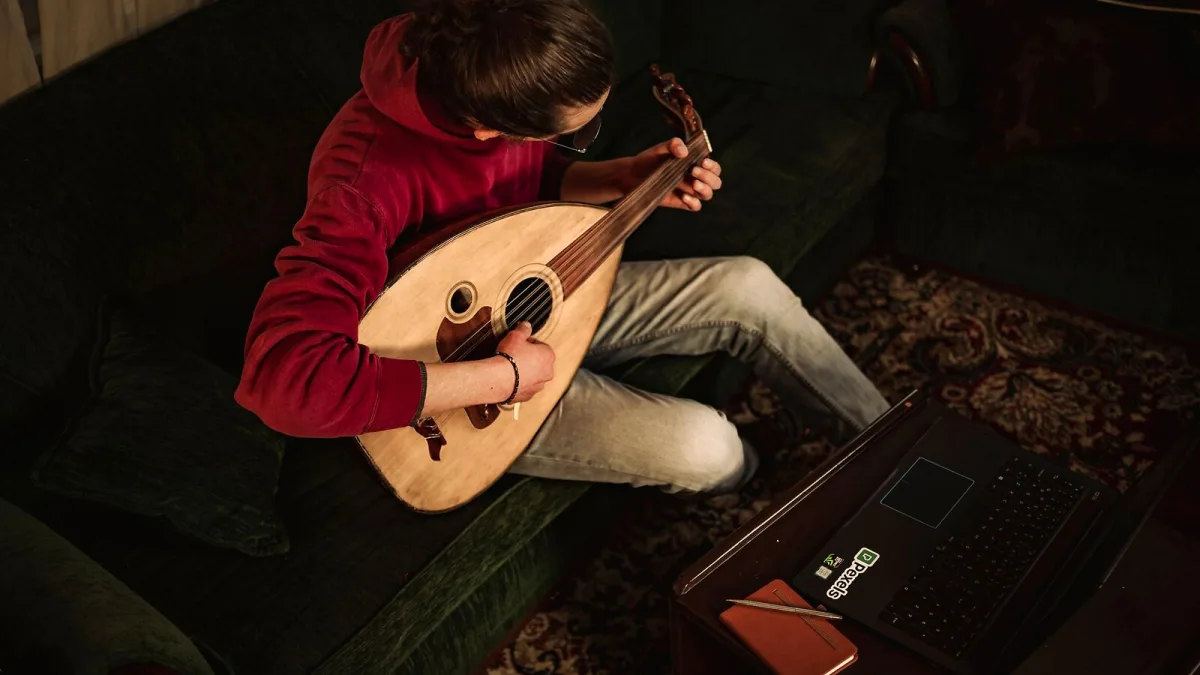
I still remember holding an oud for the first time and being surprised by how much weight settles into your lap, and how differently the whole body responds compared with anything I'd played before. Choosing one properly means looking past the decorative rosette and the polished finish to the geometry underneath, so here's what's genuinely worth your attention.
Choose Your Tradition Before Anything Else
The very first decision isn't about wood or price, it's about which tradition you're actually drawn to: Arabic, Turkish or the related Persian barbat. Arabic instruments tend to be larger, deeper and warmer; Turkish ones are generally smaller, lighter and brighter, tuned higher as a rule. Neither is objectively better, but buying an oud without deciding this first often means ending up with the wrong shape entirely for the music you actually want to play.
The Body and Soundboard
Look closely at how the oud's bowl is put together. It should be built from evenly joined ribs with no visible gaps or separation, and the soundboard should sit neither unnaturally sunken nor visibly bulging under string tension. A soundboard under real stress can develop cracks over time, so check carefully for any hairline damage before you commit, particularly on a secondhand instrument that's had years to develop problems.
The Fretless Neck and the Bridge
Because an oud has no frets to guide you, neck geometry matters enormously, sight down it for any twist or unevenness, and make sure the action feels playable rather than uncomfortably high or buzzy. The bridge should be firmly and correctly seated on the soundboard; a poorly placed bridge affects both intonation and, over time, the structural health of the soundboard itself. This isn't a detail to skip past quickly, it affects nearly everything about how the instrument feels under your hands.
Strings and Courses
Most ouds carry eleven strings across six courses, five paired plus a single bass string, though you'll occasionally meet five- or seven-course variations. Response should feel reasonably even across all the courses, with no single pairing sounding noticeably weaker or more resistant than the rest. You'll also need a proper plectrum, a risha in Arabic style or a mızrap in Turkish style, and it's worth trying a few before assuming the one that comes bundled is right for your hand.
New Versus Secondhand
- Check for cracks in the soundboard and any separation between the ribs.
- Confirm the neck is straight and the bridge is stable, not lifting or shifting.
- Test that tuning pegs turn smoothly without slipping or sticking.
- Listen for excessive buzzing or uneven volume between courses.
- Ask whether the instrument has had any repairs, and by whom.
A secondhand oud that's been well cared for can be genuinely excellent value, but inspect it more carefully than you would a new one, and involve a specialist if you're not confident judging these details yourself.
Care, Humidity and Storage
An oud's thin-ribbed bowl body is more sensitive to its environment than most Western instruments, so keep it away from radiators, direct sunlight and sudden temperature swings, and control humidity where you reasonably can. This matters more than most new buyers expect, since a dry room over one winter can genuinely cause cracking that a slightly more careful storage spot would have avoided entirely. Store it in a properly padded case rather than leaving it out, and never apply household oils or polishes to the soundboard. If something structural does go wrong, a crack, a lifting bridge, a shifted neck angle, take it to a specialist rather than a general instrument repairer unfamiliar with the build.
Reading Past the Sales Language
Listings can lean heavily on words like "professional", "master-crafted" or "concert-grade oud", none of which are standardised across sellers or regions. Ask instead about specific woods, rib count, soundboard thickness and how the instrument was set up before it left the workshop, since no controlled testing exists to prove that one wood species automatically produces a superior oud. Those concrete details tell you far more than a confident adjective ever will.
Questions Worth Asking Before You Buy
Ask which tradition the instrument is built for, what setup work has already been done, whether replacement strings are readily available for its specific tuning, and what the return or repair policy looks like. A specialist oud seller should answer all of this without hesitation, and hesitation itself is worth treating as a warning sign.
Where to Go Next
For the fuller picture of how the instrument actually works, our explainer on the oud's features and history is a useful companion read, and the best oud instruments for the money breaks these considerations down by tier. Brand new to all this? Start with our beginner's guide instead.





Comments