


Kalimba article
Kalimba Explained: Features, Types and Tips
A kalimba looks simple and sounds anything but. Here's what's really going on under your thumbs, and the types you'll come across along the way.
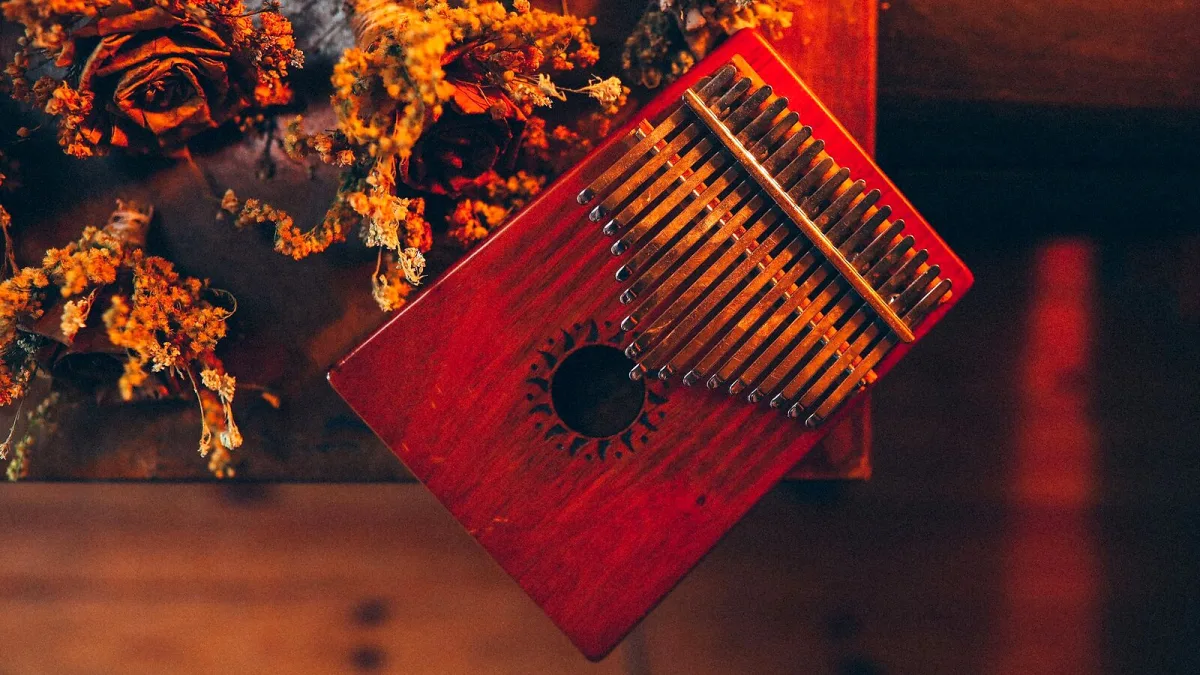
There's a particular sound that stops people in their tracks — a soft, bell-like plink that seems to hang in the air a beat longer than it should. More often than not, it's coming from a kalimba, a small wooden instrument you hold in both hands and play with your thumbs. It looks unassuming. It isn't. Here's what a kalimba actually is, how it makes that sound, the main types you'll come across, and a few things worth knowing before you go any further.
What Is a Kalimba?
A kalimba is a handheld lamellophone — the technical family name for any instrument built from thin, flexible tongues (called tines) fixed over a resonating board or box. Press a tine down with your thumb and let it go, and it springs back, vibrating to produce a single clear note. The Metropolitan Museum of Art, which holds several in its collection, describes the family simply as "thin metal or split cane tongues mounted on a resonating board or box." Tune the tines by sliding them in or out along the bridge, and you change the length that's free to vibrate — shorter gives you a higher note, longer a lower one.
In English it's often nicknamed the "thumb piano," which is a fair enough description of how you play it, even if it isn't a piano at all. The name itself is generally used for the modern, commercially made instrument, most of it tuned to familiar Western scales rather than the tunings you'd find on its older African relatives.
Kalimba or Mbira? A Distinction Worth Making
You'll see "kalimba" and "mbira" used interchangeably online, and it's worth untangling them, because they're not quite the same thing.
| Term | What it usually means |
|---|---|
| Kalimba | A modern, commercially produced thumb piano, typically Western-tuned |
| Mbira | A family of African lamellophones, including specific ceremonial instruments |
| Mbira dzavadzimu | A Zimbabwean Shona instrument with its own construction, tuning and ritual role, tied to the bira ceremony |
| Thumb piano | An informal nickname, not a precise classification |
The modern, widely sold kalimba owes much of its design to the British ethnomusicologist Hugh Tracey, who adapted features of African lamellophones into an instrument built around Western "do re mi" tuning and an alternating note layout that Western players could pick up quickly. That's a genuine debt worth acknowledging, and it's also why treating every traditional mbira as simply an earlier version of it undersells instruments with their own history and cultural weight, particularly the Shona mbira tradition of Zimbabwe.
How the Sound Actually Gets Made
Underneath the good looks, a kalimba is a fairly simple machine, and understanding its parts helps explain why one instrument sounds different from another.
- Tines — the metal tongues you pluck, each tuned to a single pitch.
- Bridge — the raised ridge the tines rest against; this is where tuning happens.
- Soundboard — the wooden surface that picks up the tine's vibration.
- Resonating chamber — on hollow-body instruments, the hollow box that amplifies the tone.
- Sound hole — found on many hollow-body designs; cover it with a finger while playing and you get a wobbly, tremolo-like effect.
A hollow-body design, with its enclosed chamber, tends to project more and carries a warmer, rounder tone. A flatboard (sometimes called "celeste") instrument, where the tines sit directly on a flat board with no chamber beneath, gives you a more immediate, percussive attack but less volume on its own. Neither is objectively better — it depends on whether you're after presence in a room or clarity for close-up recording.
The Main Types You'll Come Across
Walk into this world and you'll find no shortage of variations on the theme:
- 17-key diatonic kalimba, usually in C major — by far the most common starting point.
- 15-key alto model — generally pitched lower than the 17-key treble version.
- Flatboard or celeste build — tines on a flat board, no resonating box.
- Hollow-body design — a resonant chamber for a fuller acoustic sound.
- Acrylic version — a transparent body, often chosen for looks as much as tone.
- Pickup-equipped build — made with amplification and recording in mind.
- Extended-range instruments, with more than 17 tines for a wider melodic range.
If you're weighing these options against a budget, our complete buyer's guide goes into the specifics of what to check before you part with your money, and our look at the best kalimbas for the money breaks the market down by price tier.
Why the Notes Zigzag
Pick up a 17-key kalimba and the layout will look nothing like a piano keyboard. The lowest note sits in the middle, and pitches climb outward in alternating fashion — left, right, left, right — rather than running in a straight line. It looks odd until you realise it's designed for two thumbs working together, letting you play scale runs and simple chord shapes without your hands crossing over. It takes a session or two to feel natural, but most players find the pattern clicks faster than they expected.
A Few Things Worth Knowing
Before you take one home, a handful of practical points are worth bearing in mind. Every tine should be checked against a proper chromatic tuner rather than trusted on the maker's word — "tuned to C major" on the box is a starting claim, not a guarantee. The tine edges should feel smooth against your thumb; anything rough or sharp will make itself known within a few sessions. And humidity matters more than people expect: a kalimba left somewhere too dry or too damp will drift out of tune and, in time, the wood can warp.
If you're just starting out, our beginner's guide walks through the first steps in more depth, and our piece on setting up and using one covers tuning and playing position properly. It's also worth a look at the common mistakes newcomers make, if only to skip a few of them yourself.
The Bottom Line
A kalimba rewards curiosity. It's a genuinely accessible instrument — no reading music required, no years of technique before it sounds like something — while still carrying real depth if you want to go further with tuning, technique and repertoire. Understand what's under your thumbs, and the rest tends to follow naturally.



Comments