


Harp article
Harp Explained: Features, Types and Tips
From the chordophone basics to Sébastien Érard's 1810 pedal mechanism, here's what actually separates a lever harp from a pedal harp — and where each one turns up in music.
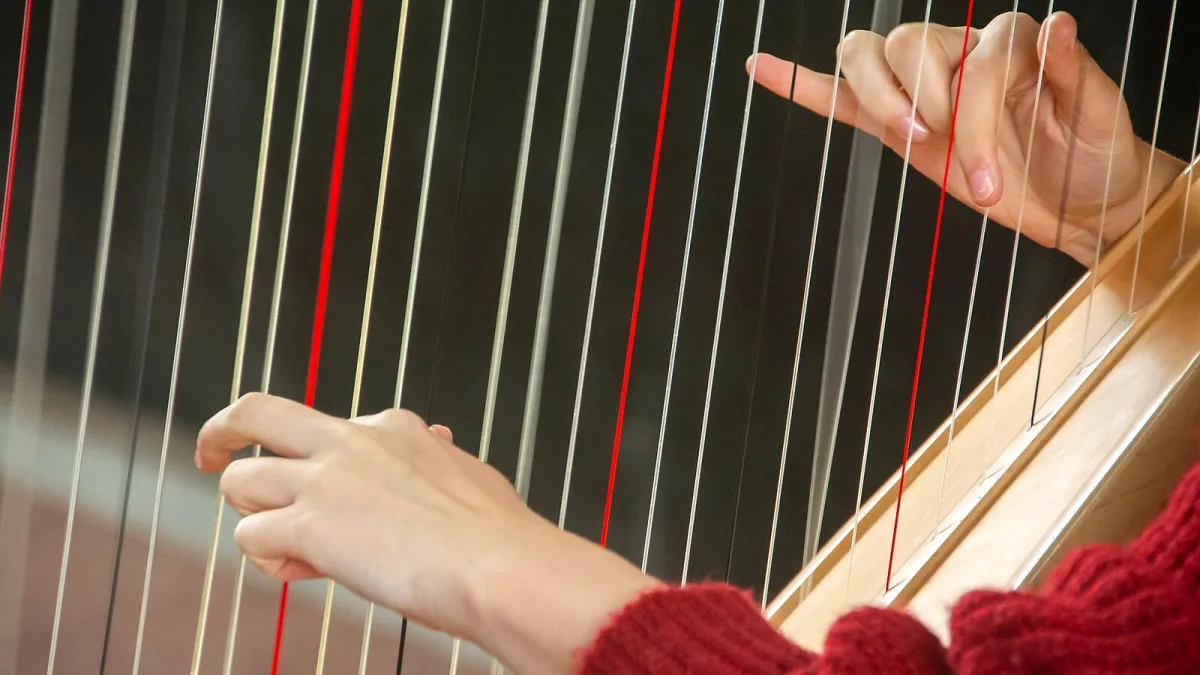
Stand a harp next to almost any other instrument and it looks like a piece of furniture that decided to sing. There is no fretboard to press, no reed to buzz — just a frame of strings, each one built to hold a single note. That simplicity is deceptive. Underneath it sits centuries of engineering and a family tree that runs from ancient Mesopotamia to the back row of a symphony orchestra. This guide sets out what the harp actually is, how its two main branches differ, and where its various strands turn up across folk, classical and contemporary music.
What Makes a Harp a Harp?
Technically, the harp belongs to the chordophone family — any instrument that makes sound from a stretched string. What sets a harp apart from a guitar or a fiddle is that each string is built to sound one pitch and one pitch only. A guitarist shortens a string with a finger to find a new note; here, every note gets its own dedicated length of string instead. That is why the frame fans out into a triangle: the low strings need to be long and thick, the high ones short and fine, and the shape has to hold the considerable tension of dozens of strings pulling against it at once.
The Parts That Do the Work
However ornate the carving gets, every harp shares the same working parts:
- Soundboard — the flat resonant panel that turns string vibration into audible sound.
- Neck — the curved or straight top member that carries the tuning pins and, on lever and pedal models, the pitch-changing hardware.
- Column (or pillar) — the front brace that stops the frame folding under string tension.
- Resonator body — the hollow box behind the soundboard that gives the tone its depth.
- Strings — nylon, gut, carbon fibre or wire, depending on the tradition and the sound wanted.
Two Families: Lever and Pedal
Nearly every instrument you will meet today falls into one of two camps, and the difference is really about how pitch gets changed mid-tune.
| Feature | Lever type | Pedal (concert) type |
|---|---|---|
| Typical setting | Folk, Celtic sessions, education | Orchestras, chamber and solo classical work |
| Pitch change | Small hand levers near the tuning pins, one per string | Seven foot pedals, each moving every string of one note name at once |
| String count | Roughly 22–38 | Around 47 |
| Range | Around three to five octaves | About six and a half octaves |
| Weight and transport | Lighter, easier to carry | Large and heavy; travel takes planning |
A pedal harp has seven pedals, one for each note name — C, D, E, F, G, A and B — and each one has three notches: flat, natural and sharp. Move a pedal and every string of that name changes pitch across the whole range in one motion, which is what lets an orchestral player shift key or handle a chromatic run without retuning by hand. Fewer moving parts means the lever harp favours music that stays largely in one key, which suits a great deal of folk and traditional repertoire perfectly well.
Where the Pedal Mechanism Came From
The seven-pedal system is not a modern add-on. It traces back to the French maker Sébastien Érard, who patented his double-action pedal design in Paris in 1810. Before that, frame instruments were largely diatonic — built to play the notes of one scale and little else. Érard's mechanism, which let each pedal raise a string through two separate semitone stages, gave players full chromatic reach for the first time and turned the pedal harp into the fixture of the modern orchestra it remains today.
Beyond the Concert Platform
Step outside the orchestra pit and the family gets considerably more varied:
- Wire-strung harps — associated with the Gaelic clarsach tradition, strung in metal rather than gut or nylon for a bright, bell-like sustain quite unlike the concert sound.
- Triple harps — a three-row design historically central to Welsh music, still used today in early-music performance.
- Cross-strung harps — use two intersecting rows of strings to reach every chromatic note without any pedals or levers at all.
- Electric models — fitted with pickups for pop, jazz and studio work, where amplification opens the door to effects and a rhythm-section role.
Regional traditions add still more variety — Paraguayan and Venezuelan harps in Latin America, and a range of African instruments loosely grouped under the same name but built quite differently. It is worth remembering that “Celtic” is a marketing label as much as a technical one; it can mean a modern lever design, a historical Gaelic wire-strung instrument, or simply anything sold for Irish and Scottish repertoire, so it pays to ask a maker exactly what they mean by it.
A Sound Shaped by the Player, Not Just the Frame
Genre for genre, the same basic design earns wildly different roles. In the concert hall it supplies arpeggios, glissandi and washes of harmonic colour behind the strings and brass. In folk and Celtic sessions, the lever harp carries melody as often as accompaniment. Jazz and pop players lean on amplified and electric builds to sit inside a rhythm section, while composers working in contemporary and experimental music explore prepared strings and extended technique to push the instrument somewhere stranger altogether.
A Few Practical Tips for Getting to Grips With One
A handful of habits mark out a confident player early on:
- Learn to damp. Strings keep ringing after they are plucked, so controlling that ring with the flat of the hand is as much a skill as playing the note itself.
- Use thumb and three fingers. Standard technique plucks with the thumb and the first three fingers of each hand; the little finger sits this one out.
- Mind the climate. Keep the harp away from radiators, direct sun and sudden humidity swings, all of which pull it out of tune fast.
- Tune often. Expect to retune after almost every move, and always with the maker's recommended key and method.
Whichever branch of the family draws you in, the same harp that once accompanied Welsh bards can just as easily turn up on a film score or a folk session tonight. If you are weighing up which type to start on, our beginner's guide walks through the easiest first steps, our buyer's guide covers what to check before you spend a penny, and our round-up of the best options by budget narrows the field further.



Comments