


Triangle Music Instrument roundup
The Best Triangle Music Instruments for the Money
A concert percussionist, a forro player and a home producer all want genuinely different things from the same bent bit of metal. Here's how to shop by use case.

There's no single "best" triangle music instrument out there, because a concert percussionist, a forró player and a home producer are all after genuinely different things from the same basic shape of metal. Rather than pretend one instrument beats all the rest, here's how the options actually break down by who you are and what you need it for.
For the Student and Educational Setting
If you're buying for a school music programme or a student just starting out, prioritise durability and consistency over tonal subtlety. A straightforward steel model with a standard rod diameter will hold up to repeated handling, occasional drops and a rotating cast of players who haven't yet learned to be gentle with it. Look for a bundle that includes a clip or cord and at least one beater, so nothing extra needs buying on day one. Our beginner's guide is worth pairing with whatever you choose here.
For the Orchestral or Concert Player
This is where rod diameter and alloy genuinely start to matter. Concert players generally want an instrument that projects clearly through a full ensemble without becoming harsh, which points towards a well-made steel model with a diameter suited to the hall and repertoire, or a specialist bronze option for a different tonal colour. Specialist percussion makers such as Black Swamp Percussion produce bronze rod triangles specifically aimed at players chasing a lower relative pitch than a standard design gives — a useful example of how far a "simple" instrument's design can actually go. At this level, it's worth trying an instrument in person, or through a trusted percussion specialist, rather than buying on spec sheet alone.
For Brazilian Forró and Rhythmic Playing
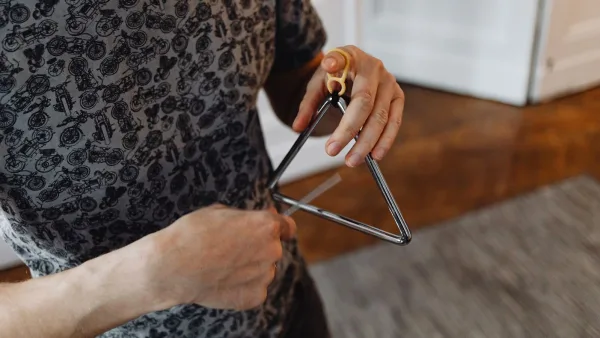
Here the priorities shift again. You want something comfortable to hold and manipulate one-handed for extended periods, since the technique relies on constantly muting and opening the tone with your fingers while striking with the other hand. A mid-sized, well-balanced steel instrument tends to suit this style better than a large concert model built purely for projection. Comfort and control matter more than raw volume in this context.
For Home Recording and Studio Use
In a studio, an instrument with a controllable, well-behaved decay is more useful than one built purely to cut through a live ensemble. A slightly smaller or thinner-rod model can be easier to manage in front of a close microphone, since you have more control over dynamics without the mic distorting on the transient. Pair it with a couple of different beaters — metal for bite, felt for a softer texture — so you've got tonal options without buying multiple instruments.
Quick Comparison by Priority
| Priority | What to look for |
|---|---|
| Durability (student/school use) | Standard steel, robust build, bundled clip and beater |
| Projection (orchestral/concert) | Considered rod diameter and alloy, possibly bronze |
| Comfort and control (forró/rhythmic) | Mid-sized, well-balanced steel |
| Recording control (studio) | Smaller or thinner rod, multiple beater options |
Don't Forget the Beaters for Your Triangle Music Instrument
Whichever category you fall into, the beater you use matters almost as much as the triangle itself. Metal gives you brightness and cut, wood is drier and more pointed, felt softens the attack right down. Buying two or three affordable beaters alongside your chosen instrument is one of the cheapest ways to expand what a single triangle can actually do.
Getting the Specifics Right
Once you know which category fits you, our buyer's guide goes deeper into the individual specs — material, suspension and rod diameter — worth checking before you commit.
The Bottom Line
The best triangle music instrument for you depends entirely on where you'll actually play it: a classroom, a concert hall, a forró session or a home studio all favour genuinely different specs. Work out your category first, then shop within it, and avoid the trap of buying the most expensive option assuming it suits every situation equally. If you want to sidestep the classic errors first, our guide to common triangle mistakes covers exactly that.




Comments