


Drum Key article
Drum Key Explained: Features, Types and Tips
A drum key is the one tool every drummer needs but rarely thinks about — here is a plain-spoken breakdown of what it does, the types available, and how to get the most out of it.
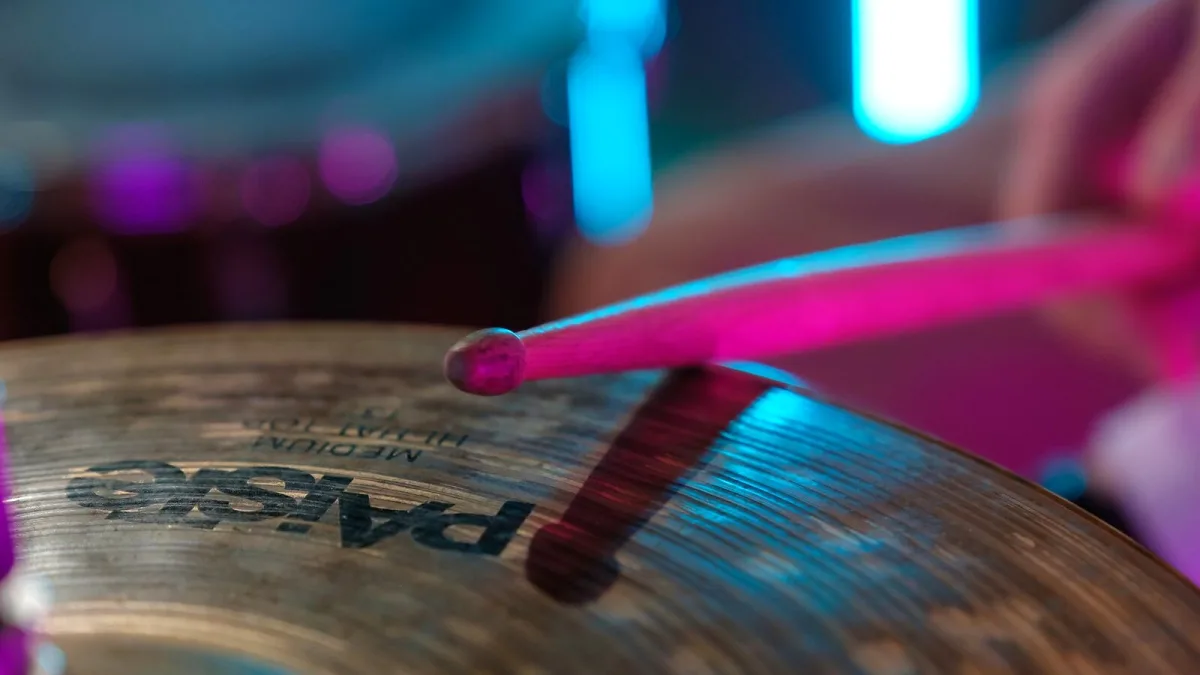
Every drummer owns at least one, most own several, and they live in stick bags, hardware cases and on top of practice room amps. This small tool has a specific job: turning the tension rods that hold drumheads in place. Here is a clear look at what it does, what types exist, and what to think about when using one.
What a Drum Key Does
This small wrench has a square socket sized to fit the heads of drum tension rods. Tension rods are the threaded bolts that pass through the drum's hoop and into the lugs on the shell. Turning them clockwise — viewed from above the rod — increases head tension and raises pitch. Turning counterclockwise loosens tension and lowers pitch.
The amount of pitch change depends on the drum, the head type, the shell dimensions, bearing edge condition and how evenly the other rods are set. The wrench just provides the mechanical rotation — the musical result comes from the whole system working together.
Types of Drum Key
Standard Key
The basic design: a compact tool, usually with the socket at one end and a simple handle at the other. Works for general maintenance and fits most modern drums. Inexpensive and widely available. Keep several in every gear bag.
T-Handle Key
A T-shaped handle gives more grip and makes repeated rotation more comfortable. Useful for head changes that involve winding down multiple rods by hand. Not dramatically different from a standard key for normal tuning adjustments.
High-Torque Key
Designed to provide extra leverage when turning stiff rods — particularly useful for marching percussion, which typically runs at higher tension than a standard kit. DW's Hi-Torq design is a commonly cited example.
Speed Key
A crank-like shape that speeds up rotation once a rod is loose. Useful when doing a full head change across multiple drums, where spinning down eight rods per drum by hand gets tedious quickly. Less useful for fine adjustments at pitch.
Ratchet Key
Uses a ratchet mechanism so the handle does not need to be lifted after every turn. Helpful in awkward positions — behind the bass drum — where there is limited room to swing the handle around.
Drill-Bit Key
Designed to fit in a power drill or driver for very fast rod removal and installation during a head change. DW makes a well-known version. The speed advantage is real, but the approach requires care: a drill applies torque mechanically and can overtighten or cross-thread a rod before you realise anything is wrong. Use it to get rods loosely in place, then finish with a hand key.
Torque Key
Attempts to apply a measured amount of torque to each rod for repeatable tension. The idea is that equal mechanical torque equals equal head tension. In practice, equal torque does not always equal equal pitch — rod friction, hardware condition and head seating all vary. A torque key can improve mechanical consistency, but listening is still the essential final step.
Socket Compatibility
Most modern drum hardware uses a common square format, but this is not universal. Older drums — particularly vintage Ludwig, vintage Slingerland and other legacy instruments — can use different dimensions. If a drum key does not fit snugly in the rod head, do not force it. A poor fit damages the rod and makes tuning impossible. When buying a key for a drum you have never used before, check the rod head size rather than assuming the current standard applies.
How to Use a Drum Key Correctly
Tuning a drum well involves even, distributed adjustments rather than turning one rod at a time:
- Bring all rods to finger-tightness first.
- Work in a crosswise or star pattern — not sequentially around the drum.
- Use small increments: quarter-turns, as Sound On Sound recommends, are a useful starting point.
- Tap the head close to each lug with a finger or drumstick to check local tension.
- Adjust any lugs that sound noticeably higher or lower than their neighbours.
- Check the pitch again after the head has been played in — heads settle.
Remo recommends tuning the resonant head slightly higher than the batter head — roughly a half-step — for clearer overtones and better sustain. This is a useful starting point rather than a universal rule.
For guidance on which key to buy before you need to use it, the buyer's guide covers every practical consideration. For the best-value picks at different price points, the best drum keys for the money has the round-up.
Practical Tips
- Keep at least one drum key in every stick bag. They get lost constantly.
- Do not use an Allen key as a substitute — the profiles are different and a poor fit damages the rod.
- If a rod is difficult to turn, check for rust, damaged threads or a cross-threaded lug before applying more force.
- Store keys in a case or bag pocket, not loose where the socket can be damaged.
The Bottom Line
A drum key is one of the simplest tools in a drummer's kit and one of the most essential. The standard design handles the vast majority of situations. Specialist options — high-torque, ratchet, speed and drill-bit — each solve specific problems for specific players. Know what you need, check the socket compatibility before buying, and keep one with you at every rehearsal and gig.



Comments