


Turntable Cartridge roundup
Turntable Cartridge: A Complete Buyer's Guide
The cartridge is where vinyl meets electricity — and where a sensible choice makes the biggest difference to your sound. Here is what the specs actually mean and where to spend your money.
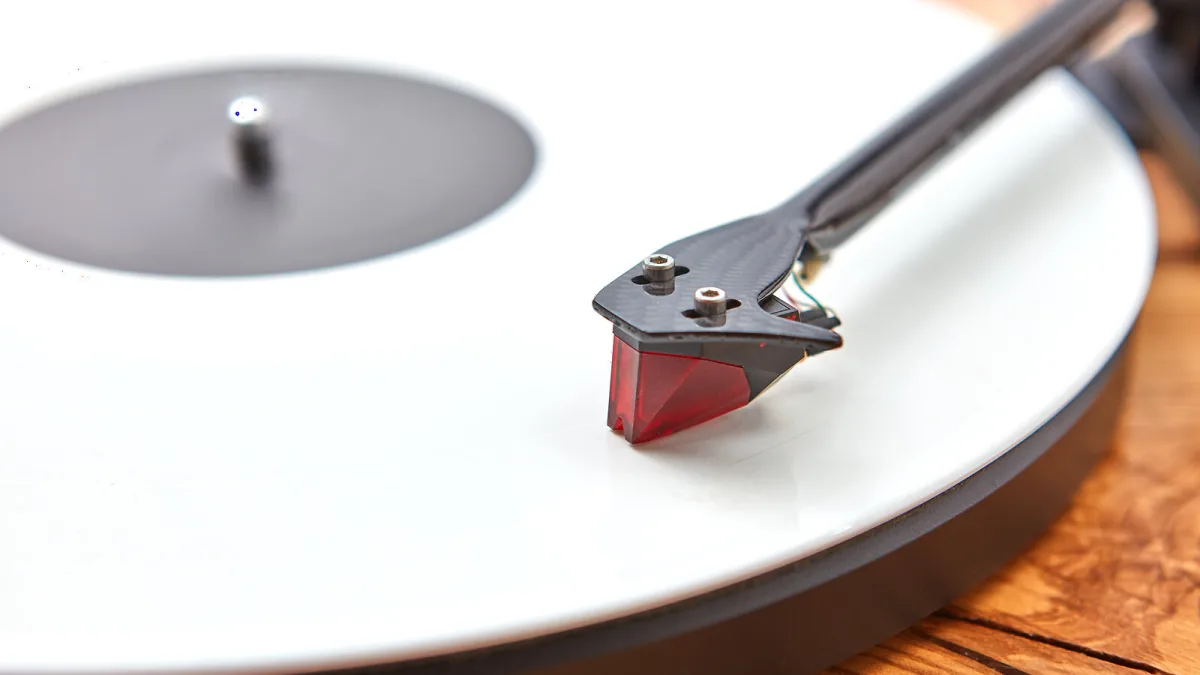
Buying a turntable cartridge is one of those decisions that sounds more straightforward than it is. There is a lot of terminology, a wide spread of prices, and real differences between options that look similar on paper. This guide cuts through all of that: what to prioritise, what the specs actually mean in practice, and where your money makes the biggest difference.
Decide Your Use Case First
Before anything else — are you setting up a home listening rig or a DJ booth? This matters enormously. DJ cartridges are built to track reliably under back-cueing, scratching, and heavier tracking forces. Hi-fi cartridges prioritise resolution, low distortion, and gentle stylus contact with the groove. Using the wrong type in the wrong context is a genuinely bad idea: a hi-fi cartridge will suffer under DJ use, and a DJ cartridge will sound blunt on a dedicated listening setup.
The rest of this turntable cartridge guide assumes a home listening setup, which is where most of the nuance lives.
Moving Magnet or Moving Coil?
This is the first real fork in the road. Moving magnet (MM) cartridges output a higher voltage signal — typically 2.5–5 millivolts — and work with any standard phono stage (the MM input most amplifiers and phono pre-amps include). The stylus is usually replaceable by the user, which keeps running costs down: replace just the stylus when it wears, not the whole cartridge.
Moving coil (MC) cartridges output a much lower signal — typically 0.2–0.5 millivolts — and need either an MC-capable phono stage or a step-up transformer to boost the signal before the phono stage. They are generally more expensive, the styli are not user-replaceable on most models, and they require more care in system matching. For a first turntable cartridge, or for a system without a dedicated MC phono stage, an MM is the sensible starting point.
Understanding the Stylus Shape
The shape of the stylus tip is directly linked to how much groove information it can retrieve — and how forgiving it is of imperfect cartridge alignment.
- Spherical: Round, simple, durable. Adequate for casual listening and DJ use; noticeably less detailed than other profiles. Usually found on budget cartridges.
- Elliptical: A more refined contact shape that traces the groove more accurately, retrieving more high-frequency detail. The standard choice for mid-range hi-fi cartridges and a meaningful step up from spherical.
- Fine-line / Shibata / MicroLine: Very narrow contact profiles that track the finest groove modulations. Rewarding on well-pressed records and with good tonearm alignment, but less forgiving of dirty or damaged records.
For most people, an elliptical stylus offers the best balance of performance and practicality. Move to fine-line only if you have a decent tonearm, are comfortable setting precise alignment, and mainly play clean records.
Tonearm Matching: The Bit People Often Miss
A turntable cartridge must be matched to the effective mass of your tonearm. The relevant parameter is compliance — how freely the stylus moves laterally, measured in compliance units (cu). High-compliance cartridges suit low-mass arms; low-compliance cartridges suit higher-mass arms.
Getting this wrong produces a resonance peak that falls inside the audible range — causing mistracking, boomy bass, and instability. Most modern hi-fi turntables use medium-mass arms (around 10–15 grams effective mass), which work well with medium-compliance cartridges (around 15–20 cu). Budget entry-level turntables often come with fixed arms that suit mid-compliance MM designs. If your turntable is not recent — a vintage Technics, a Rega Planar from the 1980s — look up its tonearm's effective mass before buying any cartridge.
Output Level and Phono Stage Matching
Your cartridge's output in millivolts must be compatible with your phono stage's gain. An MM cartridge at 5 mV feeding an MM phono stage designed for 3 mV will clip. An MC at 0.2 mV into a phono stage with inadequate gain will sound quiet and noise-floor-limited.
Check both the cartridge output specification and your phono stage's input sensitivity before buying. Most MM phono stages comfortably accept 2–5 mV. If your phono stage has switchable MM/MC gain, the matching question becomes much simpler.
Budget Tiers: Where the Money Goes
| Price range | What to expect |
|---|---|
| Under £50 | Entry-level MM, usually spherical or basic elliptical stylus. Good enough for casual listening. Often bundled with budget turntables. |
| £50–£150 | Solid MM with genuine elliptical stylus. Audio-Technica VM95E, Ortofon 2M Red/Blue sit here. Real musical performance; a significant step from budget. |
| £150–£400 | Better-body MM and entry MC territory. Ortofon 2M Bronze/Black, Nagaoka MP-200, Denon DL-103 (entry MC). Noticeably more detail and refinement. |
| £400+ | Mid-to-upper MC territory and specialist MM. Requires investment in the rest of the chain to hear the full benefit. |
What to Check Before Buying
- Does the cartridge match your tonearm's effective mass? (Check compliance vs arm mass.)
- Does your phono stage accept the cartridge's output level?
- Is the stylus user-replaceable? (Important for long-term running costs.)
- What is the recommended tracking force, and can your tonearm be adjusted to set it?
- Is the cartridge headshell-mount (standard half-inch) or a specialist fitment?
Brands Worth Knowing
Audio-Technica and Ortofon dominate the accessible end of the market for good reason: consistent quality, wide compatibility, and readily available replacement styli. Nagaoka (Japan) is worth attention at the mid-range. Denon makes the well-regarded DL-103 MC, a cartridge with a loyal following across many decades. At the higher end, Lyra, Benz Micro, and van den Hul are respected names, though they require an equally capable system to justify the investment.
For a plain-English explanation of how each component works, the turntable cartridge explainer covers the full picture. If you have just started with vinyl, the beginner's guide simplifies everything down to what you actually need to know first.
The Bottom Line
A turntable cartridge at £80–£150 with a genuine elliptical stylus will transform the sound of most mid-range turntables. Spend above that and the returns are real but require the rest of your system to be up to the standard. The cartridge is arguably the most cost-effective upgrade available on an existing vinyl setup — and it is the one component where the engineering directly touches the music.




Comments