Skip to content

Drum Machine roundup

Drum Machine: A Complete Buyer's Guide

From entry-level software to high-end hardware — what to consider at each budget, which models stand out, and how to avoid buying more than you actually need.

Drum Machine: A Complete Buyer's Guide

Choosing the right drum machine comes down to three questions: how do you want to work, what kind of sounds do you need, and what is your budget? This guide covers the main options at each level.

Budget Under £150: Software and Entry-Level Hardware

At this level, software is the obvious starting point. A drum machine plug-in such as Native Instruments Battery, XLN Audio Addictive Drums, or a built-in instrument in your DAW gives you high-quality sample playback, flexible sequencing and a large sound library for under £100. If you want hardware at this price, the options are limited but functional: the Teenage Engineering Pocket Operator series offers small, battery-powered units with decent onboard sounds and straightforward step sequencing. The workflow is limited but the price is hard to argue with.

Mid-Range £150–£500: Where It Gets Interesting

The Roland TR-6S and Behringer RD-8 sit in this range, offering analogue-style synthesis alongside sample playback. Both are capable production tools with individual outputs, solid build quality and a workflow that suits hands-on beat programming. The Arturia DrumBrute Impact is another strong mid-range choice — fully analogue, simple to programme, and with a character that suits techno and house well. At the top of this bracket, a used Roland TR-8 or TR-8S offers near-complete drum machine versatility with both analogue-modelled and sample-based sounds in one unit.

High-End £500 and Above

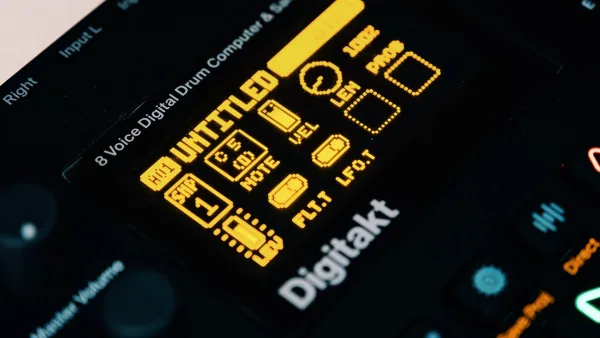
The Elektron Digitakt and Model:Samples are sampler-sequencers that double as advanced drum machine units with deep per-track processing, MIDI output and an extensive pattern chain system. For purely analogue synthesis, the Roland TR-09 (a boutique reissue of the TR-909) delivers the classic house and techno sounds in a compact, quality-built package. At the very top, modular Eurorack systems allow a fully customised approach — powerful but complex and expensive.

What to Prioritise

For most producers, the most important considerations are workflow, connectivity and sound quality — in that order. A drum machine you enjoy programming will produce better results than a technically superior unit you find awkward to use. Check that it has MIDI or USB sync if you plan to use it with a DAW. Individual outputs per sound are useful for mixing; a stereo output is fine for simpler setups. For more on how to get started once you've chosen, the setup guide covers the practical steps.

Frequently Asked Questions

Frequently Asked Questions

Is second-hand hardware worth considering?

Yes — the used market for beat-making hardware is strong, and many units hold up well over time. Roland, Elektron and Korg units from the last decade regularly appear in good condition on eBay and Reverb. Check that all pads, buttons and encoders respond correctly before buying. Avoid units that have been heavily used without servicing; pads in particular can degrade with heavy use.

Do I need individual outputs or is a stereo mix enough?

For simple setups and home recording, a stereo mix output is completely sufficient. Individual outputs become useful when you want to process each sound separately — adding compression, EQ or reverb per channel in your mixer or DAW. If your production style involves detailed mixing and sound shaping, individual outputs are a significant advantage. If you mainly programme beats and record them as a mix, one stereo output is fine.

What is MIDI sync and why does it matter?

MIDI sync allows hardware to lock its tempo to an external source — typically a DAW or another piece of hardware. This keeps everything in time. Without sync, the hardware runs at its own tempo, which may drift relative to your recording. USB MIDI is standard on most modern hardware; older units use the 5-pin DIN MIDI connector. Both work; USB is more convenient for computer integration.

Can I sample my own sounds into it?

Only on units that include a sampler. Pure synthesis units generate their sounds internally and cannot import audio. Sampler-sequencer hybrids — such as those from Elektron or the Roland SP series — allow you to record and assign your own audio samples to pads or steps. If using your own sounds is important, check the specification carefully before purchasing.

Is analogue synthesis actually better than samples?

Neither is objectively better — they are different. Analogue synthesis produces sounds directly from circuitry, with a character that can be difficult to replicate digitally. Sample-based units play back recorded audio, which can be extremely high quality but lacks the continuous variability of analogue. Many producers use both, choosing analogue for certain sounds (kick, bass drum) and samples for others (cymbals, snares with complex transients).

About Daniel Cooper

Daniel grew up in Sheffield, a city with electronic music in its bones, and spent his teens making beats on a battered laptop long before he could afford a proper studio. He's obsessed with synths, samplers and the endless tinkering of production. He writes about music software, hardware and getting good results without spending a fortune.

Comments

Leave a comment

Comments are read before they appear. Links cannot be published.

Your rating (optional)