


DJ Controller article
Dj Controller Explained: Features, Types and Tips
A DJ controller sends MIDI signals to software on your laptop, giving you physical jog wheels, faders, EQ and pads to mix with. Here is how it all fits together.
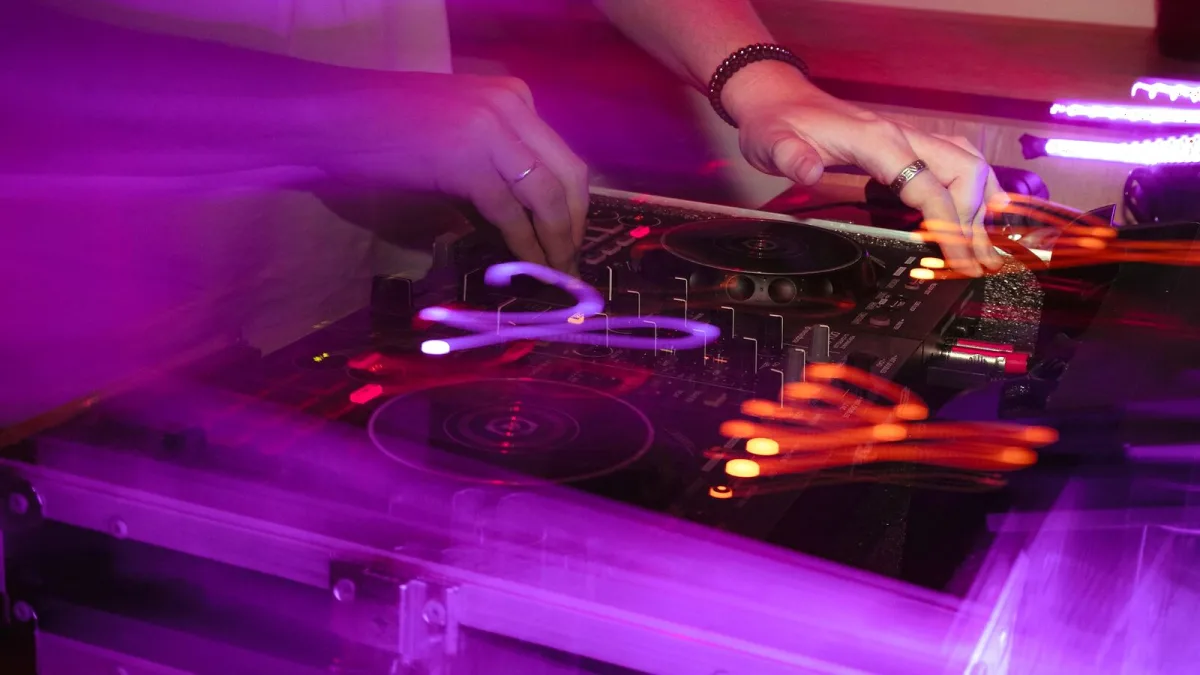
If you have spent any time trying to understand how modern DJing actually works, you will have come across the term. A DJ controller is the hardware device that sits between you and the software on your laptop — it gives you physical controls to manipulate your music rather than having to click around a screen. Jog wheels, faders, knobs, pads, buttons: all of it feeds into DJ software running on your machine, and between them, you get something that feels a lot more like the real thing than it has any right to for the price.
What a DJ Controller Does
At its core, a DJ controller does one thing: it sends MIDI data to software. Every time you push a knob, nudge a jog wheel or tap a pad, the controller sends a signal to the software telling it what to do. The software — Serato, Traktor, rekordbox and others — interprets that signal and responds: adjusting a tempo, triggering a cue point, applying an effect. The audio itself is generated by the software and sent to a built-in audio interface in the controller, which outputs to your speakers and headphones.
The Main Controls
Understanding what each section does makes the layout feel logical rather than overwhelming:
- Jog wheels — the large circular platters. On a vinyl-emulation setting, spinning them scrubs through a track. Touching the top gently nudges the tempo for manual beatmatching; more pressure on the side creates a bigger pitch shift for catching up or slowing down.
- Channel faders — control the volume of each deck individually. The standard technique is to keep both faders up during a mix, then bring in the crossfader or drop the outgoing channel.
- Crossfader — a horizontal fader that blends between the two main channels. DJs working in scratch styles use it constantly; mix DJs often tape it in the centre and use channel faders instead.
- EQ knobs — three-band equalisation (high, mid, low) on each channel. The swap technique — cutting bass on the incoming track while the outgoing track plays, then swapping when the mix is locked — is a fundamental tool.
- Gain — controls the input level of each channel before the fader. Setting this correctly is more important than most beginners realise.
- Performance pads — rubber pads that trigger hot cues, loops, samples and effects depending on the selected mode. They are where much of the creative performance work happens beyond basic mixing.
- Effects section — most controllers have at least a simple effects unit built in, allowing reverb, echo, flanger and similar processing on individual channels or the master output.
Two-Channel vs Four-Channel
Entry-level controllers are typically two-channel — two decks, one crossfader, two sets of EQ and gain. This is entirely sufficient for learning and for most performance contexts. Four-channel controllers add two more channels, allowing a third and fourth deck or the inclusion of an external mixer channel for a microphone or instrument input. They are larger, heavier and more expensive, but give significantly more flexibility for more complex performances.
Software Integration
Controllers ship bundled with software licences — usually a "Lite" version of Serato or rekordbox. These limited versions are fine for learning but restrict the number of tracks and some advanced features. A full software upgrade unlocks everything, and the cost varies by platform. Some controllers are plug-and-play with multiple software platforms; others are tightly integrated with one specific application by design.
What It Is Not
A DJ controller is not the same as a CDJ setup. Professional clubs use Pioneer CDJs — standalone media players that work without a laptop, reading files from USB drives or the network. A controller always needs a laptop; CDJs do not. Some higher-end hybrid controllers blur this line with built-in screens and standalone functionality, but the entry and mid-range market is firmly laptop-dependent.
Read More
If you are deciding which controller to buy, the complete buyer's guide covers everything from budget to feature set. If you are new to DJing entirely, the beginner's guide explains the learning curve honestly. To avoid the most common early mistakes, read common mistakes to avoid.
The Bottom Line
A DJ controller is one of the most accessible ways to get into mixing and performing. The learning curve is real — beatmatching, EQ technique, and reading a crowd all take time — but the hardware itself does not get in the way. Get the controls under your fingers, learn the software, and the creative possibilities open up quickly.



Comments