


Yamaha Piano Keys article
The Ultimate Guide to Yamaha Piano Key
A key looks simple, but there's real engineering underneath it. Here's what Yamaha's action families actually mean.
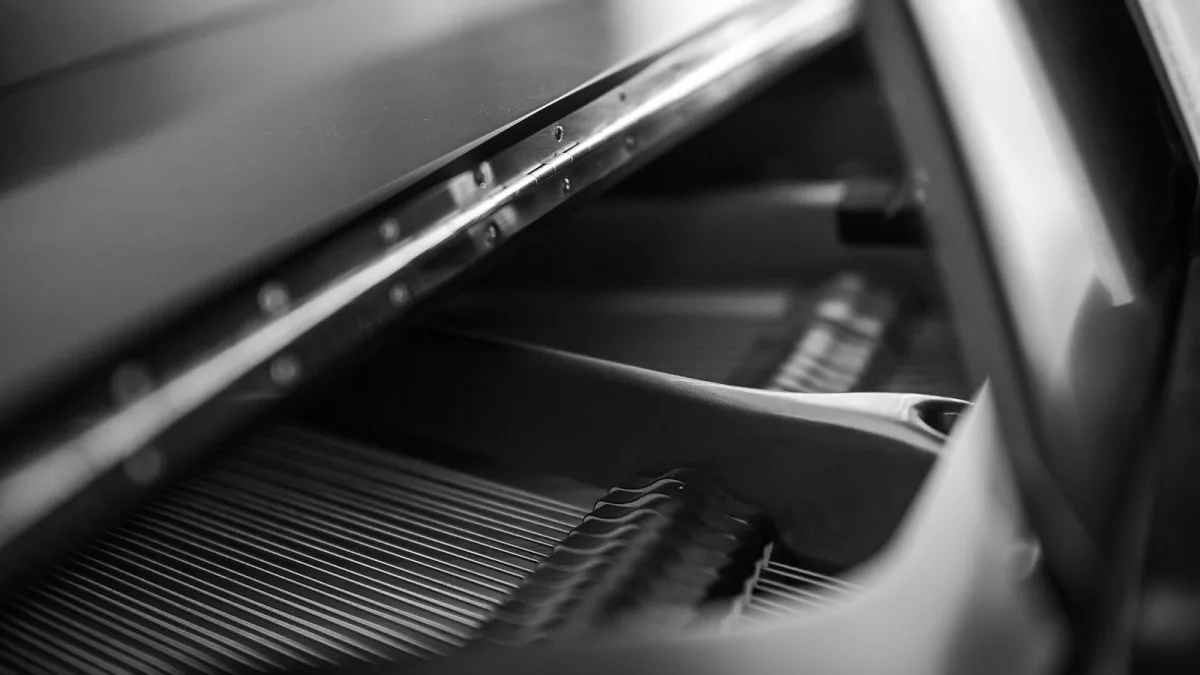
It's easy to think of a piano key as just a lever you press, but there's a surprising amount of engineering hiding underneath it — especially once Yamaha starts naming its actions with letters like GHS, GH3X and NWX. Here's what's actually going on beneath your fingers, and what those names really mean.
What a Piano Key Is Actually Doing
On an acoustic piano, a key is a lever. Pressing the front of it raises the rear, which sets off a small chain of parts that ultimately throws a felt-covered hammer at a string. Crucially, you don't control volume by pressing "harder" in a simple on/off sense — it's the speed and acceleration of that key travel that determines how fast the hammer moves, and that speed is what shapes volume and tone.
Yamaha's acoustic keys are traditionally made from spruce or similar lightweight, stable wood, often the same wood used in soundboards. On a digital piano, there's no hammer or string at all, but Yamaha builds its actions to imitate that same feel as closely as possible using weights, sensors and mechanical parts.
Why Keys Are Weighted, Not Just Heavy
On a real grand piano, the bass keys feel noticeably heavier than the treble ones, thanks to differences in hammer mass and action geometry. Yamaha's digital pianos reproduce this through graded weighting: heavier resistance low down, lighter resistance up high. A convincing graded action also has to manage key travel, initial resistance, how it feels at the bottom of the stroke, rebound and repetition speed — not just "add some springiness" evenly across the keyboard.
Yamaha's Action Families, From Entry-Level to Flagship
Rather than one fixed design, Yamaha piano keys come in several different action families, each aimed at a different kind of player:
| Action | Typical position | What it adds |
|---|---|---|
| GHS | Entry-level | Basic graded weighting; lighter and simpler |
| GH3 / GH3X | Mid-to-upper level | A third sensor for better repeated-note detection; GH3X adds escapement (let-off) simulation |
| NW / NWX | Premium | Wooden white keys for a more substantial, acoustic-like structure |
| GrandTouch-S | Compact premium | A more compact version of Yamaha's flagship geometry |
| GrandTouch | Flagship | Individually weighted keys and Yamaha's closest digital approximation of a grand piano's feel |
Yamaha's naming isn't perfectly consistent across every generation and region, so always check the exact model's official specification rather than relying on the action name alone.
Key Coverings: Ivory, Ebony and What's Underneath
Modern Yamaha keys generally use synthetic materials designed to imitate the texture and grip of traditional ivory and ebony, rather than the real thing. Genuine natural ivory does still appear on a small number of specialist or historical instruments, but it isn't the norm, and it isn't required for a good playing feel — the action underneath the surface matters far more than what's on top of it.
Where the Confusion Usually Comes From
A lot of marketing shorthand treats "wooden keys" or "weighted keys" as if they alone guarantee quality. They don't. Key material, action architecture, sensor technology and overall instrument design all work together, and a well-designed GHS action can still suit plenty of players better than a poorly matched premium one. If you're weighing up which tier actually fits you, our complete buyer's guide goes through exactly what to check, and our tiered round-up lines the action families up against typical budgets.
New to All This?
If you're just starting out and the terminology above feels like a lot, our beginner's guide breaks things down more gently, and our common mistakes guide is worth a read before you buy or start caring for a set of keys day to day.
The Bottom Line
Yamaha piano keys look simple from above, but underneath sits a genuinely thoughtful hierarchy of engineering, from the entry-level GHS action right through to GrandTouch's individually weighted, grand-piano-inspired feel. Knowing what each family actually does, rather than just its name, is the difference between choosing a piano that feels right and one that just sounds impressive on a spec sheet.





Comments