


Mixer Controller article
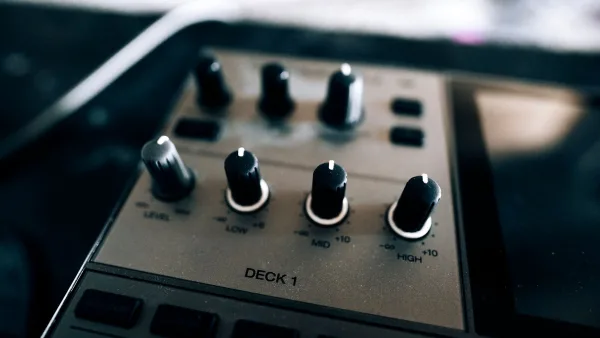
Numark Mixdeck Express Dj Controller Mixer: A Complete Guide
A mixer controller provides hands-on, tactile control of your DAW mixing, enabling intuitive fader-based mixing and real-time parameter adjustment.

A mixer controller sits at the heart of professional and home music studios because it gives you tactile mixing capability and hardware feel that a software mixing screen cannot match. If you've watched a sound engineer work a physical console, adjusting multiple channels simultaneously with smooth fader movements, or seen a producer touch and twist knobs to shape mixes in real time, you've witnessed what mixer controllers deliver. Understanding what makes these tools essential and how to choose one that fits your workflow reveals why serious music-makers invest in dedicated mixing hardware.
What Is a Mixer Controller?
A mixer controller is hardware that connects to your computer, giving you physical faders, knobs, and switches to control mixing and production parameters in your DAW. Unlike mouse-clicking levels and moving on-screen sliders, a mixer controller provides hands-on, real-time parameter adjustment that feels immediate and responsive.
Mixer controllers send control data directly to your DAW, automating tasks and enabling creative mixing workflows that would be cumbersome with only keyboard and mouse. The tactile nature of fader and knob adjustment makes mixing decisions feel more musical and intuitive.
Types of Mixer Controllers
Compact mixer controllers (8 channels or fewer) prioritise portability and affordability, ideal for bedroom producers and mobile studios. These offer basic mixing capability without excessive desk real estate or cost commitment.
Mid-range mixer controllers (16–32 channels) balance capability and practicality, suiting professional studios and serious home producers. These provide enough control surface for complex mixing whilst remaining manageable size-wise.
Large console-style mixer controllers (64+ channels) recreate the full mixing environment of professional studios, with expansive control surfaces and comprehensive functionality. These appeal to professional studios handling complex productions.
Key Features and Functionality
| Feature | Purpose | Importance |
|---|---|---|
| Faders | Channel volume adjustment | Essential—smooth fader movement enables dynamic mixing |
| Knobs/Rotary Encoders | Parameter control (pan, EQ, effects) | Critical for mixing and automation |
| Transport Controls | Playback (play, stop, record) | Convenient but not essential |
| Buttons/Switches | Solo, mute, routing | Important for mixing workflow |
| LED Displays | Visual feedback | Nice to have, improves usability |
| USB/Ethernet | Computer connection | Essential—enables DAW control |
Mixer Controller Integration with Your DAW
Modern mixer controllers integrate seamlessly with major DAWs—Pro Tools, Logic, Ableton, Reaper, Studio One. Most manufacturers provide protocol support (HUI, Mackie Control) ensuring broad DAW compatibility. Setup typically involves selecting the mixer controller in your DAW's preferences and mapping controls to parameters.
Custom mapping lets you assign any mixer controller knob to any parameter—automation possibilities are virtually unlimited. This flexibility means the same mixer controller adapts to vastly different creative needs.
Benefits of Physical Mixing
Hands-on mixing with a mixer controller accelerates creative decisions. Adjusting channel balance, panning, and effects in real time feels musical rather than technical. Many mixing engineers report that mixing with hardware feels less fatiguing than screen-based mixing over extended sessions.
Automation workflows improve dramatically with a mixer controller. Recording fader movements for dynamic mixing is more intuitive than drawing automation curves in your DAW. Real-time parameter adjustment whilst monitoring audio provides immediate feedback, aiding musical decision-making.
The tactile feedback and visual control surface provide better spatial awareness of your mix. Rather than clicking tracks to adjust them, you see and feel multiple channels simultaneously, developing intuitive understanding of balance and mix relationships.
Popular Mixer Controller Options
Entry-level mixer controllers from brands like Behringer and Novation offer basic functionality at accessible prices—under £200 for 8-channel models. These work adequately for bedroom producers and educational use.
Professional options from PreSonus, Soundcraft, and SSL (SSL UF8 and UC1) represent serious investments offering superior build quality, professional features, and DAW integration. These sit in the £2,000–£5,000+ range, justified by professional use and durability.
Mid-range options like the Behringer X-Touch and Novation SL III bridge affordability and capability, providing professional-grade mixing control at reasonable cost.
Size and Studio Integration
Compact mixer controllers fit comfortably on standard studio desks alongside keyboard controllers and microphone stands. They require minimal setup and occupy reasonable space. Larger console-style controllers demand dedicated desk real estate and represent significant studio investment.
Consider your workflow before committing to size. Full-time mixing engineers benefit from larger control surfaces. Producer-musicians splitting time between playing instruments and mixing may prefer compact solutions offering mixing capability without consuming entire studio space.
Build Quality and Durability
Professional mixer controllers feature robust construction, quality faders, and reliable encoders rated for thousands of hours of operation. Professional models withstand touring and daily studio use indefinitely with basic maintenance.
Budget mixer controllers use less robust components; faders may feel scratchy after extended use, encoders might develop dead zones. They're adequate for light use; heavy professional use demands higher-end options.
Connectivity and Flexibility
Most mixer controllers offer USB connection for basic DAW control. Professional models add Ethernet, MIDI, and audio connectivity enabling hardware synthesizer integration, external monitor control, and multi-device operation.
Consider your planned workflow. Do you need to control external gear? Will you use it for live mixing? These questions guide mixer controller selection toward appropriate features.
The Learning Curve
Using a mixer controller involves learning your DAW's control mapping alongside the hardware itself. Modern designs are generally intuitive—faders control volume, knobs adjust parameters, buttons toggle options. Most producers adapt within hours.
Extensive customisation is possible but optional. Start with factory mappings and defaults; add custom configurations as your workflow evolves and specific needs arise.
Value and Investment Justification
For professional mixing and production work, a quality mixer controller pays for itself quickly through improved workflow, faster mixing, and superior mixing results. Time savings and creative benefits justify the investment.
For hobby and bedroom production, a compact mixer controller at £100–£300 offers enjoyable mixing capability without excessive financial commitment. The tactile feedback and improved workflow benefits accumulate over time.
Choosing Your Mixer Controller
Assess your needs honestly. How many channels do you typically mix? What DAW do you use? Will you need external gear connectivity? Budget constraints and studio space availability also guide the decision. Research user reviews from professionals in your genre to understand real-world performance and integration reliability.
A quality mixer controller transforms mixing from screen-based menu-diving into tactile, intuitive creative work. Whether professional or amateur, hands-on mixing feels more musical and produces better results than mouse-and-keyboard alternatives.




Comments