


Silent Concert Headphones article
Everything You Need to Know About Silent Concert Headphones
Nothing about silent concert headphones is mysterious once you see the full signal chain behind them — let's take it apart calmly, piece by piece.

Silent concert headphones let an audience hear a live show, DJ set or guided performance without a single loudspeaker filling the room. Nothing about the term is mysterious once you see the full signal chain behind it, so let's take it apart calmly, piece by piece, the way you'd want any new bit of technology explained.
What Silent Concert Headphones Actually Are
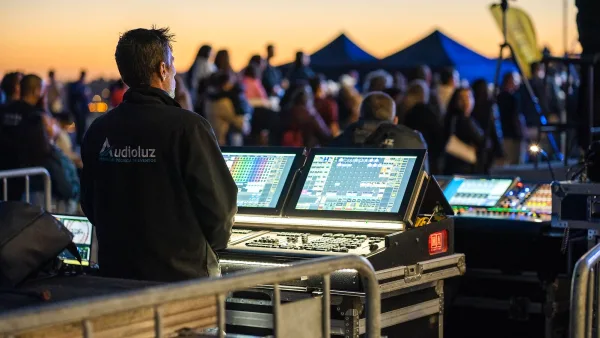
A microphone, instrument feed or DJ mixer sends the programme into a mixer, which passes it to a wireless transmitter. That transmitter broadcasts the signal over a radio channel, each headset receives and decodes it, and the wearer picks a channel and sets their own volume. The headphone itself is really just the last, most visible link in a longer chain — the transmitter, the frequency planning and the event workflow around it matter just as much.
Not Just Silent Discos
Silent disco is the version most people picture first — a dance event with several music channels running at once — but the same equipment turns up at silent gigs with a live band, guided museum tours, historic buildings where amplification isn't allowed, late-night outdoor events with strict noise limits, and multilingual productions where each language gets its own channel. The headphone hasn't changed; the use case has.
How the Signal Actually Travels
| Technology | Typical Strength | Main Limitation |
|---|---|---|
| RF/UHF | Long range, good audience capacity, low latency | Needs proper frequency planning |
| 2.4 GHz digital | Widely available, good channel management | Can share crowded spectrum with Wi-Fi |
| Infrared | Reliable in controlled indoor spaces | Needs line of sight; unsuitable outdoors |
| Bluetooth | Convenient for a personal device | Usually unsuitable for a large shared audience |
Most professional systems favour RF or UHF over ordinary Bluetooth precisely because a live audience needs many receivers working reliably at once, not the one-to-one pairing Bluetooth is built for.
Channels, Explained Simply
Three-channel systems are common, and a channel might carry a different DJ, a separate stage, a language translation, or music alongside spoken commentary. Switching is usually a button, dial or illuminated selector right on the headset, often colour-coded so nobody has to guess which programme they're currently hearing.
What the Range and Battery Numbers Actually Mean
Manufacturers commonly quote roughly 8 to 12 hours of battery life and anywhere from about 100 to 300 metres of range, but treat these as best-case figures rather than guarantees. Real-world range shrinks with walls, crowd density, competing radio signals and transmitter placement, and battery runtime drops with age, cold weather and higher volume. "Up to" genuinely means up to, not typically.
Hearing Safety Matters Here Too
It's tempting to assume silent concert headphones must be gentler on your ears than a loudspeaker, but that isn't automatically true. The listener controls the volume directly at the ear, and some systems can reach genuinely uncomfortable levels if pushed. A well-run event sets a sensible system maximum, avoids heavy bass boost, and gives clear volume guidance — treat "silent" as a description of the room, never as a safety guarantee for your hearing.
Hygiene Is Worth a Thought Too
A headset worn by dozens of different people in one evening needs proper cleaning between uses — wipeable ear pads, sanitised headbands, and a way of pulling any visibly damaged unit out of circulation. It's not glamorous, but it's exactly the sort of practical detail that separates a well-run event from an uncomfortable one.
The Bottom Line
Once you understand the chain — source, transmitter, channel, headset — the whole format stops feeling mysterious and starts feeling like sensible engineering for a genuinely awkward problem: how to let people enjoy loud music without disturbing everyone nearby. If you're choosing a system to buy, our buyer's guide covers what actually matters, and our beginner's guide keeps things even simpler if this is all new to you. Our round-up by budget and common mistakes to avoid are both worth reading before an event day arrives.




Comments